



 Blog
Blog
 May 26, 2026
Last updated: May 2026
Stateful applications remember information about previous client interactions. Stateless applications treat every request as independent — no memory between calls. The choice between these two designs shapes how an application scales, how it handles failures, and increasingly how AI agents consume it. This guide explains the difference, gives concrete examples of each, and covers the modern pairing (stateless API + stateful AI agent) that's becoming the standard architecture in 2026.
Quick summary
- Stateful: server remembers per-client information between requests (sessions, in-memory state).
- Stateless: each request is self-contained; server keeps no client state.
- Why statelessness matters: easier horizontal scaling, simpler caching, resilient to individual server failures.
- When stateful wins: real-time multiplayer, video calls, collaborative editing, persistent connections.
- What's new: AI agents pair stateless APIs with stateful in-LLM conversation context — see AI Data Gateway.
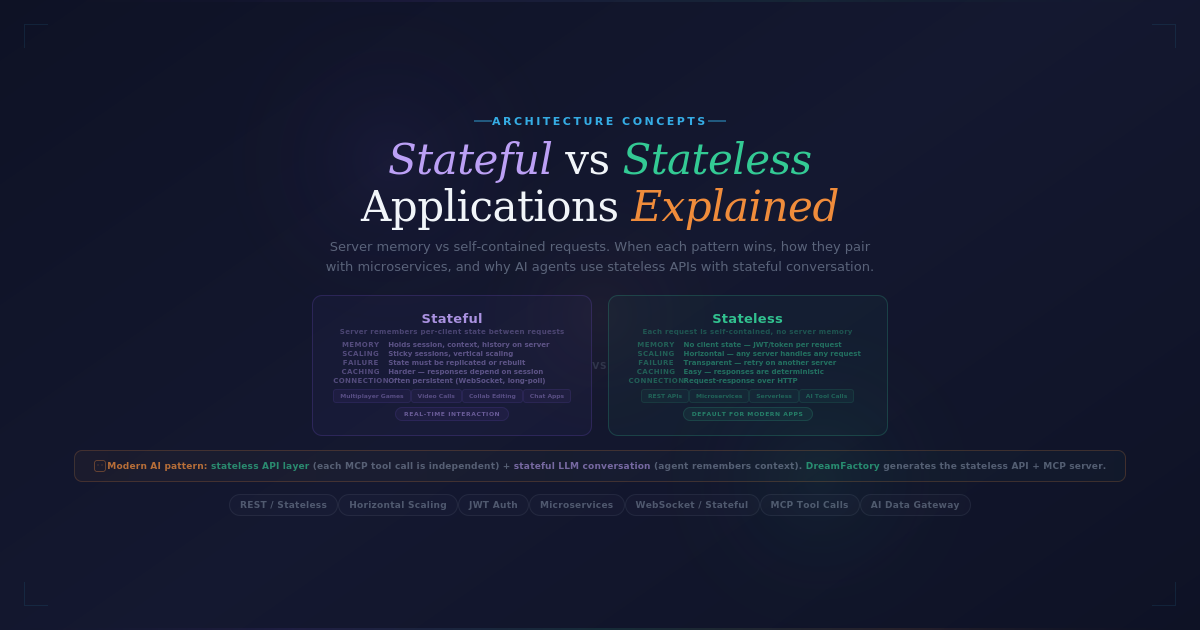
Stateful vs stateless at a glance
|
Dimension |
Stateful |
Stateless |
|---|---|---|
|
Server memory |
Holds per-client state |
Keeps no client state |
|
Each request |
Builds on previous requests |
Self-contained |
|
Scaling |
Sticky sessions, vertical scaling |
Horizontal scaling — any server can handle any request |
|
Failure recovery |
State must be replicated or re-built |
Server failures are transparent — retry on another server |
|
Caching |
Harder — responses depend on session |
Easy — responses are deterministic given the request |
|
Typical examples |
Multiplayer games, video conferencing, chat, collaborative editing |
REST APIs, microservices, web pages, AI agent tool calls |
|
Connection style |
Often persistent (WebSocket, long-poll) |
Request-response over HTTP |
What is a stateful application?
A stateful application maintains memory of past client interactions on the server side. The server tracks who you are, what you've done, and what you might do next — and uses that context to shape responses.
Concrete examples:
- Online multiplayer games: The server holds the current world state, player positions, and game logic in memory. Every player action updates that shared state.
- Video conferencing: Zoom, Teams, Google Meet maintain stateful connections that track participants, media streams, and meeting state.
- Collaborative editing: Google Docs, Figma, Notion synchronise state across editors in real time.
- Chat applications: WhatsApp, Slack, Discord track presence, typing indicators, and message ordering.
- Database connections: A long-lived connection to a database is inherently stateful — the connection holds session, transaction, and cursor state.
What is a stateless application?
A stateless application doesn't remember anything between client requests. Every request must include all the information needed to process it. The server processes the request, returns a response, and forgets the client immediately.
This is the architectural foundation of REST. Statelessness is one of Roy Fielding's six REST constraints — the others being client-server separation, cacheability, layered architecture, uniform interface, and code-on-demand.
Examples:
- REST APIs: Stripe, Twilio, GitHub. Each call carries its own auth token; the server doesn't track sessions.
- Static web pages: HTML served from a CDN — every visitor gets the same response.
- Microservices: Most internal services in a microservices architecture are stateless; persistent state lives in dedicated databases.
- Serverless functions: AWS Lambda, Cloudflare Workers, Vercel Functions — by design, each invocation starts fresh.
- AI agent tool calls: When an LLM agent calls an API via the Model Context Protocol, each call is independent.
Trade-offs: when to use stateful vs stateless
Statelessness is the default for most modern web applications because it scales better, handles failures better, and is easier to operate. Stateful designs win specifically when:
- You need real-time interaction. Multiplayer games and collaborative tools can't make a fresh request for every state change — the latency and overhead would be prohibitive.
- The state is large and changes frequently. Holding game world state in memory and broadcasting deltas is far more efficient than re-fetching the entire state on every interaction.
- You have persistent client connections. WebSocket-based applications maintain state because the connection itself is stateful.
For everything else — public APIs, mobile app backends, microservices, cron jobs, CDN-served content — stateless wins.

Stateless design and microservices
Microservices work best when individual services are stateless. That's what allows them to be independently deployed, replicated, and load-balanced. Persistent state typically lives in dedicated databases or caches; the services themselves remain stateless.
This pairing — stateless services + dedicated state stores — is the foundation of most modern web-scale architectures. Netflix runs thousands of stateless microservices on AWS, with state held in databases (Cassandra, DynamoDB) and caches (EVCache, Memcached). Each service can be scaled, redeployed, or rebuilt without losing user-facing state.
How AI agents fit into stateful vs stateless design
The biggest shift to web architecture in the last two years isn't another framework — it's who's calling the API. AI agents built on large language models now make a growing share of API calls, and they introduce a new wrinkle on the stateful/stateless question.
The pairing is: stateless API layer + stateful AI conversation. The agent itself maintains conversational state inside the LLM's context window — it remembers what the user asked, what tools it called, and what results came back. But each individual API call the agent makes is stateless. The agent passes identity and context with every call.
This works because of the Model Context Protocol (MCP), the emerging standard for how AI models discover and call APIs at runtime. MCP-exposed tools are REST-style — stateless calls with all context in the request. The conversational state lives in the LLM, not in the API layer.
That keeps the API layer simple to scale, while letting the agent layer do the long-context work it's good at.
The piece of infrastructure handling the security and governance of agent traffic is the AI Data Gateway — a secure intermediary between enterprise data sources and AI systems. It enforces identity passthrough, deterministic query enforcement, prompt logging, and field-level data governance for agent traffic. See What is an AI Data Gateway and Zero Trust for LLMs.
How DreamFactory fits in
DreamFactory's foundational capability is instant REST API generation: connect a database (Oracle, SQL Server, PostgreSQL, MySQL, Snowflake, Databricks, MongoDB — 40+ supported), and the platform auto-generates a fully documented, role-protected REST API in minutes, with no code written. The platform has been doing exactly this for over a decade. Authentication (Microsoft Entra ID, OAuth 2.0, OpenID Connect, SAML 2.0, LDAP, Active Directory, API keys), role-based access control (per table, endpoint, and HTTP verb), rate limiting (per user, role, or service), audit logging (every call captured with calling user, timestamp, and payload), and OpenAPI documentation are built in. Server-side scripting in PHP, Python, or Node.js handles custom business logic.
The AI Data Gateway is the newer chapter — a built-in MCP server that exposes the same auto-generated REST API to AI agents (Claude Desktop, Claude Code, ChatGPT, Cursor, Windsurf). The company's framing: "turn your database into an auditable, governed API layer for AI." The core principle is data stays put — keep your systems of record intact, generate a governed API on top, and let AI agents query through that layer rather than receiving raw data extracts. In DreamFactory's MCP tutorial, CTO Kevin McGahey demonstrates the full flow: database credentials, one MCP call, auto-generated API, read-only role, API key — and Claude Code building a working dashboard in minutes.
DreamFactory deploys via Linux installer (Ubuntu, Debian, CentOS, RHEL, Fedora), Windows (IIS or Apache), Docker, Kubernetes via official Helm chart, or NPX quick install. Air-gapped deployment is fully supported — as used by the Vermont Agency of Transportation to expose an Oracle database and a 1970s-era IBM S370 mainframe through a unified API layer.
DreamFactory's customers include ExxonMobil, Toyota, Saint-Gobain, PPG, Deloitte, Google Cloud, AkerBP, Netgear, Miller Industries, the National Institutes of Health, the Vermont Agency of Transportation, D.A. Davidson, and Pillsbury Law — spanning energy, automotive, industrial, finance, government, healthcare, and legal. G2 rates the product 4.7 with badges for "Easiest to Use," "Fastest Implementation," and "Best ROI." See the DreamFactory AI page or request a demo.
Frequently asked questions
What's the difference between stateful and stateless applications?
A stateful application remembers information about previous interactions — typically through sessions, cookies, or in-memory state on the server. A stateless application treats every request as independent; it doesn't store anything about the client between requests. Statelessness is a core REST principle and underpins horizontal scalability.
Why are REST APIs stateless?
Statelessness makes REST APIs trivial to scale horizontally. Because the server keeps no per-client state, any server in a cluster can handle any request. This also makes responses safer to cache, easier to load-balance, and resilient to individual server failures. See REST APIs: an overview of basic principles.
Are stateful applications still useful?
Yes — for real-time interactive applications. Multiplayer games, video conferencing, collaborative editing tools, and chat apps all benefit from server-held state. WebSockets and long-lived connections often pair with stateful designs.
How do stateless applications handle user sessions?
Through self-contained tokens. The client holds a JWT or signed cookie that includes the user's identity and any session context; every request includes that token. The server validates the token (cryptographically) without needing to look up session state. This keeps the server stateless while still supporting authentication.
What are the performance trade-offs of stateless design?
Stateless designs trade per-request overhead (re-authenticating on each call, re-fetching context) for horizontal scalability and simplicity. For most workloads the trade is favourable. Stateful designs avoid the per-request overhead but lock you into vertical scaling and complex session-replication for high availability.
How do AI agents fit into stateful vs stateless design?
AI agents call APIs through tools registered via the Model Context Protocol (MCP), and the API layer is almost always stateless — agents pass identity and context with every call rather than maintaining server-side session state. The agent itself maintains conversational state inside the LLM context window. This pairing — stateless API + stateful conversation — is the modern AI consumption pattern. See What is an AI Data Gateway.
Can a single application be both stateful and stateless?
Yes — and most modern applications are. The API layer is typically stateless (REST, easily scaled). The connection layer for real-time features (WebSockets for chat, video, collaborative editing) is stateful. Persistent state lives in databases. The architectural skill is knowing which layer should hold which kind of state.
How does microservices architecture relate to stateless design?
Microservices work best when individual services are stateless — it's what allows them to be independently deployed, replicated, and load-balanced. Persistent state typically lives in dedicated databases or caches; the services themselves remain stateless.
Related blog posts