---
title: What is an AI Data Gateway? | DreamFactory
description: Connect AI to enterprise and legacy data securely with an AI Data Gateway enforcing identity passthrough, data masking, RBAC, and audit logs.
image: https://assets.seobotai.com/cdn-cgi/image/quality=75,w=1536,h=1024/dreamfactory.com/698b7965676cd2891cb2ae20-1770750493971.jpg
---
[](https://www.dreamfactory.com/)
Products & Services
[AI Data Gateway](https://www.dreamfactory.com/ai-data-gateway/overview)
[Overview Why DreamFactory exists](https://www.dreamfactory.com/ai-data-gateway/overview) [Data Gov, Comp, Security Policy enforcement at the API layer](https://www.dreamfactory.com/ai-data-gateway/ai-data-governance) [Standard API Layer One contract for every backend](https://www.dreamfactory.com/ai-data-gateway/standard-api-layer) [API Gateway Functionality Routing, auth, rate limits, observability](https://www.dreamfactory.com/ai-data-gateway/api-gateway-functionality) [Deployment & Integration Self-hosted, cloud, hybrid](https://www.dreamfactory.com/ai-data-gateway/on-premise-deployment-and-integration) [Developer Productivity Auto-generated, never hand-coded](https://www.dreamfactory.com/ai-data-gateway/ai-development-accelerated) [AI App Architectures Patterns for RAG, agents, MCP](https://www.dreamfactory.com/ai-data-gateway/enterprise-ai-architectures)
AI Data Models
[AIOpenAI](https://www.dreamfactory.com/use-cases/openai) [GGoogle Gemini](https://www.dreamfactory.com/use-cases/google-gemini) [CAnthropic Claude](https://www.dreamfactory.com/use-cases/anthropic-claude-landing) [LMeta Llama](https://www.dreamfactory.com/use-cases/meta-llama) [MMistral AI](https://www.dreamfactory.com/use-cases/mistral) [CoCohere](https://www.dreamfactory.com/use-cases/cohere)
Services and support
[Quickstart Service Packages Expert-led Quickstarts to production](https://www.dreamfactory.com/services-and-support/quickstart-services-packages)
API Management
[Generate & Manage REST APIs From any database, in seconds](https://www.dreamfactory.com/api-management/generate-rest-apis) [Features Security, scripting, self-hosted & more](https://www.dreamfactory.com/api-management/features) [API Generation The complete guide to auto-generated APIs](https://blog.dreamfactory.com/a-complete-guide-to-api-generation) [API Management Concepts, tools, and best practises](https://blog.dreamfactory.com/what-is-api-management-a-brief-overview-of-api-management-concepts-and-tools?_gl=1*jl0njh*_gcl_au*MjQzMjgwMTc3LjE3ODIzMjI3MzY)
Use Cases
AI Use Cases
[AI Data Access Secure, governed reads for your LLMs](https://www.dreamfactory.com/use-cases/ai-data-access) [MCP Server Drop-in Model Context Protocol](https://www.dreamfactory.com/use-cases/mcp-server) [Legacy Modernization Wrap mainframes with REST](https://www.dreamfactory.com/use-cases/legacy-modernization) [Data Governance Audit every call, enforce every policy](https://www.dreamfactory.com/use-cases/data-governance)
[Customer Case Studies](https://www.dreamfactory.com/case-studies)
[Energy Modernization](https://www.dreamfactory.com/case-studies/energy-snowflake-modernization) [Government Modernization](https://www.dreamfactory.com/case-studies/government-mainframe-oracle-modernization) [Government Business Intelligence](https://www.dreamfactory.com/case-studies/government-sql-server-bi-analyst-queries) [Manufacturing Modernization](https://www.dreamfactory.com/case-studies/steel-manufacturing-sap-erp-modernization) [Financial Services Investor Portal](https://www.dreamfactory.com/case-studies/financial-services-sql-server-investor-portal) [Non-Profit Partner Data Sharing](https://www.dreamfactory.com/case-studies/non-profit-sql-server-partner-data-sharing) [Professional Services Exec Dashboards](https://www.dreamfactory.com/case-studies/professional-services-erp-dashboards) [Education HR and External Data Sharing](https://www.dreamfactory.com/case-studies/education-student-hr-sql-server-mysql-external-data-sharing)
Industries
Industries
#### [Healthcare HIPAA-grade APIs across EHR, claims, and labs.](https://www.dreamfactory.com/use-cases/healthcare)
#### [Financial Services Portfolios, partners, and portals on one layer.](https://www.dreamfactory.com/use-cases/financial-services)
#### [Government Modernize mainframes without re-platforming.](https://www.dreamfactory.com/use-cases/government)
#### [Manufacturing SAP, MES, and shop-floor data, governed.](https://www.dreamfactory.com/use-cases/manufacturing)
#### [Spotlight How enterprises run on DreamFactory From healthcare to energy to finance — governance baked into every endpoint. Browse case studies →](https://www.dreamfactory.com/case-studies)
Connectors
SQL Database
[SQL SQL Server](https://www.dreamfactory.com/connectors/sql-server) [OR Oracle](https://www.dreamfactory.com/connectors/oracle) [PG PostgreSQL](https://www.dreamfactory.com/connectors/postgresql) [My MySQL](https://www.dreamfactory.com/connectors/mysql)
NoSQL & Docs
[Dy DynamoDB](https://www.dreamfactory.com/connectors/dynamodb) [Do DocumentDB](https://www.dreamfactory.com/connectors/azure-documentdb) [Mo MongoDB](https://www.dreamfactory.com/connectors/mongodb) [Cb CouchDB](https://www.dreamfactory.com/connectors/couch-db)
Cloud Warehouses
[S3 S3](https://www.dreamfactory.com/connectors/amazon-s3) [Ab Azureblob](https://www.dreamfactory.com/connectors/azure-blob) [FS FTP/SFTP](https://www.dreamfactory.com/connectors/ftp-sftp) [LS Local Storage](https://www.dreamfactory.com/connectors/local-storage)
C & SaaS
[Sf Salesforce](https://www.dreamfactory.com/connectors/salesforce) [API REST / SOAP](https://www.dreamfactory.com/connectors/soap-to-rest)
[See all 30+ connectors](https://www.dreamfactory.com/connectors)
[Blog](https://blog.dreamfactory.com/)
[FREE 30 Minute Demo](https://www.dreamfactory.com/demo)
[](https://www.dreamfactory.com/)
 
Back to main menu
Products & Services
Use Cases
Industries
Connectors
[Blog](https://blog.dreamfactory.com/)
[FREE 30 Minute Demo](https://www.dreamfactory.com/demo)
[AI Data Gateway](https://www.dreamfactory.com/ai-data-gateway/overview)
[Overview Why DreamFactory exists](https://www.dreamfactory.com/ai-data-gateway/overview) [Data Gov, Comp, Security Policy enforcement at the API layer](https://www.dreamfactory.com/ai-data-gateway/ai-data-governance) [Standard API Layer One contract for every backend](https://www.dreamfactory.com/ai-data-gateway/standard-api-layer) [API Gateway Functionality Routing, auth, rate limits, observability](https://www.dreamfactory.com/ai-data-gateway/api-gateway-functionality) [Deployment & Integration Self-hosted, cloud, hybrid](https://www.dreamfactory.com/ai-data-gateway/on-premise-deployment-and-integration) [Developer Productivity Auto-generated, never hand-coded](https://www.dreamfactory.com/ai-data-gateway/ai-development-accelerated) [AI App Architectures Patterns for RAG, agents, MCP](https://www.dreamfactory.com/ai-data-gateway/enterprise-ai-architectures)
AI Data Models
[AIOpenAI](https://www.dreamfactory.com/use-cases/openai) [GGoogle Gemini](https://www.dreamfactory.com/use-cases/google-gemini) [CAnthropic Claude](https://www.dreamfactory.com/use-cases/anthropic-claude-landing) [LMeta Llama](https://www.dreamfactory.com/use-cases/meta-llama) [MMistral AI](https://www.dreamfactory.com/use-cases/mistral) [CoCohere](https://www.dreamfactory.com/use-cases/cohere)
Services and support
[Quickstart Service Packages Expert-led Quickstarts to production](https://www.dreamfactory.com/services-and-support/quickstart-services-packages)
AI Data Models
[Generate & Manage REST APIs From any database, in seconds](https://www.dreamfactory.com/api-management/generate-rest-apis) [Features Security, scripting, self-hosted & more](https://www.dreamfactory.com/api-management/features) [API Generation The complete guide to auto-generated APIs](https://blog.dreamfactory.com/a-complete-guide-to-api-generation) [API Management Concepts, tools, and best practises](https://blog.dreamfactory.com/what-is-api-management-a-brief-overview-of-api-management-concepts-and-tools?_gl=1*jl0njh*_gcl_au*MjQzMjgwMTc3LjE3ODIzMjI3MzY)
AI Use Cases
[AI Data Access Secure, governed reads for your LLMs](https://www.dreamfactory.com/use-cases/ai-data-access) [MCP Server Drop-in Model Context Protocol](https://www.dreamfactory.com/use-cases/mcp-server) [Legacy Modernization Wrap mainframes with REST](https://www.dreamfactory.com/use-cases/legacy-modernization) [Data Governance Audit every call, enforce every policy](https://www.dreamfactory.com/use-cases/data-governance)
[Customer Case Studies](https://www.dreamfactory.com/case-studies)
[Energy Modernization](https://www.dreamfactory.com/case-studies/energy-snowflake-modernization) [Government Modernization](https://www.dreamfactory.com/case-studies/government-mainframe-oracle-modernization) [Government Business Intelligence](https://www.dreamfactory.com/case-studies/government-sql-server-bi-analyst-queries) [Manufacturing Modernization](https://www.dreamfactory.com/case-studies/steel-manufacturing-sap-erp-modernization) [Financial Services Investor Portal](https://www.dreamfactory.com/case-studies/financial-services-sql-server-investor-portal) [Non-Profit Partner Data Sharing](https://www.dreamfactory.com/case-studies/non-profit-sql-server-partner-data-sharing) [Professional Services Exec Dashboards](https://www.dreamfactory.com/case-studies/professional-services-erp-dashboards) [Education HR and External Data Sharing](https://www.dreamfactory.com/case-studies/education-student-hr-sql-server-mysql-external-data-sharing)
Industries
#### [Healthcare HIPAA-grade APIs across EHR, claims, and labs.](https://www.dreamfactory.com/use-cases/healthcare)
#### [Financial Services Portfolios, partners, and portals on one layer.](https://www.dreamfactory.com/use-cases/financial-services)
#### [Government Modernize mainframes without re-platforming.](https://www.dreamfactory.com/use-cases/government)
#### [Manufacturing SAP, MES, and shop-floor data, governed.](https://www.dreamfactory.com/use-cases/manufacturing)
SQL Database
[SQL SQL Server](https://www.dreamfactory.com/connectors/sql-server) [OR Oracle](https://www.dreamfactory.com/connectors/oracle) [PG PostgreSQL](https://www.dreamfactory.com/connectors/postgresql) [My MySQL](https://www.dreamfactory.com/connectors/mysql)
NoSQL & Docs
[Dy DynamoDB](https://www.dreamfactory.com/connectors/dynamodb) [Do DocumentDB](https://www.dreamfactory.com/connectors/azure-documentdb) [Mo MongoDB](https://www.dreamfactory.com/connectors/mongodb) [Cb CouchDB](https://www.dreamfactory.com/connectors/couch-db)
Cloud Warehouses
[S3 S3](https://www.dreamfactory.com/connectors/amazon-s3) [Ab Azureblob](https://www.dreamfactory.com/connectors/azure-blob) [FS FTP/SFTP](https://www.dreamfactory.com/connectors/ftp-sftp) [LS Local Storage](https://www.dreamfactory.com/connectors/local-storage)
C & SaaS
[Sf Salesforce](https://www.dreamfactory.com/connectors/salesforce) [API REST / SOAP](https://www.dreamfactory.com/connectors/soap-to-rest)
[See all 30+ connectors](https://www.dreamfactory.com/connectors)
[ Blog](https://blog.dreamfactory.com/)
# What is an AI Data Gateway? | DreamFactory
by Kevin Hood
 February 10, 2026
Table of contents
RECOMMENDED ARTICLES
- [A Complete Guide to API Generation](https://blog.dreamfactory.com/a-complete-guide-to-api-generation)
- [10 Best API Management Tools](https://blog.dreamfactory.com/what-is-api-management-a-brief-overview-of-api-management-concepts-and-tools)
- [Creating a Microsoft SQL Server API in Less Than 5 minutes with DreamFactory](https://blog.dreamfactory.com/creating-a-microsoft-sql-server-api-in-less-than-5-minutes-with-dreamfactory)
- [Hasura vs. DreamFactory: A Comprehensive Comparison](https://blog.dreamfactory.com/hasura-vs-dreamfactory)
- [Build A Snowflake REST API in Less Than 5 Minutes](https://blog.dreamfactory.com/generate-a-snowflake-rest-api-in-less-than-5-minutes)
An AI Data Gateway is a secure intermediary that connects enterprise data sources (like databases and file systems) with AI systems. It simplifies how AI accesses data while enforcing strict security, compliance, and governance measures. Instead of allowing direct access to sensitive data, the gateway uses secure REST APIs to control and monitor all interactions.
### Key Features:
- **Secure Access**: Controls who can access data and what they can do with it.
- **Identity Passthrough**: Tracks and logs user-specific actions for compliance.
- [**Legacy System Integration**](https://blog.dreamfactory.com/legacy-modernization-and-the-value-of-enterprise-systems/): Converts [older systems into API endpoints](https://blog.dreamfactory.com/ring-fencing-apis-modernizing-legacy-databases/) without major changes.
- **Data Masking**: Protects sensitive information by redacting or encrypting it.
- **Deterministic Queries**: Ensures consistent and predictable AI responses.
### Why It Matters:
1. **Security**: Prevents over-permissioned AI access and blocks unauthorized data use.
2. **Compliance**: Simplifies audits with detailed logging and role-based access controls.
3. **Efficiency**: Reduces development time by automating API creation for legacy systems.
AI Data Gateways are crucial for industries like healthcare, finance, and regulated environments, where data security and compliance are non-negotiable.
## How to Securely Use LLMs with Your Data | [DreamFactory](https://dreamfactory.com/) AI Gateway
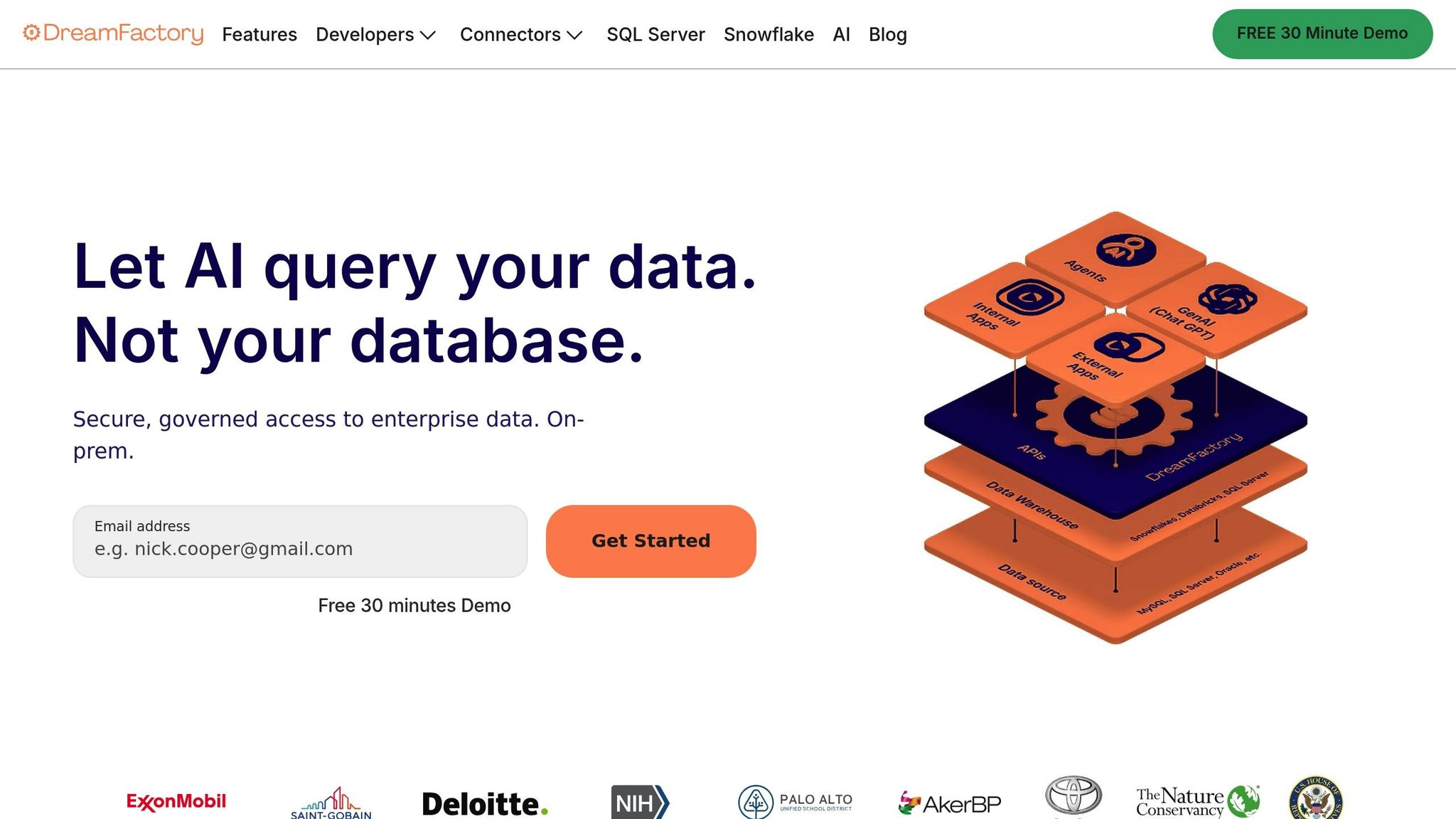
## How AI Data Gateways Work
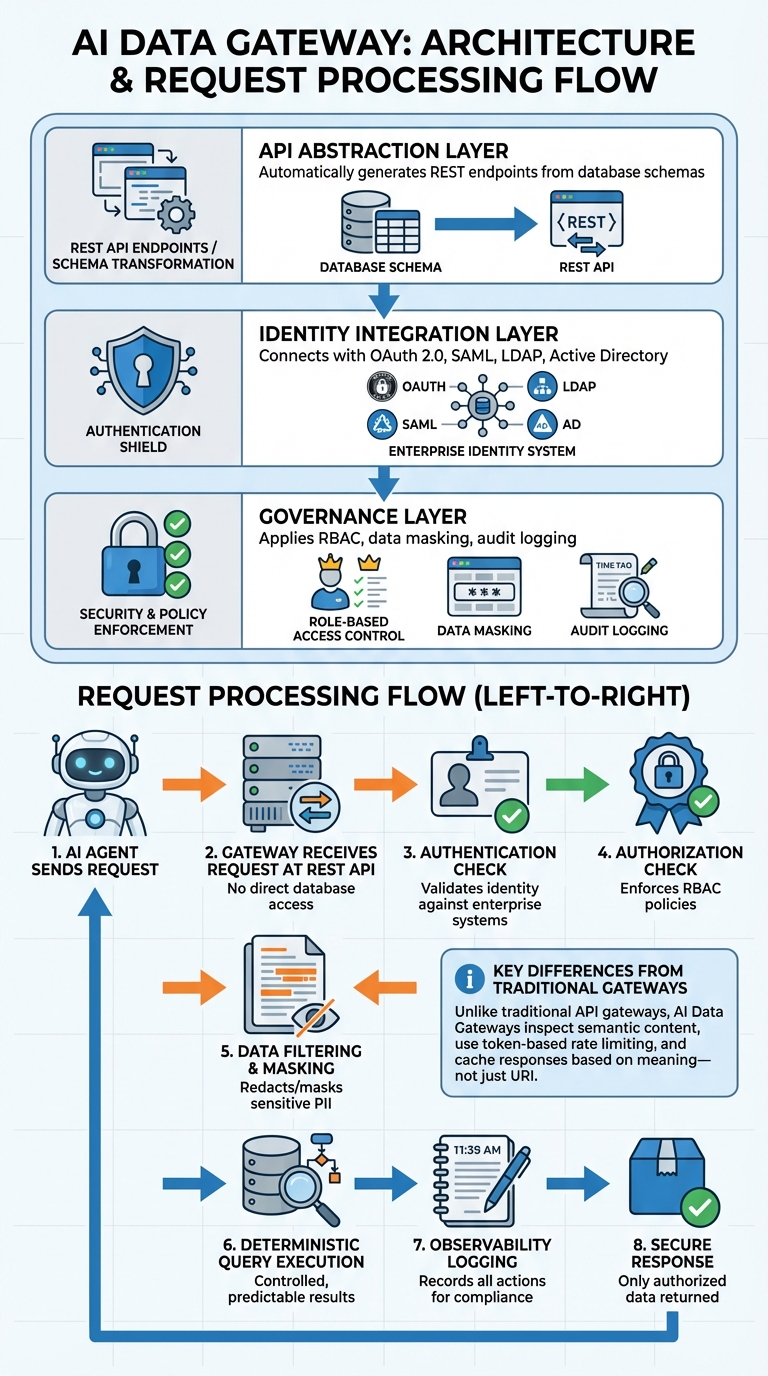
How AI Data Gateway Processes Requests: Architecture and Data Flow
### Architecture Components
An AI Data Gateway acts as a secure bridge between your AI systems and enterprise data sources, ensuring policies are enforced without requiring direct access to databases. Its architecture is built around three main layers:
- **API abstraction layer**: Automatically generates REST endpoints based on your existing database schemas.
- **Identity integration layer**: Connects with enterprise authentication systems like [OAuth 2.0](https://oauth.net/2/), [SAML](https://en.wikipedia.org/wiki/Security_Assertion_Markup_Language), [LDAP](https://en.wikipedia.org/wiki/Lightweight_Directory_Access_Protocol), or [Active Directory](https://learn.microsoft.com/en-us/windows-server/identity/ad-ds/get-started/virtual-dc/active-directory-domain-services-overview).
- **Governance layer**: Applies security measures such as role-based access control (RBAC), data masking, and audit logging.
This setup allows the gateway to transform database schemas into REST endpoints dynamically. Instead of dealing with raw SQL queries, AI agents interact with these governed endpoints. Each request is subject to strict authentication and authorization checks, ensuring AI systems only access data they are permitted to use, mirroring the permissions of the user or service account making the request.
Let’s dive into how these components manage the flow of data and handle query processing.
### Data Flow and Query Processing
When an AI agent requests data, it communicates with the gateway’s REST API instead of directly accessing the database. The gateway ensures that only authorized and consistent data is provided. Every request is validated against established policies, and deterministic queries are executed to deliver controlled, predictable results.
Each request passes through several layers of control: authentication, authorization, data filtering, and observability logging. This process ensures compliance and accountability. As Marco Palladino, CTO and Co-Founder of [Kong](https://konghq.com/), puts it:
> "The AI gateway operates in a similar way to a traditional API gateway: instead of acting as a reverse proxy for exposing our internal APIs to other clients, it is being deployed as an egress proxy for AI traffic".
Unlike traditional API gateways that focus solely on routing requests, AI Data Gateways go further by inspecting the semantic content of requests and responses. They use token-based rate limiting and cache responses based on their meaning, not just the URI. Additionally, sensitive data is redacted or masked in both requests and responses before it reaches the AI model, ensuring privacy and security.
The gateway also integrates seamlessly with enterprise systems to enhance functionality and maintain security protocols.
### Integration with Enterprise Systems
AI Data Gateways are designed to work with your existing security infrastructure. They integrate with enterprise identity providers using protocols like OAuth 2.0, [OpenID Connect](https://openid.net/developers/how-connect-works/), SAML, JWT, and LDAP. This **identity passthrough** feature means AI agents inherit permissions from your current access control systems, ensuring that audit logs reflect actual user actions rather than generic service account activity. This approach also supports deterministic queries, maintaining the integrity of legacy data.
For older systems, the gateway employs a "wrap, don’t rip" strategy. Instead of replacing legacy databases or ERPs, it overlays modern API access, enabling AI to query even decades-old data without altering the original code. Additionally, many gateways support the [**Model Context Protocol**](https://modelcontextprotocol.io/specification/2025-11-25) **(MCP)**, which standardizes how AI assistants access enterprise data, reducing the need for custom integrations with each new model.
To add flexibility, the gateway can host scripts written in PHP, Python, or Node.js. These scripts can validate, enrich, or transform data before it reaches the AI, ensuring the system remains adaptable while keeping security centralized.
## Benefits of Using an AI Data Gateway
The AI Data Gateway offers a range of critical benefits, focusing on enhanced security, modernization of legacy systems, and faster AI development workflows. Here's how it delivers value in these areas:
### Security and Governance Controls
The AI Data Gateway enforces **zero-trust principles** by acting as an intermediary between AI models and enterprise data. Instead of allowing direct access to databases, the gateway uses controlled REST endpoints to handle data retrieval. This approach eliminates risks like SQL injection and ensures that AI models cannot execute raw SQL commands.
As AI systems become more autonomous, their actions and decision-making processes face increasing regulatory scrutiny. By using identity passthrough, the gateway ensures that audit logs reflect the actual user behind an action, not just a generic service account. This level of traceability is essential for meeting compliance requirements.
> "The rules you already live by follow every question and action - so progress doesn't come at the cost of control." - DreamFactory
The gateway also applies **role-based access control (RBAC)**, data masking, and audit trails automatically. For example, you can assign "read-only" roles to AI systems, limiting their access to specific views rather than entire databases. This ensures a least-privilege approach from the start. When paired with Retrieval-Augmented Generation (RAG), these controls can improve AI response accuracy by up to 90%.
### Modernizing Legacy Systems
Using a "wrap, don't rip" philosophy, the AI Data Gateway allows legacy systems to integrate with modern AI tools without requiring disruptive overhauls. By converting legacy systems into documented REST endpoints, the gateway makes them accessible for AI use in minutes. For instance, creating a [production-ready API takes an average of just 5 minutes](https://www.dreamfactory.com/academy).
This approach eliminates the need to migrate data or build custom integrations for each AI model. Instead, the gateway provides a single, consistent access point that works across multiple AI assistants, saving time and effort.
> "Layer AI on legacy systems now and modernize on your schedule, not AI's." - DreamFactory
Every action taken by an AI through the gateway is logged and timestamped, offering the transparency needed for regulatory compliance in industries governed by [GDPR](https://en.wikipedia.org/wiki/General_Data_Protection_Regulation), [HIPAA](https://en.wikipedia.org/wiki/Health_Insurance_Portability_and_Accountability_Act), and similar frameworks. This centralized governance simplifies compliance by securing data at the gateway level, rather than requiring protection measures for each individual system or database.
### Faster AI Development Workflows
The gateway doesn't just secure and modernize systems - it also speeds up the development process. By decoupling development from backend infrastructure, it allows developers to focus on AI logic while the gateway manages security, user authentication, and connectivity. Terence Bennett, CEO of DreamFactory, highlights this shift:
> "Traditional API development via manual endpoint coding is slow and inflexible." - DreamFactory
The gateway's model-agnostic design means developers can switch between AI models or assistants without reworking the underlying data connections. During prototyping, the ability to generate APIs instantly from schemas eliminates the need for manual endpoint coding. For testing, API-level data masking ensures secure testing with anonymized production data. When moving to production, the gateway’s decoupled architecture requires only policy updates - no code changes.
Developers can also use server-side scripting in PHP, Python, or Node.js to add features like data validation or custom workflows at the API level. This reusable logic layer accelerates the development cycle, cutting the time from concept to deployment from months to just days.
## Use Cases for AI Data Gateways
### Enterprise AI Deployment
AI Data Gateways play a key role in enterprise AI deployment by ensuring security and simplifying modernization. They enforce security policies independently of backend systems, creating a centralized trust layer that operates seamlessly across multiple AI models and tools. This eliminates the need for custom integrations and allows enterprises to manage AI securely and efficiently.
Using standards like the Model Context Protocol (MCP), gateways provide a unified interface that connects AI tools to enterprise systems. AI agents access data through REST endpoints that enforce Role-Based Access Control (RBAC), ensuring secure and authenticated access. Deterministic queries and identity passthrough further enhance security by uniquely verifying each request.
> "In an AI-driven enterprise, digital trust directly correlates with adoption, customer confidence, and regulatory resilience." - TrueFoundry
The rise of agentic AI - autonomous systems capable of making real-time decisions - makes this architecture even more essential. Unlike traditional workflows, these systems require dynamic access to legacy data while maintaining strict governance. By integrating with existing enterprise identity systems like LDAP, SAML, or OAuth, the gateway allows AI agents to use the same credentials as human employees, avoiding the pitfalls of managing disparate API keys.
### Healthcare and Financial Services
Industries like healthcare and finance face unique challenges due to strict compliance requirements, such as HIPAA or GDPR. AI Data Gateways address these concerns by automatically detecting and masking personally identifiable information (PII) before it is sent to external large language model (LLM) providers.
In financial institutions, gateways enable advanced natural language instruction analysis. Instead of relying on static rules engines, banks now deploy fine-tuned language models to analyze AI-driven instructions. For example, if an AI attempts to approve a fraudulent loan or transfer funds based on a malicious prompt, the gateway intercepts and blocks the request before it reaches critical systems. This ensures unauthorized actions are prevented while maintaining detailed audit trails of all access requests.
Data residency is another pressing issue. [Gartner](https://www.gartner.com/en) predicts that by 2030, over 75% of European and Middle Eastern enterprises will relocate AI workloads to address geopolitical risks, a sharp increase from less than 5% in 2025. AI Data Gateways help organizations comply with regional laws by routing traffic to local model endpoints and storing logs within specific geographic boundaries. In fact, inquiries about cloud sovereignty and geopatriation surged by 305% in the first half of 2025.
| Data Classification | Description | Access Level |
| --- | --- | --- |
| **Public** | Freely accessible content | Unrestricted |
| **Internal** | Employee-only information | Internal roles only |
| **Confidential** | Sensitive customer/vendor data | Restricted to specific agents |
| **Restricted** | Financial, health, or regulated content | Highest security, full audit required |
This framework ensures organizations maintain compliance and data sovereignty, even in complex operational landscapes.
### Air-Gapped and Regulated Environments
In highly secure environments like defense agencies, power grids, or medical research facilities, data often cannot leave the firewall. These air-gapped systems operate without internet connectivity, and AI Data Gateways enable their functionality by offering local LLM runtimes and pre-bundled dependencies that don't rely on external access.
The operational model for air-gapped setups is unique. Gateways manage tasks like license validation and model updates using encrypted USB drives, ensuring systems remain functional without external connectivity. For hybrid environments, where sensitive workloads stay on-premise while less critical tasks utilize cloud scalability, gateways enforce consistent security controls. Acting as a central checkpoint, they apply zero-trust principles across all AI traffic, regardless of where the model operates.
This is particularly critical as 66% of MCP servers currently operate with inadequate security, and 43% are vulnerable to command injection attacks that could lead to arbitrary code execution. Despite these robust protections, the gateway introduces minimal latency - less than 10 milliseconds - ensuring smooth performance. Whether in air-gapped setups or hybrid environments, AI Data Gateways provide a unified, secure approach to managing data access and governance without requiring changes to core systems.
## Conclusion
### Key Takeaways
AI Data Gateways are essential for successfully deploying AI systems. They tackle the critical challenge of granting AI access to enterprise data while maintaining strict security, compliance, and operational control. Acting as a centralized trust layer, these gateways enforce **authentication**, **authorization**, and **audit logging** for all AI traffic. This setup shields systems from threats like prompt injection, unauthorized tool execution, and exposure of sensitive secrets.
With APIs already driving 83% of internet traffic - a number expected to increase as autonomous AI agents grow - this gateway model fits seamlessly into how modern systems operate.
> "AI Gateways aren't optional - they're mission-critical for sustainable and safe AI adoption."
> – Marco Palladino, CTO and Co-Founder, Kong
The security upgrades offered by gateways are especially critical. Alarmingly, 66% of Model Context Protocol (MCP) servers currently follow weak security practices, putting sensitive data at risk. Gateways counteract this by implementing **token-based rate limiting**, **PII masking**, and **content filtering**. For high-stakes actions, they can even incorporate human-in-the-loop approvals.
These measures lay the groundwork for smoother and safer AI deployment.
### Next Steps for Implementation
To make the most of these security and modernization benefits, start by identifying a clear use case and conducting a risk assessment. Focus on workflows with the highest impact, pinpoint relevant data sources, and outline your security requirements. A repeatable process could include:
- Defining the use case
- Identifying necessary data
- Generating APIs
- Configuring policies
- Deploying behind the gateway
- Connecting AI agents
- Iterating based on results
Set up real-time dashboards to track token usage, model performance, and security incidents. This not only provides financial oversight and audit trails for compliance but also helps optimize costs when working with multiple large language model providers. For organizations operating in air-gapped or hybrid environments, ensure the gateway supports local LLM runtimes and secure updates without relying on external connectivity.
> "Success depends on safely, clearly, and consistently exposing data to AI agents."
> – Terence Bennett, CEO, DreamFactory
As AI systems increasingly take on autonomous, real-time decision-making roles, this architecture becomes indispensable. Unlike traditional API gateways, AI Data Gateways handle semantic content, enforce token-based limits, and protect against prompt injection. Engaging with experts to map out your infrastructure and compliance needs can speed up deployment and help you sidestep common challenges.
## FAQs
### Do I need to move my data to the cloud to use AI?
You don’t have to move your data to the cloud. With an AI Data Gateway, you can securely connect to your on-premises and legacy systems, enabling live access to your data without the hassle of migration. This approach ensures your data remains secure and governed while still powering advanced AI applications.
### How does identity passthrough work with my current login system?
Identity passthrough works alongside your current login system to safely share user identity details with AI applications. This means the AI system can identify the user making a request without needing additional authentication steps. It provides smooth, secure access while respecting user-specific permissions.
### What makes AI queries “deterministic,” and why does it matter?
Deterministic AI operates on a straightforward principle: the same input always leads to the same output. This predictability is especially important in industries like healthcare and finance, where decisions need to be transparent and reliable. Unlike probabilistic models, deterministic AI ensures results that are stable and easy to trace. This makes it easier for organizations to audit decisions, comply with regulations, and minimize errors. By delivering consistent outcomes, deterministic AI helps create workflows that are transparent and accountable, fostering greater trust in AI-driven processes.
## Related Blog Posts
- [LLM Data Gateways: Bridging the Gap Between Raw Data and Enterprise-Ready AI](https://blog.dreamfactory.com/blog/llm-data-gateways-bridging-the-gap-between-raw-data-and-enterprise-ready-ai/)
- [The Missing Layer Between Your Data Warehouse and GenAI - Introducing the Data AI Gateway](https://blog.dreamfactory.com/blog/the-missing-layer-between-your-data-warehouse-and-genai-introducing-the-data-ai-gateway/)
- [Blueprint for Enterprise GenAI: Governance, Gateways, and Guardrails](https://blog.dreamfactory.com/blog/blueprint-for-enterprise-genai-governance-gateways-and-guardrails/)
- [Performance Under Pressure: Why AI Gateways Matter for Real-Time AI](https://blog.dreamfactory.com/blog/performance-under-pressure-why-ai-gateways-matter-for-real-time-ai/)
TAGS: [DreamFactory,](https://blog.dreamfactory.com/tag/dreamfactory) [Legacy Systems,](https://blog.dreamfactory.com/tag/legacy-systems) [LLM Security,](https://blog.dreamfactory.com/tag/llm-security) [AI Data Gateway](https://blog.dreamfactory.com/tag/ai-data-gateway)

Kevin Hood
Kevin Hood is an accomplished solutions engineer specializing in data analytics and AI, enterprise data governance, data integration, and API-led initiatives.
Stay Connected with
The Connector Newsletter!
Subscribe to stay up-to-date with DreamFactory's latest product updates, API best practices, and tech humor in your inbox.
[](https://www.dreamfactory.com/)
[Call Sales +1 (415) 993-5877](tel:+14159935877)
Open – Mon–Fri 9–5 PT
[FREE 30 Minute Demo](https://www.dreamfactory.com/demo)
#### Follow us
- [GitHub](https://github.com/dreamfactorysoftware/dreamfactory)
- [Facebook](https://www.facebook.com/dfsoftwareinc/)
- [X (Twitter)](https://twitter.com/dfsoftwareinc)
- [LinkedIn](https://www.linkedin.com/company/dreamfactory-software)
- [YouTube](https://www.youtube.com/c/dreamfactorysoftware)
### Features
[Features](https://www.dreamfactory.com/features) [Self hosted](https://www.dreamfactory.com/features#self) [API Generation](https://www.dreamfactory.com/features#api) [Security](https://www.dreamfactory.com/features#secure) [Customization](https://www.dreamfactory.com/features#custom) [Pricing](https://www.dreamfactory.com/pricing)
### Installers
[Linux](https://www.dreamfactory.com/features#installer) [Docker](https://www.dreamfactory.com/features#installer) [Kubernetes](https://www.dreamfactory.com/features#installer)
### API Resources
[Documentation](https://docs.dreamfactory.com/) [Case Studies](https://www.dreamfactory.com/stories) [White Papers](https://www.dreamfactory.com/resources/whitepapers) [Academy](https://www.dreamfactory.com/academy) [API Calculator](https://calculator.dreamfactory.com) [Open Source](https://github.com/dreamfactorysoftware)
### Company
[Blog](https://blog.dreamfactory.com/) [Hub](https://www.dreamfactory.com/hub) [About us](https://www.dreamfactory.com/about) [Partners](https://www.dreamfactory.com/partners) [Support](https://www.dreamfactory.com/support) [Connectors](https://www.dreamfactory.com/connectors) [Contact Us](https://www.dreamfactory.com/demo)
© 2025 DreamFactory. All rights reserved.
[Terms of Use](https://www.dreamfactory.com/terms-of-use) [Privacy Policy](https://www.dreamfactory.com/privacy-policy) [LLMs](https://www.dreamfactory.com/llms.txt)
```json
{
"@context" : "https://schema.org",
"@type" : "BlogPosting",
"author" : {
"@type" : "Person",
"name" : "Kevin Hood",
"url" : "https://blog.dreamfactory.com/author/kevin-hoo"
},
"dateModified" : "2026-05-07T18:07:27.631Z",
"datePublished" : "2026-02-10T19:06:41.000Z",
"headline" : "What is an AI Data Gateway? | DreamFactory",
"image" : [ "https://assets.seobotai.com/cdn-cgi/image/quality=75,w=1536,h=1024/dreamfactory.com/698b7965676cd2891cb2ae20-1770750493971.jpg" ],
"mainEntityOfPage" : {
"@id" : "https://blog.dreamfactory.com/what-is-ai-data-gateway",
"@type" : "WebPage"
},
"publisher" : {
"@type" : "Organization",
"logo" : {
"@type" : "ImageObject",
"url" : "https://blog.dreamfactory.com/hubfs/DreamFactory%20-%20Orange%20-%20Transparent-1.png"
}
}
}
```
```json
{
"@context" : "https://schema.org",
"@type" : "FAQPage",
"mainEntity" : [ {
"@type" : "Question",
"acceptedAnswer" : {
"@type" : "Answer",
"text" : "You don’t have to move your data to the cloud. With an AI Data Gateway, you can securely connect to your on-premises and legacy systems, enabling live access to your data without the hassle of migration. This approach ensures your data remains secure and governed while still powering advanced AI applications.
"
},
"name" : "Do I need to move my data to the cloud to use AI?"
}, {
"@type" : "Question",
"acceptedAnswer" : {
"@type" : "Answer",
"text" : "Identity passthrough works alongside your current login system to safely share user identity details with AI applications. This means the AI system can identify the user making a request without needing additional authentication steps. It provides smooth, secure access while respecting user-specific permissions.
"
},
"name" : "How does identity passthrough work with my current login system?"
}, {
"@type" : "Question",
"acceptedAnswer" : {
"@type" : "Answer",
"text" : "Deterministic AI operates on a straightforward principle: the same input always leads to the same output. This predictability is especially important in industries like healthcare and finance, where decisions need to be transparent and reliable. Unlike probabilistic models, deterministic AI ensures results that are stable and easy to trace. This makes it easier for organizations to audit decisions, comply with regulations, and minimize errors. By delivering consistent outcomes, deterministic AI helps create workflows that are transparent and accountable, fostering greater trust in AI-driven processes.
"
},
"name" : "What makes AI queries “deterministic,” and why does it matter?"
} ]
}
```