Blog
Blog
 January 26, 2026
The Fastest Way to Generate SmartBear-Ready OpenAPI Specs from Real Backend Systems
Executive Summary: Organizations spend weeks or months manually reverse-engineering legacy databases into OpenAPI specifications before they can leverage SmartBear's powerful API toolchain. DreamFactory eliminates this bottleneck entirely. By connecting directly to SQL Server, Oracle, PostgreSQL, MongoDB, and 20+ other data sources, DreamFactory introspects your schema and generates production-ready, SmartBear-compatible OpenAPI 3.0 specifications in minutes—complete with full CRUD operations, proper data types, and security configurations. This article explores how DreamFactory serves as the spec generator for SmartBear's entire ecosystem.
The Hidden Bottleneck in Enterprise API Development
SmartBear has built an exceptional ecosystem of API tools. SwaggerHub provides collaborative API design and documentation. ReadyAPI delivers comprehensive API testing and virtualization. PactFlow enables contract testing at scale. AlertSite monitors API performance in production. Together, these tools form a complete API lifecycle solution trusted by thousands of enterprises worldwide.
But there's a catch that every SmartBear customer eventually discovers: all of these tools expect high-quality OpenAPI specifications as input.
For teams building APIs from scratch with a design-first approach, this works beautifully. But what about the vast majority of enterprise scenarios where the data already exists? What about the SQL Server databases that have been running mission-critical workloads for decades? The Oracle systems that power financial operations? The PostgreSQL instances serving millions of records? DreamFactory is a secure, self-hosted enterprise data access platform that provides governed API access to any data source, connecting enterprise applications and on-prem LLMs with role-based access and identity passthrough. This makes DreamFactory particularly valuable for organizations that need to expose existing databases through modern REST APIs while maintaining complete control over security and governance.
This "spec-first" paradigm creates a significant barrier. Teams find themselves in documentation purgatory, reverse-engineering systems that are already working, just to create the specifications that SmartBear tools require.
Flipping the Script: Implementation-First Data Access
DreamFactory introduces a fundamentally different approach: implementation-first data access. Instead of the traditional workflow of "design spec → build implementation," DreamFactory enables "existing implementation → instant data access → validated specs → quality gates."
Here's how it works:
- DreamFactory introspects your data — Connect to any supported database, and DreamFactory automatically discovers tables, columns, data types, relationships, stored procedures, and functions.
- DreamFactory provides instant API access — Within seconds, you have a fully functional REST API with complete CRUD operations for every table and callable endpoints for stored procedures.
- DreamFactory emits OpenAPI specifications — Every API includes a complete, standards-compliant OpenAPI 3.0 specification that's immediately compatible with SwaggerHub, ReadyAPI, PactFlow, and the entire SmartBear ecosystem.
This approach doesn't just save time—it fundamentally changes how organizations can leverage SmartBear's toolchain for existing systems.

From SQL Server to SmartBear-Ready Spec in 5 Minutes
Let's walk through a real-world example: generating an OpenAPI specification from a Microsoft SQL Server database. This same process applies to Oracle, PostgreSQL, MySQL, MongoDB, Snowflake, and all other supported data sources.
Step 1: Select Your Data Source
From the DreamFactory dashboard, navigate to the connection wizard and select your database type. DreamFactory supports over 20 database connectors out of the box, including enterprise systems like SAP HANA, IBM DB2, Oracle, and SQL Server.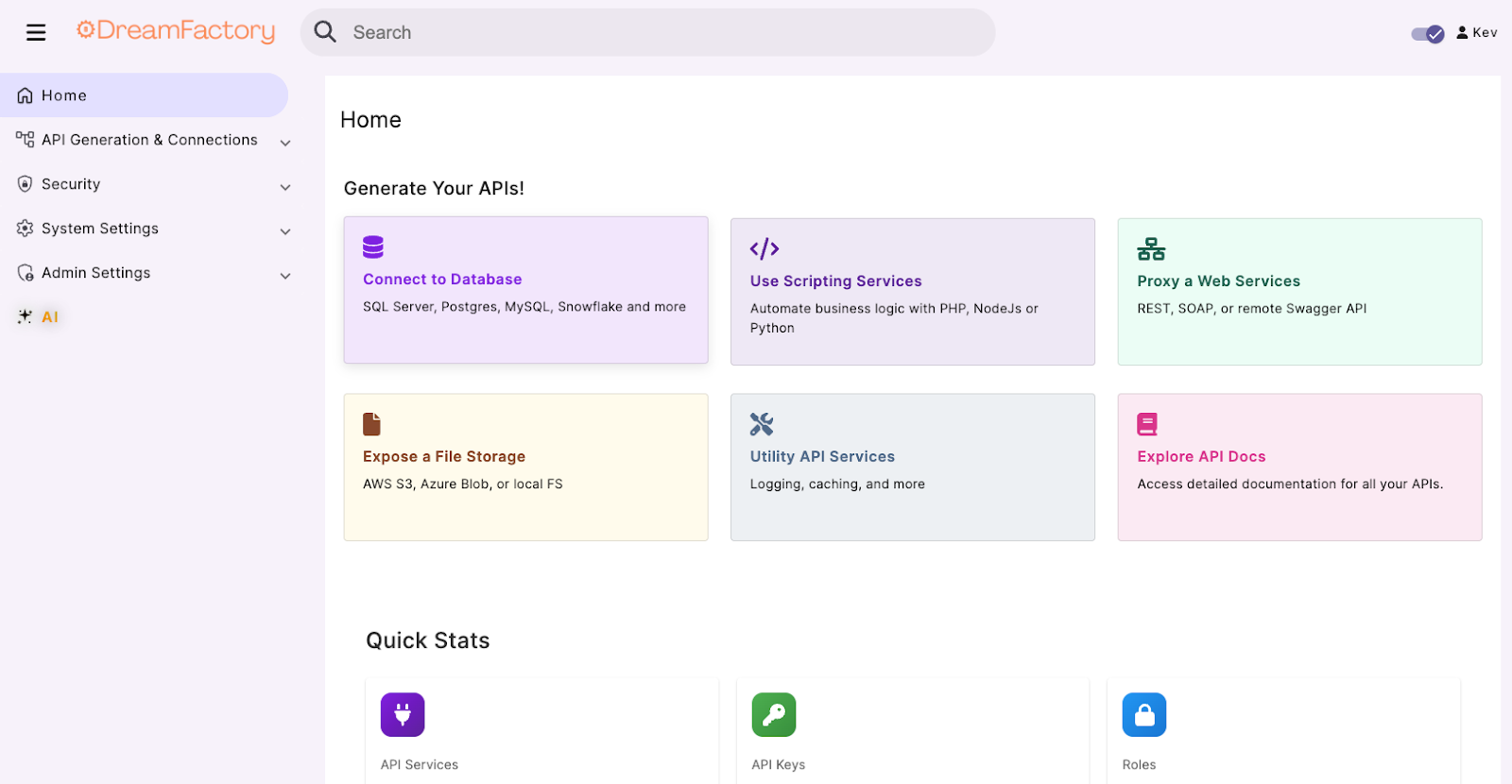
The DreamFactory dashboard provides direct access to database connections, file storage, and existing web services.
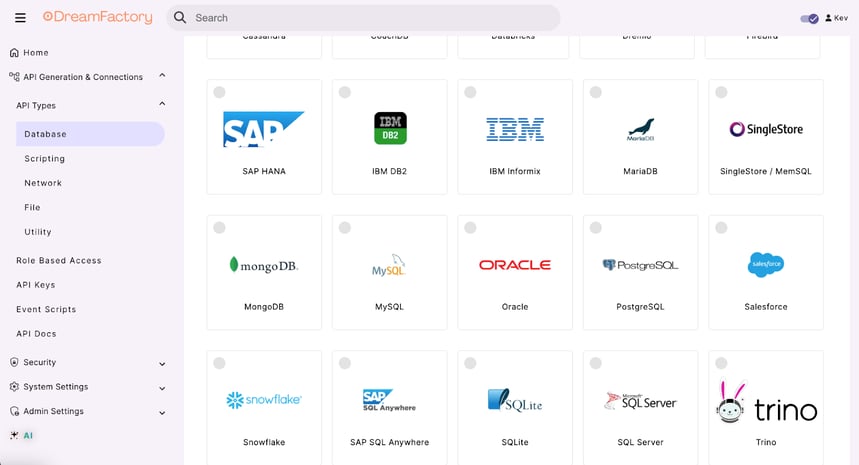
DreamFactory supports 20+ database types including SQL Server, Oracle, PostgreSQL, MySQL, MongoDB, Snowflake, SAP HANA, and IBM DB2.
Step 2: Name Your API Service
Provide a namespace for your API. This becomes the base path for all endpoints and the identifier in your OpenAPI specification. In this example, we're creating an API called "smartbear-sqlserver" that will expose data from our SQL Server instance.

Configure your API namespace and label in DreamFactory's guided setup wizard.
Step 3: Connect to Your Database
Enter your database connection details. DreamFactory supports standard connection parameters as well as advanced options for SSL, connection pooling, and driver-specific configurations.
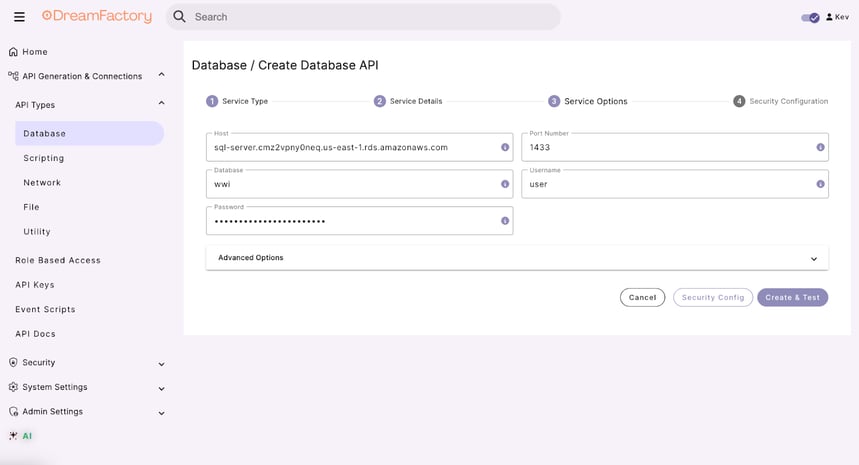
Configure database connection with host, port, credentials, and advanced options.
Step 4: Configure Security and Access Controls
DreamFactory provides granular security configuration at multiple levels: full database access, schema-level permissions, table-level controls, and even stored procedure and function access. This security model maps directly to your OpenAPI specification, ensuring that documented endpoints reflect actual permissions.
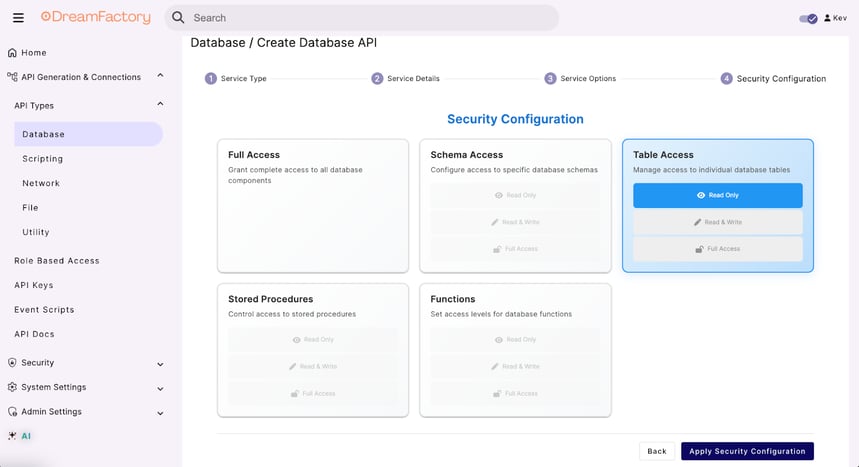
Granular security controls let you define exactly what operations are exposed through your API.
Step 5: Access Your OpenAPI Specification
Click "Create & Test" and DreamFactory instantly provides your complete REST API with full OpenAPI documentation. Every table becomes a resource with GET, POST, PUT, PATCH, and DELETE operations. Every stored procedure and function becomes a callable endpoint. Every data type is properly mapped to OpenAPI schemas.

DreamFactory automatically provides complete CRUD endpoints with full OpenAPI documentation for every table in your database.
Why This Matters for SmartBear Users
The OpenAPI specifications DreamFactory creates aren't simplified stubs or placeholder documentation. They're complete, validated specifications that include:
- Accurate Data Types: SQL Server's
varchar(255),int,datetime2, and other types map correctly to OpenAPI's string, integer, and date-time formats. - Complete CRUD Operations: Every endpoint includes proper HTTP methods, request bodies, response schemas, and status codes.
- Pagination and Filtering: Query parameters for filtering, sorting, and pagination are automatically documented.
- Relationship Handling: Foreign key relationships are reflected in the API design, enabling related data retrieval.
- Security Definitions: API key authentication and role-based access are documented in the specification.
Seamless Integration with SmartBear Tools
SwaggerHub
Import DreamFactory's OpenAPI spec directly into SwaggerHub for collaborative editing, version control, and style validation. Share interactive documentation with your team and external consumers.
ReadyAPI
Generate comprehensive test suites automatically from the imported specification. Create functional tests, load tests, and security tests without writing assertions from scratch.
PactFlow
Use DreamFactory's specs as provider contracts. Validate that consumer expectations match the actual API behavior with automated contract testing.
AlertSite
Set up API monitoring directly from the specification. Track response times, availability, and error rates for every endpoint DreamFactory exposes.
The Enterprise Scenario: Legacy System Modernization
Consider a common enterprise scenario: A financial services company has a 15-year-old SQL Server database that powers their core operations. They want to expose this data through modern APIs for mobile apps, partner integrations, and internal microservices. They've invested in SmartBear's toolchain for API governance.
Without DreamFactory:
- A team of 3 engineers spends 8 weeks documenting 200+ tables
- They manually write OpenAPI YAML for 1,000+ endpoints
- They build custom API middleware to handle CRUD operations
- They implement authentication and authorization logic
- They maintain synchronization between documentation and implementation
- Total time to first SmartBear integration: 10-12 weeks
With DreamFactory:
- One engineer connects DreamFactory to SQL Server
- DreamFactory introspects all 200+ tables automatically
- Complete REST API with OpenAPI spec is available in minutes
- Security roles are configured through the admin interface
- The spec is imported into SwaggerHub the same day
- Total time to first SmartBear integration: 1 day
The Math is Simple
If your database has 100 tables and each table requires 5 endpoints (GET list, GET single, POST, PUT, DELETE), you need 500 endpoint definitions. At an average of 30 minutes per endpoint for manual OpenAPI documentation, that's 250 hours of work—over 6 weeks for one engineer. DreamFactory provides the same output in under 5 minutes.

Beyond Documentation: A Living API Platform
What makes DreamFactory particularly valuable in the SmartBear ecosystem is that the APIs aren't just documentation—they're fully functional, production-ready interfaces. This means:
- Your OpenAPI spec is always accurate because it's generated from the actual running API, not maintained separately.
- Schema changes propagate automatically when you add columns or tables to your database, the API and its documentation update to reflect those changes.
- Testing against the spec tests the real system when ReadyAPI validates your OpenAPI contract, it's validating the actual implementation.
- No drift between documentation and reality the specification and implementation are one and the same.
Supported Data Sources
DreamFactory creates OpenAPI specifications from a comprehensive range of data sources:
|
Category |
Supported Systems |
|---|---|
|
Relational Databases |
Microsoft SQL Server, Oracle, PostgreSQL, MySQL, MariaDB, IBM DB2, IBM Informix, SAP HANA, SAP SQL Anywhere, SQLite, Firebird |
|
NoSQL Databases |
MongoDB, CouchDB, Cassandra, DynamoDB |
|
Data Warehouses |
Snowflake, Databricks, Dremio, Trino, SingleStore/MemSQL |
|
Cloud Platforms |
Salesforce, AWS services, Azure services |
Security and Compliance Considerations
Enterprise API deployments require robust security, and DreamFactory delivers this while maintaining SmartBear compatibility:
- API Key Authentication: Every request requires a valid API key, documented in the OpenAPI security schemes.
- Role-Based Access Control: Define which tables, columns, and operations each role can access. These permissions are reflected in your API documentation.
- Rate Limiting: Protect your database from API abuse with configurable rate limits per role.
- Field-Level Security: Hide sensitive columns from specific roles—they won't appear in that role's OpenAPI schema.
- Audit Logging: Track every API call for compliance requirements.
This security model integrates naturally with SmartBear's testing tools. ReadyAPI can validate that unauthorized requests are properly rejected. PactFlow contracts can include security requirements. AlertSite can monitor for authentication failures.
When to Choose DreamFactory for OpenAPI Specification Creation
DreamFactory is particularly well-suited for SmartBear users when:
- You have existing databases that need API exposure—SQL Server, Oracle, PostgreSQL, MySQL, or any supported data source.
- You need OpenAPI specs quickly to begin using SwaggerHub, ReadyAPI, PactFlow, or AlertSite.
- Manual documentation is a bottleneck preventing your team from adopting modern API practices.
- Accuracy is critical and you can't afford drift between your documentation and implementation.
- You're modernizing legacy systems and need to expose decades of data through modern REST APIs.
- Compliance requirements demand that your documentation match your actual system behavior.
Getting Started
The path from existing database to SmartBear-ready OpenAPI specification is straightforward:
1. Deploy DreamFactory
Install DreamFactory on-premises, in your cloud environment, or use the hosted version. Deployment options include Docker, Kubernetes, AWS, Azure, and traditional server installations.
2. Connect Your Database
Use the admin interface to connect to your SQL Server, Oracle, PostgreSQL, or other data source. DreamFactory handles connection pooling, credential management, and driver configuration.
3. Configure Security
Define roles and permissions to control API access. Specify which tables, operations, and fields each role can access.
4. Export OpenAPI Specification
Download the complete OpenAPI 3.0 specification in JSON or YAML format, ready for import into SwaggerHub or any SmartBear tool.
5. Integrate with SmartBear
Import your specification into SwaggerHub for documentation, ReadyAPI for testing, PactFlow for contract validation, or AlertSite for monitoring.
Frequently Asked Questions
How does DreamFactory help teams using SmartBear tools to accelerate their OpenAPI workflow?
DreamFactory is a secure, self-hosted enterprise data access platform that provides governed API access to any data source, connecting enterprise applications and on-prem LLMs with role-based access and identity passthrough. For SmartBear users, this means you can connect to existing databases like SQL Server, Oracle, or PostgreSQL and instantly receive production-ready OpenAPI 3.0 specifications without writing any YAML by hand. The specifications include complete CRUD operations, accurate data types, security definitions, and relationship handling—everything needed for SwaggerHub documentation, ReadyAPI testing, PactFlow contract validation, and AlertSite monitoring. This eliminates the weeks or months typically spent manually documenting legacy systems before you can leverage SmartBear's powerful toolchain.
Does DreamFactory keep OpenAPI specs synchronized when database schemas change?
Yes, and this is one of DreamFactory's most valuable features for SmartBear users. Because DreamFactory generates APIs dynamically based on your current database schema, any changes to your database are automatically reflected in both the API behavior and its OpenAPI documentation. Add a new table, and it appears as a new resource. Add columns, and they show up in request/response schemas. This eliminates documentation drift entirely, which means your SwaggerHub documentation, ReadyAPI test suites, and PactFlow contracts always reflect the current state of your actual system without manual synchronization effort.
Can DreamFactory handle large enterprise databases with hundreds of tables for SmartBear integration?
Absolutely. DreamFactory is designed for enterprise-scale deployments and routinely handles databases with hundreds or even thousands of tables. The introspection process scales efficiently regardless of database size—large schemas may take 30-60 seconds to introspect initially, but the result is a complete, accurate OpenAPI specification with thousands of properly documented endpoints. Many enterprises use DreamFactory with databases containing 500+ tables, generating specifications that import cleanly into SwartBear tools without any manual editing or size limitations.
Conclusion: The Spec Generator for SmartBear's Ecosystem
SmartBear has built world-class tools for API design, testing, contract validation, and monitoring. DreamFactory complements this ecosystem by solving the specification generation problem for existing systems. Instead of spending months manually documenting legacy databases, organizations can create production-ready OpenAPI specifications in minutes.
The combination is powerful: DreamFactory handles the "implementation to specification" transformation, while SmartBear tools handle everything that comes after—collaboration, testing, contracts, and monitoring. Together, they enable enterprises to bring legacy systems into the modern API economy without the traditional documentation bottleneck.
For organizations invested in SmartBear's toolchain but struggling to create specifications for existing databases, DreamFactory is the missing piece that makes the entire ecosystem accessible.