---
title: "REST APIs vs SQL: Data Aggregation Guide"
description: Choose REST APIs for secure, multi-source access and SQL for high-performance internal aggregations.
image: https://assets.seobotai.com/cdn-cgi/image/quality=75,w=1536,h=1024/dreamfactory.com/69cfde121b352ff267cd3a19-1775233495570.jpg
---
[](https://www.dreamfactory.com/)
Products & Services
[AI Data Gateway](https://www.dreamfactory.com/ai-data-gateway/overview)
[Overview Why DreamFactory exists](https://www.dreamfactory.com/ai-data-gateway/overview) [Data Gov, Comp, Security Policy enforcement at the API layer](https://www.dreamfactory.com/ai-data-gateway/ai-data-governance) [Standard API Layer One contract for every backend](https://www.dreamfactory.com/ai-data-gateway/standard-api-layer) [API Gateway Functionality Routing, auth, rate limits, observability](https://www.dreamfactory.com/ai-data-gateway/api-gateway-functionality) [Deployment & Integration Self-hosted, cloud, hybrid](https://www.dreamfactory.com/ai-data-gateway/on-premise-deployment-and-integration) [Developer Productivity Auto-generated, never hand-coded](https://www.dreamfactory.com/ai-data-gateway/ai-development-accelerated) [AI App Architectures Patterns for RAG, agents, MCP](https://www.dreamfactory.com/ai-data-gateway/enterprise-ai-architectures)
AI Data Models
[AIOpenAI](https://www.dreamfactory.com/use-cases/openai) [GGoogle Gemini](https://www.dreamfactory.com/use-cases/google-gemini) [CAnthropic Claude](https://www.dreamfactory.com/use-cases/anthropic-claude-landing) [LMeta Llama](https://www.dreamfactory.com/use-cases/meta-llama) [MMistral AI](https://www.dreamfactory.com/use-cases/mistral) [CoCohere](https://www.dreamfactory.com/use-cases/cohere)
Services and support
[Quickstart Service Packages Expert-led Quickstarts to production](https://www.dreamfactory.com/services-and-support/quickstart-services-packages)
API Management
[Generate & Manage REST APIs From any database, in seconds](https://www.dreamfactory.com/api-management/generate-rest-apis) [Features Security, scripting, self-hosted & more](https://www.dreamfactory.com/api-management/features) [API Generation The complete guide to auto-generated APIs](https://blog.dreamfactory.com/a-complete-guide-to-api-generation) [API Management Concepts, tools, and best practises](https://blog.dreamfactory.com/what-is-api-management-a-brief-overview-of-api-management-concepts-and-tools?_gl=1*jl0njh*_gcl_au*MjQzMjgwMTc3LjE3ODIzMjI3MzY)
Use Cases
AI Use Cases
[AI Data Access Secure, governed reads for your LLMs](https://www.dreamfactory.com/use-cases/ai-data-access) [MCP Server Drop-in Model Context Protocol](https://www.dreamfactory.com/use-cases/mcp-server) [Legacy Modernization Wrap mainframes with REST](https://www.dreamfactory.com/use-cases/legacy-modernization) [Data Governance Audit every call, enforce every policy](https://www.dreamfactory.com/use-cases/data-governance)
[Customer Case Studies](https://www.dreamfactory.com/case-studies)
[Energy Modernization](https://www.dreamfactory.com/case-studies/energy-snowflake-modernization) [Government Modernization](https://www.dreamfactory.com/case-studies/government-mainframe-oracle-modernization) [Government Business Intelligence](https://www.dreamfactory.com/case-studies/government-sql-server-bi-analyst-queries) [Manufacturing Modernization](https://www.dreamfactory.com/case-studies/steel-manufacturing-sap-erp-modernization) [Financial Services Investor Portal](https://www.dreamfactory.com/case-studies/financial-services-sql-server-investor-portal) [Non-Profit Partner Data Sharing](https://www.dreamfactory.com/case-studies/non-profit-sql-server-partner-data-sharing) [Professional Services Exec Dashboards](https://www.dreamfactory.com/case-studies/professional-services-erp-dashboards) [Education HR and External Data Sharing](https://www.dreamfactory.com/case-studies/education-student-hr-sql-server-mysql-external-data-sharing)
Industries
Industries
#### [Healthcare HIPAA-grade APIs across EHR, claims, and labs.](https://www.dreamfactory.com/use-cases/healthcare)
#### [Financial Services Portfolios, partners, and portals on one layer.](https://www.dreamfactory.com/use-cases/financial-services)
#### [Government Modernize mainframes without re-platforming.](https://www.dreamfactory.com/use-cases/government)
#### [Manufacturing SAP, MES, and shop-floor data, governed.](https://www.dreamfactory.com/use-cases/manufacturing)
#### [Spotlight How enterprises run on DreamFactory From healthcare to energy to finance — governance baked into every endpoint. Browse case studies →](https://www.dreamfactory.com/case-studies)
Connectors
SQL Database
[SQL SQL Server](https://www.dreamfactory.com/connectors/sql-server) [OR Oracle](https://www.dreamfactory.com/connectors/oracle) [PG PostgreSQL](https://www.dreamfactory.com/connectors/postgresql) [My MySQL](https://www.dreamfactory.com/connectors/mysql)
NoSQL & Docs
[Dy DynamoDB](https://www.dreamfactory.com/connectors/dynamodb) [Do DocumentDB](https://www.dreamfactory.com/connectors/azure-documentdb) [Mo MongoDB](https://www.dreamfactory.com/connectors/mongodb) [Cb CouchDB](https://www.dreamfactory.com/connectors/couch-db)
Cloud Warehouses
[S3 S3](https://www.dreamfactory.com/connectors/amazon-s3) [Ab Azureblob](https://www.dreamfactory.com/connectors/azure-blob) [FS FTP/SFTP](https://www.dreamfactory.com/connectors/ftp-sftp) [LS Local Storage](https://www.dreamfactory.com/connectors/local-storage)
C & SaaS
[Sf Salesforce](https://www.dreamfactory.com/connectors/salesforce) [API REST / SOAP](https://www.dreamfactory.com/connectors/soap-to-rest)
[See all 30+ connectors](https://www.dreamfactory.com/connectors)
[Blog](https://blog.dreamfactory.com/)
[FREE 30 Minute Demo](https://www.dreamfactory.com/demo)
[](https://www.dreamfactory.com/)
 
Back to main menu
Products & Services
Use Cases
Industries
Connectors
[Blog](https://blog.dreamfactory.com/)
[FREE 30 Minute Demo](https://www.dreamfactory.com/demo)
[AI Data Gateway](https://www.dreamfactory.com/ai-data-gateway/overview)
[Overview Why DreamFactory exists](https://www.dreamfactory.com/ai-data-gateway/overview) [Data Gov, Comp, Security Policy enforcement at the API layer](https://www.dreamfactory.com/ai-data-gateway/ai-data-governance) [Standard API Layer One contract for every backend](https://www.dreamfactory.com/ai-data-gateway/standard-api-layer) [API Gateway Functionality Routing, auth, rate limits, observability](https://www.dreamfactory.com/ai-data-gateway/api-gateway-functionality) [Deployment & Integration Self-hosted, cloud, hybrid](https://www.dreamfactory.com/ai-data-gateway/on-premise-deployment-and-integration) [Developer Productivity Auto-generated, never hand-coded](https://www.dreamfactory.com/ai-data-gateway/ai-development-accelerated) [AI App Architectures Patterns for RAG, agents, MCP](https://www.dreamfactory.com/ai-data-gateway/enterprise-ai-architectures)
AI Data Models
[AIOpenAI](https://www.dreamfactory.com/use-cases/openai) [GGoogle Gemini](https://www.dreamfactory.com/use-cases/google-gemini) [CAnthropic Claude](https://www.dreamfactory.com/use-cases/anthropic-claude-landing) [LMeta Llama](https://www.dreamfactory.com/use-cases/meta-llama) [MMistral AI](https://www.dreamfactory.com/use-cases/mistral) [CoCohere](https://www.dreamfactory.com/use-cases/cohere)
Services and support
[Quickstart Service Packages Expert-led Quickstarts to production](https://www.dreamfactory.com/services-and-support/quickstart-services-packages)
AI Data Models
[Generate & Manage REST APIs From any database, in seconds](https://www.dreamfactory.com/api-management/generate-rest-apis) [Features Security, scripting, self-hosted & more](https://www.dreamfactory.com/api-management/features) [API Generation The complete guide to auto-generated APIs](https://blog.dreamfactory.com/a-complete-guide-to-api-generation) [API Management Concepts, tools, and best practises](https://blog.dreamfactory.com/what-is-api-management-a-brief-overview-of-api-management-concepts-and-tools?_gl=1*jl0njh*_gcl_au*MjQzMjgwMTc3LjE3ODIzMjI3MzY)
AI Use Cases
[AI Data Access Secure, governed reads for your LLMs](https://www.dreamfactory.com/use-cases/ai-data-access) [MCP Server Drop-in Model Context Protocol](https://www.dreamfactory.com/use-cases/mcp-server) [Legacy Modernization Wrap mainframes with REST](https://www.dreamfactory.com/use-cases/legacy-modernization) [Data Governance Audit every call, enforce every policy](https://www.dreamfactory.com/use-cases/data-governance)
[Customer Case Studies](https://www.dreamfactory.com/case-studies)
[Energy Modernization](https://www.dreamfactory.com/case-studies/energy-snowflake-modernization) [Government Modernization](https://www.dreamfactory.com/case-studies/government-mainframe-oracle-modernization) [Government Business Intelligence](https://www.dreamfactory.com/case-studies/government-sql-server-bi-analyst-queries) [Manufacturing Modernization](https://www.dreamfactory.com/case-studies/steel-manufacturing-sap-erp-modernization) [Financial Services Investor Portal](https://www.dreamfactory.com/case-studies/financial-services-sql-server-investor-portal) [Non-Profit Partner Data Sharing](https://www.dreamfactory.com/case-studies/non-profit-sql-server-partner-data-sharing) [Professional Services Exec Dashboards](https://www.dreamfactory.com/case-studies/professional-services-erp-dashboards) [Education HR and External Data Sharing](https://www.dreamfactory.com/case-studies/education-student-hr-sql-server-mysql-external-data-sharing)
Industries
#### [Healthcare HIPAA-grade APIs across EHR, claims, and labs.](https://www.dreamfactory.com/use-cases/healthcare)
#### [Financial Services Portfolios, partners, and portals on one layer.](https://www.dreamfactory.com/use-cases/financial-services)
#### [Government Modernize mainframes without re-platforming.](https://www.dreamfactory.com/use-cases/government)
#### [Manufacturing SAP, MES, and shop-floor data, governed.](https://www.dreamfactory.com/use-cases/manufacturing)
SQL Database
[SQL SQL Server](https://www.dreamfactory.com/connectors/sql-server) [OR Oracle](https://www.dreamfactory.com/connectors/oracle) [PG PostgreSQL](https://www.dreamfactory.com/connectors/postgresql) [My MySQL](https://www.dreamfactory.com/connectors/mysql)
NoSQL & Docs
[Dy DynamoDB](https://www.dreamfactory.com/connectors/dynamodb) [Do DocumentDB](https://www.dreamfactory.com/connectors/azure-documentdb) [Mo MongoDB](https://www.dreamfactory.com/connectors/mongodb) [Cb CouchDB](https://www.dreamfactory.com/connectors/couch-db)
Cloud Warehouses
[S3 S3](https://www.dreamfactory.com/connectors/amazon-s3) [Ab Azureblob](https://www.dreamfactory.com/connectors/azure-blob) [FS FTP/SFTP](https://www.dreamfactory.com/connectors/ftp-sftp) [LS Local Storage](https://www.dreamfactory.com/connectors/local-storage)
C & SaaS
[Sf Salesforce](https://www.dreamfactory.com/connectors/salesforce) [API REST / SOAP](https://www.dreamfactory.com/connectors/soap-to-rest)
[See all 30+ connectors](https://www.dreamfactory.com/connectors)
[ Blog](https://blog.dreamfactory.com/)
# REST APIs vs SQL: Data Aggregation Guide
by Kevin Hood
 April 3, 2026
Table of contents
RECOMMENDED ARTICLES
- [A Complete Guide to API Generation](https://blog.dreamfactory.com/a-complete-guide-to-api-generation)
- [10 Best API Management Tools](https://blog.dreamfactory.com/what-is-api-management-a-brief-overview-of-api-management-concepts-and-tools)
- [Creating a Microsoft SQL Server API in Less Than 5 minutes with DreamFactory](https://blog.dreamfactory.com/creating-a-microsoft-sql-server-api-in-less-than-5-minutes-with-dreamfactory)
- [Hasura vs. DreamFactory: A Comprehensive Comparison](https://blog.dreamfactory.com/hasura-vs-dreamfactory)
- [Build A Snowflake REST API in Less Than 5 Minutes](https://blog.dreamfactory.com/generate-a-snowflake-rest-api-in-less-than-5-minutes)
**Choosing between REST APIs and SQL for data aggregation depends on your needs.**
- **REST APIs**: Best for secure, scalable, and controlled access to data, especially in distributed systems or AI-driven environments. They use [token-based authentication](https://blog.dreamfactory.com/the-complete-guide-to-api-tokens), support multi-source aggregation, and handle high concurrency with horizontal scaling. However, they can suffer from higher latency and rigid endpoint designs.
- **SQL**: Ideal for internal teams needing fast, complex aggregations within structured databases. It excels at handling large datasets with advanced query capabilities like joins and window functions. But it requires schema knowledge, struggles with scalability under heavy loads, and exposes databases to security risks without proper governance.
### Quick Comparison
| Feature | REST APIs | SQL (Direct Access) |
| --- | --- | --- |
| **Performance** | Relies on caching; can face latency issues | Excels at complex joins and aggregations |
| **Security** | Token-based (OAuth, JWT); centralized logs | Vulnerable to SQL injection; manual setup |
| **Scalability** | Horizontal scaling with load balancers | Vertical scaling; limited by hardware |
| **Ease of Use** | Simplifies multi-source data access | Requires deep schema knowledge |
| **AI Compatibility** | Supports rate limiting and schema abstraction | Raw access but lacks safeguards |
**Conclusion**: Use REST APIs for secure, multi-source data aggregation in AI or distributed systems. Choose SQL for high-performance internal analytics with structured data.
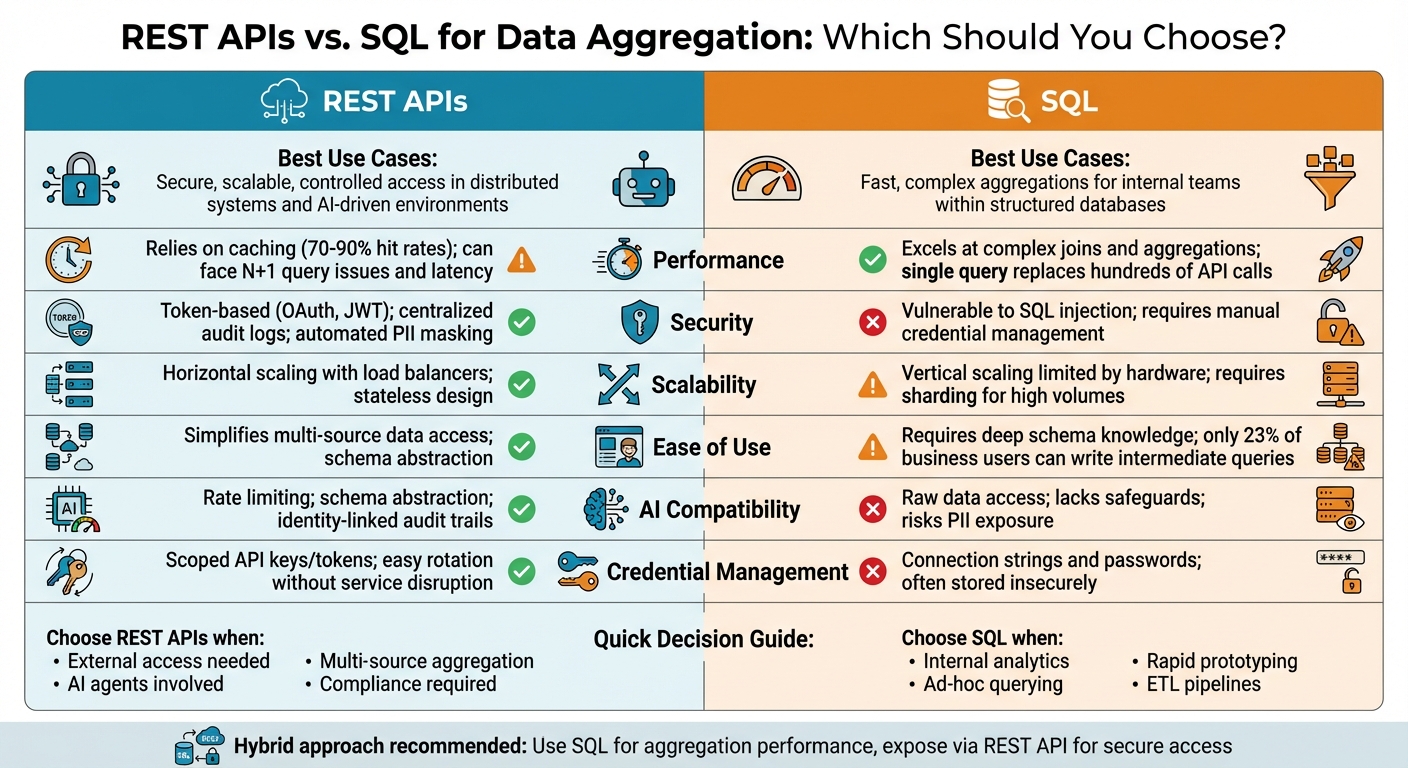
REST APIs vs SQL for Data Aggregation: Feature Comparison Chart
## No Code API Tutorial for [SQL Server](https://www.microsoft.com/en-us/sql-server): Instantly Generate Secure [SQL Server](https://www.microsoft.com/en-us/sql-server) REST APIs
## How REST APIs Handle Data Aggregation
REST APIs simplify data aggregation by delivering pre-aggregated JSON through HTTP methods. Here's how it works:
- **GET**: Retrieves datasets.
- **POST**: Triggers server-side operations, like executing [PostgreSQL stored procedures](https://blog.dreamfactory.com/calling-a-postgresql-stored-procedure-from-an-api).
- **PATCH**: Updates multiple related records within a single transaction.
REST APIs also allow "related" parameters in URIs (e.g., `?related=table_name`) to perform JOIN-like operations. This means developers receive unified JSON responses with nested arrays, eliminating the need to manually manage foreign key relationships. Instead of writing SQL queries tailored to specific database engines like [MySQL](https://www.mysql.com/) or [PostgreSQL](https://www.postgresql.org/), developers can access all the necessary data in one request, streamlining integration with AI systems.
> "The REST API will deliver an array of objects along with related objects in a sub-array. This is a very powerful feature... because large database documents can be downloaded and used immediately without any additional processing as a JSON object." - Terence Bennett, CEO, DreamFactory
REST APIs also prioritize security. [OAuth 2.0](https://oauth.net/2/), API keys, and [Role-Based Access Control (RBAC)](https://www.dreamfactory.com/resources/whitepapers/security-guide) ensure that only authorized users access specific data subsets. Credentials are encrypted, and rate limiting prevents databases from being overwhelmed by excessive requests, a common issue in distributed AI workloads.
### Where REST APIs Excel
REST APIs shine in distributed environments, particularly for AI-driven enterprises that need controlled access to multiple data sources without direct database connections. Their stateless nature ensures each request is self-contained, enabling horizontal scaling with microservices and load balancers to handle thousands of concurrent requests.
REST APIs also offer server-side filtering, partitioning records by user, role, or region before sending data to applications. This feature is essential for businesses that need to meet compliance requirements in enterprise AI deployments.
Their uniform interface makes integration across platforms easier. For example, whether pulling customer data from a CRM or transaction records from an e-commerce system, AI systems interact using consistent HTTP/JSON patterns instead of dealing with database-specific drivers.
Caching at the API level can significantly reduce database load - by as much as 70% to 90% for read-heavy applications. Additionally, compressing query results with gzip or brotli can cut payload sizes by 70% to 85%. For enterprises focused on security, centralized audit logging tracks details like timestamps, user identities, source IPs, and latency. These logs can be forwarded to SIEM tools like [Splunk](https://www.splunk.com/) or [Datadog](https://www.datadoghq.com/) for further analysis.
Platforms like DreamFactory enhance these features with identity passthrough, ensuring row-level security and displaying real user information in audit logs instead of generic service accounts. This approach integrates seamlessly with existing security setups like OAuth 2.0, LDAP/AD, and SAML/SSO, and supports deployment across on-premises, air-gapped, private cloud, edge, or hybrid environments.
### Where REST APIs Fall Short
While REST APIs have many strengths, they come with trade-offs. One major drawback is network latency. Each HTTP request includes overhead from headers, authentication tokens, and connection setup. When aggregating data from multiple endpoints, these delays can add up quickly. Poorly designed REST implementations may also suffer from the "N+1 Query Problem", where retrieving 4,000 rows requires 4,000 individual API calls instead of one efficient query.
Another challenge lies in endpoint design. Unlike SQL, which allows flexible queries, REST APIs rely on predefined endpoints for specific data aggregation patterns. If an AI model requires a new combination of filters or joins, developers must either modify existing endpoints or create new ones. This rigidity can be a stumbling block for analytics workloads, where business intelligence (BI) tools typically send one query to join tables, filter rows, calculate aggregates, and sort results.
> "BI tools expect to send one complex query that joins tables, filters row, calculates aggregates, sorts result all at once... REST APIs are built not really for that kind of load. Instead of sending one smart query, you have to send dozens or hundreds of tiny, paginated requests instead." - Jeff Hainsworth, Senior Product Marketing Manager for Data + Analytics, insightsoftware
Individual unoptimized REST requests can take about 1 second each. For BI dashboards requiring multiple datasets, total load times can exceed the 3-second threshold users expect, leading to frustration and potential abandonment. Additionally, managing REST APIs introduces operational challenges. Teams must maintain documentation, versioning, rate limits, and monitoring infrastructure - tasks that wouldn't be necessary with direct database access.
## How SQL Handles Data Aggregation
SQL makes it possible to group and summarize data using tools like `GROUP BY` and aggregate functions such as `COUNT`, `SUM`, `AVG`, `MIN`, and `MAX`. Combining these with `JOIN` clauses allows users to merge data from multiple tables, creating detailed summaries. For instance, a retailer could analyze millions of transactions by grouping sales data by region and product category, then calculating total revenue for each combination - all in just one query.
The real magic happens when SQL aggregates data across multiple related tables. Using `JOIN` clauses, SQL can connect tables through primary and foreign keys, enabling complex summaries with `GROUP BY`. For example, a financial services company might join customer accounts, transactions, and merchant data to calculate average spending by customer segment. The `HAVING` clause is especially useful here, as it filters aggregated groups after calculations, while `WHERE` filters rows before grouping.
Modern SQL offers even more advanced tools, like window functions for running totals and rankings, as well as `CUBE` and `ROLLUP` for hierarchical subtotals. For massive datasets, approximate aggregation functions like `APPROX_COUNT_DISTINCT()` provide faster results - processing data 3–5 times quicker with an error margin of less than 2%.
SQL processes queries in a specific order - `FROM`, `WHERE`, `GROUP BY`, `HAVING`, `SELECT`, and `ORDER BY` - to ensure efficient aggregation. This structured approach highlights SQL's ability to deliver both speed and precision.
### Where SQL Excels
In environments where accuracy and speed are critical - think finance or healthcare - SQL shines. It gives developers precise control over data retrieval and manipulation, letting them focus on *what* data they need without worrying about *how* the database fetches it. This makes SQL especially suited for industries where compliance and repeatable queries are essential.
Aggregate functions are another strength, performing calculations directly in the database before results are sent to applications. By indexing `GROUP BY` columns strategically, query times can drop from minutes to seconds, even for datasets with millions of rows. For massive tables, using `LIMIT` and `OFFSET` ensures queries avoid memory overloads.
SQL also handles normalized data with ease. Using joins, a single query can pull related information from multiple tables at once. For example, an e-commerce platform analyzing customer behavior might join user profiles, order history, product catalogs, and shipping data - completing the analysis in one query instead of multiple requests.
The language supports advanced filtering with logical operators, wildcards, and parenthetical grouping, accommodating diverse data types like text, numbers, and dates. Materialized views with incremental refresh capabilities can boost performance by over 10x for frequently accessed queries. This combination of flexibility and computational power makes SQL the backbone of enterprise data management. In fact, most corporate data resides in relational systems like MySQL, PostgreSQL, and SQL Server.
> "Learning SQL allowed me to go to the source and query directly into our tables to find the information I needed. It made me feel powerful to know I could find analysis that no one else could." - Hannah Jun, Email Marketing Manager
### Where SQL Falls Short
One of SQL's biggest challenges is its **dependency on schema structure**. Writing queries often requires deep knowledge of database design and complex join logic, making it difficult for non-technical users or front-end developers to work with. When normalized tables are updated, all related aggregation queries usually need manual adjustments, creating extra work. Only 23% of business users are skilled enough to write intermediate SQL queries.
> "SQL lacks a modular, reusable representation for aggregated numbers." - GoodData
Direct database access can also pose **security risks**. Without proper governance - like APIs or stored procedures - databases become vulnerable to [SQL injection attacks](https://blog.dreamfactory.com/how-dreamfactory-prevents-sql-injection-attacks/). Managing authentication, authorization, and audit logging manually adds to the workload, whereas REST APIs handle these tasks centrally with token-based authentication.
SQL faces **scalability issues** under heavy demand. Grouping data with many distinct values can strain memory and slow performance. Poorly optimized queries can even lock databases, leading to wasted resources and server bottlenecks. At Uber, manual SQL queries used to take an average of 10 minutes before optimization tools were introduced. The cost of query-related database downtime? U.S. businesses lose an average of $84,650 per hour. Even a 100-millisecond delay in query execution can reduce conversion rates by 7%.
Finally, SQL's stateful nature limits its ability to meet the demands of modern AI systems. Unlike REST APIs, which scale horizontally across microservices and load balancers, SQL connections are tied to specific database instances. This makes it harder to distribute workloads across regions or implement controlled access for enterprise AI projects.
## REST APIs vs. SQL: Side-by-Side Comparison
Let’s break down the key differences between REST APIs and SQL in a straightforward comparison. The decision to use one over the other isn't just about personal preference - it hinges on how well each method performs in specific scenarios.
SQL shines when it comes to handling complex joins and aggregations within a single database. On the other hand, REST APIs offer an added layer of security and the ability to scale horizontally, which is a major advantage in AI-driven environments.
The performance gap between the two becomes apparent in certain use cases. For example, a single SQL query can retrieve data that would otherwise require hundreds of REST API calls. Meanwhile, REST APIs leverage caching to reduce database load, often achieving cache hit rates between 70–90%. These differences highlight how each approach addresses the demands of modern systems.
Security is another area where REST APIs stand out. They use token-based controls like OAuth or scoped API keys, which can be rotated without exposing database credentials. SQL, by contrast, depends on traditional credentials such as connection strings and passwords, which require careful management.
When it comes to scalability, REST APIs take the lead with their stateless design. This allows load balancers to distribute requests across multiple servers seamlessly. SQL databases, however, typically scale vertically by upgrading hardware, though sharding and partitioning can help manage larger workloads. For AI agents that generate high volumes of requests - sometimes hundreds per minute - REST APIs can enforce rate limits to protect database performance, a feature absent in direct SQL connections.
### Comparison Table
| Feature | REST APIs | SQL (Direct Access) |
| --- | --- | --- |
| **Performance** | Relies on caching; can face N+1 query issues but achieves 70–90% cache hit rates | Excels at complex joins and aggregations; a single query can replace many API calls |
| **Security** | Supports OAuth, JWT, API gateways, and RBAC with automated PII masking | Manages credentials directly with table/schema-level grants; depends on sanitization |
| **Scalability** | Scales horizontally with stateless design and load balancing | Scales vertically via hardware upgrades; sharding helps with high-volume needs |
| **AI Compatibility** | Provides schema abstraction, rate limiting, and identity-linked audit trails | Offers raw data access but risks PII exposure and limited query logging |
| **Credential Management** | Uses scoped API keys or tokens that are easy to rotate | Relies on connection strings and passwords, often stored insecurely |
| **Audit Trail** | Offers detailed, identity-linked logs with timestamps | Limited to generic query logs tied to shared accounts |
This table highlights the essential differences, making it easier to decide which approach aligns with your needs.
For example, platforms like DreamFactory demonstrate how you can [generate APIs in minutes](https://www.dreamfactory.com/academy) to deliver secure, scalable, and controlled access to enterprise data. Using REST APIs, AI systems can efficiently retrieve insights without directly querying the database, offering a practical balance of performance, security, and scalability.
## Which Approach to Use for Data Aggregation
The choice between REST APIs and SQL depends on factors like access needs, security requirements, and the complexity of your data operations. It boils down to **who needs access**, **how secure the setup must be**, and **what kind of data operations are required**.
For enterprises with AI agents, external collaborators, or multiple applications accessing data, REST APIs offer a controlled and secure access layer that direct SQL connections lack. For instance, aggregating data from [Snowflake](https://www.snowflake.com/en/), PostgreSQL, and [Salesforce](https://www.salesforce.com/) while managing AI systems generating hundreds of requests per minute is a scenario where REST APIs shine. They provide the necessary security and abstraction for such complex environments.
On the other hand, SQL is ideal for **internal analytics teams** working in controlled settings. When data engineers handle massive datasets or when BI tools need sub-second query performance, SQL’s speed and flexibility - free from HTTP overhead - make it the better option.
### When REST APIs Are the Better Choice
REST APIs are particularly useful when **security, governance, and abstraction** are top priorities. They are indispensable for AI-driven applications where models need access to enterprise data without directly interacting with the database schema.
For example, AI agents from external vendors often require controlled data access. Direct SQL connections would expose the database schema and require managing credentials across multiple systems, which can be risky. REST APIs solve this problem with **token-based authentication** like OAuth or scoped API keys, which can be rotated without service disruption.
> "The AI model never touches the database directly. Every request goes through DreamFactory's authentication, authorization, and logging." - Kevin McGahey, Solutions Engineer, DreamFactory
REST APIs also excel in **multi-source data aggregation**. If you’re combining data from SQL databases, NoSQL stores, and SaaS platforms like Salesforce, an API layer unifies these sources under one interface. Platforms like DreamFactory facilitate connections to over 30 data sources while maintaining identity passthrough, ensuring audit logs reflect real users instead of generic service accounts.
**Cost control** is another advantage. For example, in Snowflake deployments, caching at the API level can reduce compute costs by 50-90% for read-heavy AI workloads. REST APIs with caching prevent repeated database hits for the same data, which can significantly lower monthly bills.
REST APIs also provide **rate limiting**, which is critical for AI environments. When models generate hundreds of requests per minute, REST gateways can enforce limits to prevent database overload - a feature direct SQL connections lack. Additionally, REST gateways can handle long-running processes, such as LLM inference, with extended timeouts of up to 300 seconds.
DreamFactory’s solution is particularly relevant for enterprise AI. It offers an abstraction layer with identity passthrough, integrates with existing authentication systems (OAuth, LDAP, SSO), and includes features like threat protection and audit logging. Whether deployed on-premises, in air-gapped environments, or hybrid setups, it ensures secure and governed data access for AI systems.
### When SQL Is the Better Choice
SQL is the preferred option for **internal analytics and data science** teams operating in controlled environments. It’s especially effective when performing complex operations like joins, aggregations with GROUP BY, or window functions on terabyte-scale datasets. SQL’s native optimizations deliver performance that REST APIs can’t match.
For **ad-hoc querying**, SQL provides the flexibility analysts need. Whether building dashboards or running exploratory queries with constantly changing requirements, SQL is faster than setting up and maintaining REST endpoints. A single SQL query can achieve what might take multiple API calls and client-side data manipulation.
SQL also simplifies **rapid prototyping**. For small teams working on internal tools where security abstraction isn’t a priority, direct database access eliminates the overhead of creating an API layer. This straightforward approach is efficient and effective for quick results.
Take e-commerce inventory reporting as an example. Processing millions of SKUs with operations like SUM() OVER() partitions is where SQL excels. Proper indexing ensures sub-second query times, even for massive datasets. For billions of rows, SQL’s query optimizer and execution engine are purpose-built to handle such loads.
**ETL pipelines** running on scheduled intervals are another strong use case for SQL. Aggregating sales data nightly for internal reporting, especially when both the source and destination are controlled by the team, doesn’t benefit from the added complexity of REST APIs. Instead, direct SQL connections with stored procedures provide the necessary performance and control.
However, SQL has its limitations. It works best when **access control is simple** and users are internal. For scenarios requiring data exposure to external systems, fine-grained permissions, or governed access for AI agents, REST APIs provide the security and abstraction necessary to outweigh SQL’s performance advantages. These considerations should guide your decision on the best approach for data aggregation.
## Conclusion
Deciding between REST APIs and SQL for data aggregation boils down to matching the tool to your specific needs. SQL shines when it comes to handling complex aggregations. With proper indexing, it can process large datasets in about 100 milliseconds, making it an excellent choice for internal analytics teams. Whether it's ad-hoc queries or building dashboards, SQL offers the speed and efficiency needed - provided that [direct database access](https://blog.dreamfactory.com/direct-database-connectors-risks) is secure and well-managed.
On the other hand, REST APIs are ideal when priorities include security, governance, and integrating data from multiple sources. They add an abstraction layer that is especially useful in AI-driven environments. Features like [API keys vs OAuth](https://blog.dreamfactory.com/how-to-secure-rest-apis-api-keys-vs-oauth/) for token-based authentication, rate limiting, and audit logging ensure controlled, scalable access. However, it’s worth noting that chaining REST API endpoints can introduce 2–5× more latency compared to direct SQL queries.
For AI workloads, the stakes are even higher. Direct database connections can leave organizations vulnerable to prompt injection attacks and may not meet compliance requirements under regulations like [GDPR](https://en.wikipedia.org/wiki/General_Data_Protection_Regulation) or [HIPAA](https://en.wikipedia.org/wiki/Health_Insurance_Portability_and_Accountability_Act). Tools like DreamFactory address this challenge by offering a secure REST layer over SQL databases. With features such as identity passthrough, OAuth/LDAP/SSO integration, and detailed audit logging, DreamFactory enables AI systems to query data securely without exposing the underlying database schema.
> "The answer is an API layer that mediates between AI and data - providing security, governance, and reliability." - Kevin McGahey, Solutions Engineer, DreamFactory
A hybrid approach often provides the best of both worlds. Use SQL for its aggregation performance, then expose the results via a REST API to ensure secure and scalable access. Whether your setup is on-premises, air-gapped, or hybrid, this strategy balances performance with security. It ensures that data remains protected while still being readily accessible to authorized systems and teams.
## FAQs
### When should I use a hybrid approach (SQL for aggregation, REST for access)?
When you need the best of both worlds - SQL's power in handling complex data aggregation and REST APIs' ability to offer secure and flexible data access - a hybrid approach works perfectly. SQL is excellent for managing heavy-duty queries and joins, while REST APIs ensure controlled, scalable access to the data. This setup reduces direct database exposure, enforces strict access controls, and makes integration easier. It's especially useful in AI-driven setups where abstracting schemas and securing API access are top priorities.
### How can I avoid the REST API N+1 request problem for analytics?
To tackle the REST API N+1 request problem in analytics, consider using **SQL joins** directly within your API layer. This approach allows you to retrieve related data in a single request, cutting down on unnecessary round-trips. Tools like **DreamFactory** make this process easier by enabling the use of optimized SQL queries within REST APIs.
Another way to enhance efficiency is by designing APIs to handle **batch requests** or by structuring responses to include related data in one go. These methods are especially useful for high-volume analytics scenarios, where performance and scalability are critical.
### What’s the safest way to let AI access enterprise data without exposing the database?
Using a **secure API layer** is the best way to ensure safe and controlled access to your data. By doing this, you avoid direct database connections, which can expose sensitive schema details and increase risks. Tools like **DreamFactory** make this process easier by allowing AI to query data securely. They achieve this by using features like identity passthrough, existing authentication methods (such as OAuth, LDAP, or SSO), threat protection, and audit logging - all while keeping your data safely within your infrastructure.
## Related Blog Posts
- [From SOAP to REST: Why DreamFactory's Approach to API Design Matters in the Age of MCP](https://blog.dreamfactory.com/blog/from-soap-to-rest-why-dreamfactorys-approach-to-api-design-matters-in-the-age-of-mcp/)
- [Cross-Database Queries with REST APIs](https://blog.dreamfactory.com/blog/cross-database-queries-with-rest-apis/)
- [Bridging SQL and Vector DBs: Unified Data AI Gateways for Hybrid AI Stacks](https://blog.dreamfactory.com/blog/bridging-sql-and-vector-dbs-unified-data-ai-gateways-for-hybrid-ai-stacks/)
- [Scaling REST APIs for High-Volume Databases](https://blog.dreamfactory.com/blog/scaling-rest-apis-high-volume-databases/)

Kevin Hood
Kevin Hood is an accomplished solutions engineer specializing in data analytics and AI, enterprise data governance, data integration, and API-led initiatives.
Stay Connected with
The Connector Newsletter!
Subscribe to stay up-to-date with DreamFactory's latest product updates, API best practices, and tech humor in your inbox.
[](https://www.dreamfactory.com/)
[Call Sales +1 (415) 993-5877](tel:+14159935877)
Open – Mon–Fri 9–5 PT
[FREE 30 Minute Demo](https://www.dreamfactory.com/demo)
#### Follow us
- [GitHub](https://github.com/dreamfactorysoftware/dreamfactory)
- [Facebook](https://www.facebook.com/dfsoftwareinc/)
- [X (Twitter)](https://twitter.com/dfsoftwareinc)
- [LinkedIn](https://www.linkedin.com/company/dreamfactory-software)
- [YouTube](https://www.youtube.com/c/dreamfactorysoftware)
### Features
[Features](https://www.dreamfactory.com/features) [Self hosted](https://www.dreamfactory.com/features#self) [API Generation](https://www.dreamfactory.com/features#api) [Security](https://www.dreamfactory.com/features#secure) [Customization](https://www.dreamfactory.com/features#custom) [Pricing](https://www.dreamfactory.com/pricing)
### Installers
[Linux](https://www.dreamfactory.com/features#installer) [Docker](https://www.dreamfactory.com/features#installer) [Kubernetes](https://www.dreamfactory.com/features#installer)
### API Resources
[Documentation](https://docs.dreamfactory.com/) [Case Studies](https://www.dreamfactory.com/stories) [White Papers](https://www.dreamfactory.com/resources/whitepapers) [Academy](https://www.dreamfactory.com/academy) [API Calculator](https://calculator.dreamfactory.com) [Open Source](https://github.com/dreamfactorysoftware)
### Company
[Blog](https://blog.dreamfactory.com/) [Hub](https://www.dreamfactory.com/hub) [About us](https://www.dreamfactory.com/about) [Partners](https://www.dreamfactory.com/partners) [Support](https://www.dreamfactory.com/support) [Connectors](https://www.dreamfactory.com/connectors) [Contact Us](https://www.dreamfactory.com/demo)
© 2025 DreamFactory. All rights reserved.
[Terms of Use](https://www.dreamfactory.com/terms-of-use) [Privacy Policy](https://www.dreamfactory.com/privacy-policy) [LLMs](https://www.dreamfactory.com/llms.txt)
```json
{
"@context" : "https://schema.org",
"@type" : "BlogPosting",
"author" : {
"@type" : "Person",
"name" : "Kevin Hood",
"url" : "https://blog.dreamfactory.com/author/kevin-hoo"
},
"dateModified" : "2026-04-16T18:00:00.444Z",
"datePublished" : "2026-04-03T16:23:05.000Z",
"headline" : "REST APIs vs SQL: Data Aggregation Guide",
"image" : [ "https://assets.seobotai.com/cdn-cgi/image/quality=75,w=1536,h=1024/dreamfactory.com/69cfde121b352ff267cd3a19-1775233495570.jpg" ],
"mainEntityOfPage" : {
"@id" : "https://blog.dreamfactory.com/rest-apis-vs-sql-for-data-aggregation",
"@type" : "WebPage"
},
"publisher" : {
"@type" : "Organization",
"logo" : {
"@type" : "ImageObject",
"url" : "https://blog.dreamfactory.com/hubfs/DreamFactory%20-%20Orange%20-%20Transparent-1.png"
}
}
}
```
```json
{
"@context" : "https://schema.org",
"@type" : "FAQPage",
"mainEntity" : [ {
"@type" : "Question",
"acceptedAnswer" : {
"@type" : "Answer",
"text" : "When you need the best of both worlds - SQL's power in handling complex data aggregation and REST APIs' ability to offer secure and flexible data access - a hybrid approach works perfectly. SQL is excellent for managing heavy-duty queries and joins, while REST APIs ensure controlled, scalable access to the data. This setup reduces direct database exposure, enforces strict access controls, and makes integration easier. It's especially useful in AI-driven setups where abstracting schemas and securing API access are top priorities.
"
},
"name" : "When should I use a hybrid approach (SQL for aggregation, REST for access)?"
}, {
"@type" : "Question",
"acceptedAnswer" : {
"@type" : "Answer",
"text" : "To tackle the REST API N+1 request problem in analytics, consider using SQL joins directly within your API layer. This approach allows you to retrieve related data in a single request, cutting down on unnecessary round-trips. Tools like DreamFactory make this process easier by enabling the use of optimized SQL queries within REST APIs.
Another way to enhance efficiency is by designing APIs to handle batch requests or by structuring responses to include related data in one go. These methods are especially useful for high-volume analytics scenarios, where performance and scalability are critical.
"
},
"name" : "How can I avoid the REST API N+1 request problem for analytics?"
}, {
"@type" : "Question",
"acceptedAnswer" : {
"@type" : "Answer",
"text" : "Using a secure API layer is the best way to ensure safe and controlled access to your data. By doing this, you avoid direct database connections, which can expose sensitive schema details and increase risks. Tools like DreamFactory make this process easier by allowing AI to query data securely. They achieve this by using features like identity passthrough, existing authentication methods (such as OAuth, LDAP, or SSO), threat protection, and audit logging - all while keeping your data safely within your infrastructure.
"
},
"name" : "What’s the safest way to let AI access enterprise data without exposing the database?"
} ]
}
```