Blog
Blog

 December 5, 2025
If your company is still delivering data to customers via FTP (File Transfer Protocol) or SFTP, you are trapped in a legacy workflow. While FTP was the standard for decades, today's digital landscape requires speed, security, and automation.
Relying on manual file uploads, batch scripts, and static CSVs is no longer just "old school"—it is a liability. It leads to data latency, security risks, and poor customer satisfaction.
Modern businesses are moving from "file drops" to using modern API's. This article explains why you should replace FTP/SFTP with APIs and how DreamFactory automates this transition securely.
The High Cost of Legacy FTP Delivery
Why are IT leaders urgently moving away from FTP? The "FTP Fatigue" is real, and the costs are measurable:
- Data Latency: FTP relies on batch processing. Your customers are making decisions on data that is hours or days old.
- Security Risks: Standard FTP sends data in plain text. Even SFTP involves managing static SSH keys and credentials that are easily mishandled or lost.
- Zero Visibility: FTP is a "black box." You upload a file and hope the customer parses it correctly. You have no real-time logging to see who accessed what data.
- High Maintenance: Engineering teams waste valuable hours maintaining brittle transfer scripts and troubleshooting failed uploads.
The Market Demand: Real-Time API Access
What We Are Seeing in the Field: At DreamFactory, we see a clear trend: Customers are demanding APIs, not files.
B2B partners need to ingest your data directly into their analytics dashboards, mobile apps, and SaaS platforms. Asking them to write code to parse a daily CSV file adds friction to the relationship. By offering a secure REST API, you make it easier for them to do business with you, turning your data delivery into a competitive advantage.
How DreamFactory Automates the FTP-to-API Migration
DreamFactory is an REST API platform that sits between your data sources (SQL Server, Oracle, Snowflake, etc.) and your customers. It allows you to instantaneously convert database records into secure JSON streams without writing code.
Here is the operational workflow for replacing FTP with a modern, multi-tenant API approach:
1. Connect Your Database (No Code Required)
DreamFactory acts as a secure gateway. You connect your source database—whether it is on-premise SQL Server or cloud-based Snowflake—to the DreamFactory admin console.
- The Result: DreamFactory automatically generates a full suite of REST API endpoints (GET, POST, PUT, DELETE) for that database.
2. Implement Dynamic Authentication
Legacy FTP relies on static passwords. DreamFactory utilizes modern, dynamic security.
- Integration: Authenticate users via Active Directory, LDAP, Okta, or standard SSO.
- Session Tokens: Upon login, the user receives a temporary JSON Web Token (JWT). This session token is time-bound and expires automatically, drastically reducing the attack surface compared to static FTP keys.
3. Apply Role-Based Access Control (RBAC)
You do not need to create unique API endpoints for every customer. DreamFactory uses powerful RBAC to govern access.
- Granular Control: Assign roles that limit users to specific HTTP verbs (e.g.,
GETonly) or specific tables.
4. Achieve Multi-Tenancy with Server-Side Filters
The biggest challenge in moving from FTP folders to APIs is Data Isolation. How do you ensure Customer A never sees Customer B's data?
DreamFactory solves this with Lookup Keys and Server-Side Filters:
- Lookup Keys: When a user logs in, their session is tagged with a unique identifier (e.g.,
PartnerID = 101). - The Filter: You set a global rule on the API Role: "Allow access to the Orders table, but ALWAYS filter by
PartnerID." - The Outcome: The API query is intercepted and modified on the server side. Customer A receives only their data, guaranteeing privacy in a multi-tenant environment.

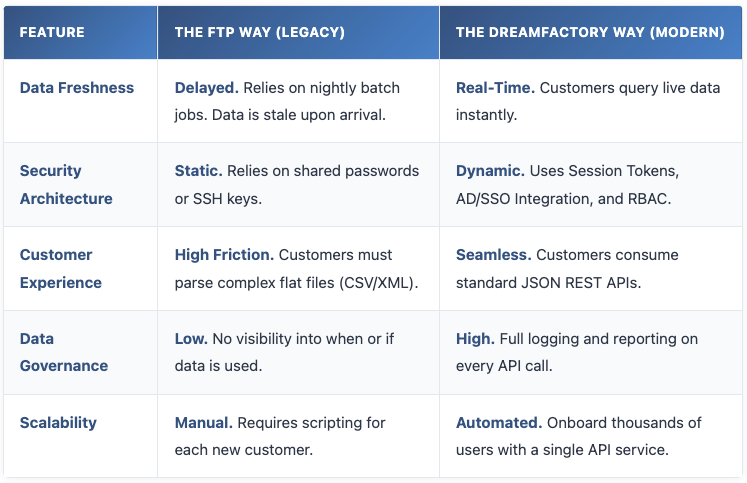
Comparison: FTP vs. DreamFactory API
For decision-makers comparing legacy methods against modern digital strategy, here is the breakdown:
FAQs
A: No. DreamFactory is not a database; it is an API generation gateway. It sits on top of your existing data storage (SQL, NoSQL, or File Storage) and serves it securely. Your data remains where it is.
A: Yes. While SFTP encrypts the transfer, managing the credentials is the weak link. DreamFactory enables granular control down to the specific row or column level. You can prevent a user from seeing sensitive fields (like PII) completely, which is impossible with a standard file dump.
A: Yes. DreamFactory supports database pagination and server-side filtering, allowing customers to pull large datasets efficiently in manageable chunks (pages) rather than downloading massive, unwieldy files.
A: Modern developers prefer APIs. By providing a DreamFactory-generated API, you also provide Swagger (OpenAPI) documentation. This allows your customers to integrate your data into their applications in minutes, not days.
Conclusion
The transition from FTP to API is a critical step in digital transformation. It signals to your market that you are a modern, secure, and customer-centric partner.
DreamFactory makes this transition seamless, handling the complexity of security, authentication, and API generation so you can focus on your data.
Stop managing files. Start managing connections.