Blog
Blog

 January 27, 2025
Looking to simplify automation and API integration? Here's how OpenAI's Operator, internal APIs, and DreamFactory work together to transform workflows:
- OpenAI's Operator: Uses AI to handle web tasks like bookings and submissions without relying on specialized APIs. It excels at consumer-facing tasks but struggles with highly complex systems.
- Internal APIs: Provide secure, scalable data handling and integration across systems. They're essential for compliance and managing sensitive data.
- DreamFactory: Automates API creation from existing databases with strong security features like RBAC and OAuth, simplifying integration for businesses.
Quick Comparison:
| Solution | Key Strengths | Challenges |
|---|---|---|
| OpenAI's Operator | Automates web tasks with human-like AI | Limited to U.S. users, struggles with complex tasks |
| Internal APIs | Secure and scalable data integration | Requires ongoing maintenance and resources |
| DreamFactory | Speeds up API creation with robust security | Initial setup can be complex, needs expertise |
Combine these tools to create efficient, secure, and scalable systems for modern automation and integration. Keep reading to learn how these technologies complement each other.
Operator: OpenAI's First AI Agent
1. OpenAI's Operator
OpenAI's Operator is reshaping task automation by using advanced AI models like the Computer-Using Agent (CUA) model and GPT-4o. Unlike traditional tools, this AI agent can independently navigate web interfaces and perform tasks without needing specialized APIs. This signals a major change in how automation tools interact with software.
Operator's performance varies depending on the task. It achieves an 87% success rate on routine web tasks (WebVoyager). However, its success drops to 58.1% for more complex tasks (WebArena) and 38.1% for operating system tasks (OSWorld).
"AI is evolving from this tool that could answer your questions to one that is also able to take action in the world, carrying out complex, multistep workflows"
The system is particularly effective for automating tasks like consumer interactions, data handling, and filling out detailed forms. To maintain security and reliability, Operator includes features like task monitoring, a takeover mode, and threat detection.
"Operator employs tools that seek to limit the model's susceptibility to malicious prompts, hidden instructions, and phishing attempts"
Transparency is a key focus, allowing users to oversee and, if needed, override its actions. Currently, Operator is available to U.S. users across ChatGPT's subscription tiers. However, it struggles with highly complex interfaces and specialized tasks.
While Operator introduces a new way for AI to interact with software, its challenges highlight the ongoing value of traditional APIs for handling complex and secure workflows. Balancing these cutting-edge AI capabilities with proven API systems is essential for robust automation solutions.
2. Internal APIs
According to RapidAPI's 2020-2021 Developer Survey, 75% of developers actively work on internal APIs, showing how important they are for modern organizations.
Internal APIs help businesses work smarter across industries. For example, Estonia's X-Road platform saved 2.8 million person-hours in 2014 by streamlining government data sharing. Companies like The Guardian and Evernote also rely heavily on internal API traffic, with internal usage surpassing external traffic by ratios of 6-7:1 and 99:1, respectively.
| Aspect | Internal API Benefits |
|---|---|
| Security | Better authentication, authorization, and encrypted data transfer |
| Integration | Smooth data sharing between systems like CRM and sales tools |
| Scalability | Handles large data loads and adapts to growing business needs |
| Compliance | Centralized control for monitoring and managing data access |
Internal APIs prioritize data security with features like multi-factor authentication, OAuth tokens, HTTPS, and detailed access controls. These APIs also break down organizational silos, making it easier for developers to connect and use different backend systems.
They play a key role in supporting AI tools like Operator by ensuring they work within secure and standardized frameworks. While AI agents like Operator are gaining traction, internal APIs remain essential for maintaining data consistency, meeting compliance requirements, and enabling enterprise-grade automation.
Tools like DreamFactory further simplify the process of creating APIs, boosting integration and automation efforts for businesses even more.
3. DreamFactory (API Generation Platform)
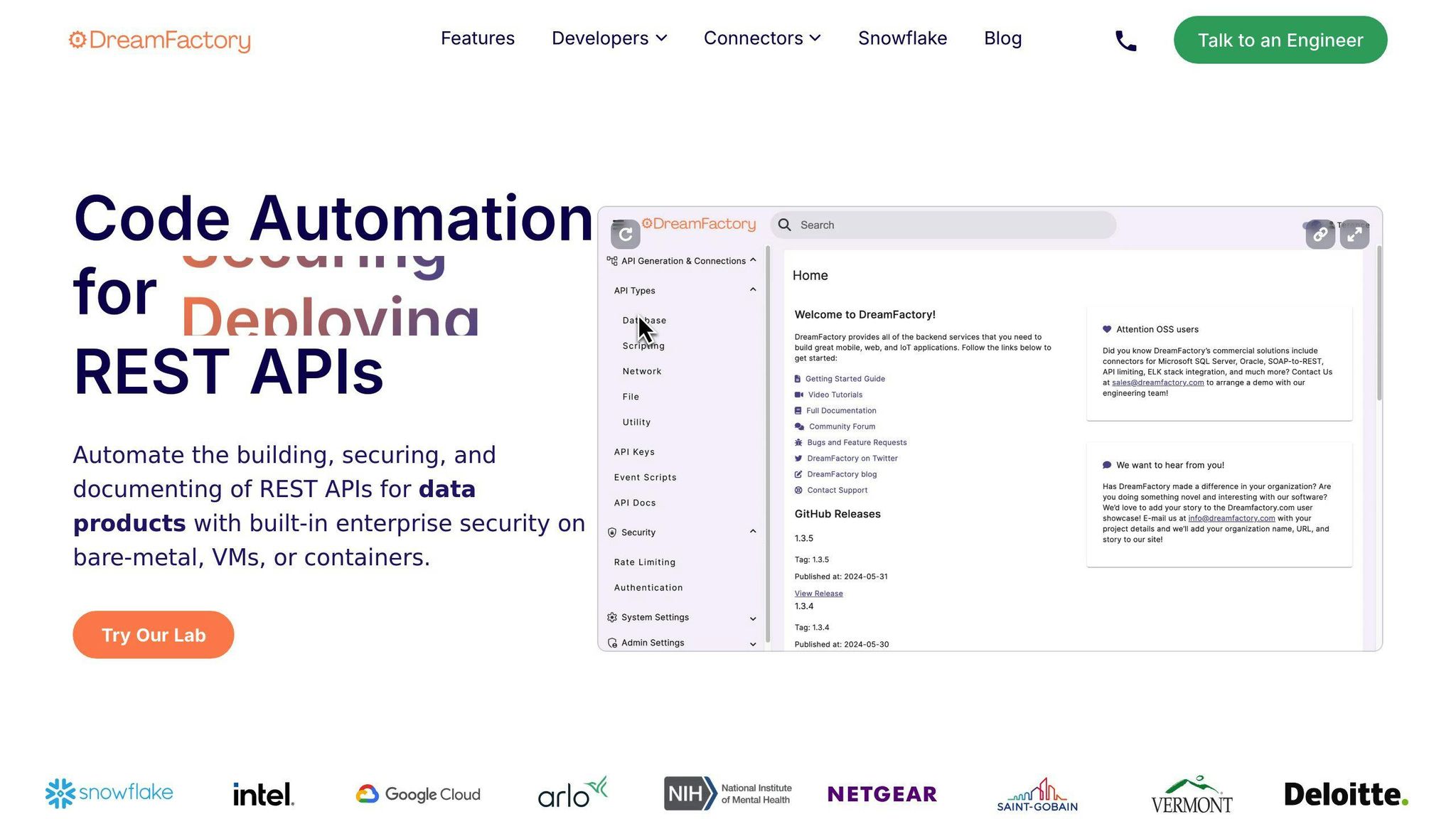
DreamFactory simplifies API creation with automated tools that help integrate internal systems and support AI-driven processes. It specializes in generating REST APIs from existing databases and data sources, offering compatibility with over 20 enterprise-grade connectors.
| Security Feature | Implementation |
|---|---|
| Access Control & Authentication | Role-based permissions, API key management, OAuth integration |
| Data Protection | End-to-end encryption, secure data transfer |
| Compliance Management | Tools to meet regulatory standards like GDPR and HIPAA |
Built for scalability and performance, DreamFactory is a great fit for large-scale enterprise use. It supports multiple programming languages for server-side scripting, allowing developers to adjust API behavior while maintaining consistency.
One standout feature is its auto-generated Swagger documentation. This makes integration between existing APIs and AI tools like Operator straightforward by providing clear, machine-readable endpoint details. The documentation helps bridge traditional APIs with modern automated systems.
DreamFactory also works across various deployment environments and includes built-in logging for detailed insights into API usage. For organizations moving toward AI-driven workflows, it offers a secure and standardized way to manage and scale API creation without limits.
Advantages and Disadvantages
Here's a breakdown of the strengths and challenges of each solution to help organizations make informed choices:
| Solution | Advantages | Disadvantages |
|---|---|---|
| OpenAI's Operator | • Handles complex web tasks with human-like interactions • Self-corrects and includes a takeover mode for sensitive tasks • Combines vision capabilities with advanced reasoning |
• Available only to U.S. Pro users • Struggles with complex interfaces that need detailed oversight • Limited compatibility with older systems • Scores under 10% on key tasks in risk assessment |
| Internal APIs | • Strong security and compliance features • Reliable data integration and consistency • Simplifies internal workflows • Highly scalable for growing needs |
• Requires substantial development resources • Needs continuous maintenance • Difficult to adjust for evolving demands • Frequent updates may be needed for compatibility |
| DreamFactory | • Quickly generates APIs from existing databases • Includes robust security features like RBAC and OAuth • Supports 20+ enterprise connectors • Auto-generates Swagger documentation |
• Custom pricing for the commercial version • Initial setup can be complex • Steep learning curve for advanced capabilities • Requires technical expertise for custom implementations |
A smart strategy is to combine these solutions to maximize their benefits while addressing their limitations. For example, Operator can handle external-facing tasks, internal APIs can secure data processing, and DreamFactory can speed up API creation for new integrations.
Imagine a scenario where customer interactions are processed: Operator manages front-end engagement, internal APIs ensure secure handling of sensitive data, and DreamFactory enables quick API development for new integration needs. This balanced approach not only ensures efficiency but also provides flexibility and security for future task management.
Conclusion
The combination of OpenAI's Operator, internal APIs, and platforms for generating APIs marks a shift in how automation and integration are handled. Operator's ability to mimic human interactions with software opens up new automation opportunities. At the same time, internal APIs provide the secure and scalable backbone needed for reliable data management. Platforms like DreamFactory step in to simplify and speed up API creation without compromising security.
This trio of tools brings several advantages:
- Operator simplifies complex web tasks, cutting down on development time.
- Internal APIs offer secure and scalable data handling.
- DreamFactory streamlines API creation while adhering to enterprise security standards.
Together, these technologies form a robust system for modern automation. While Operator has its limitations, advancements in AI and API tools are paving the way for more secure and intricate workflows. Businesses should aim to build ecosystems where these technologies work together seamlessly.
The real value comes from combining these tools to create systems that are efficient, secure, and scalable. With OpenAI continuously improving Operator and expanding its availability across different user tiers, the future holds even more advanced integrations between AI-driven tools and traditional API frameworks.
Related Blog Posts