Blog
Blog
 February 11, 2026
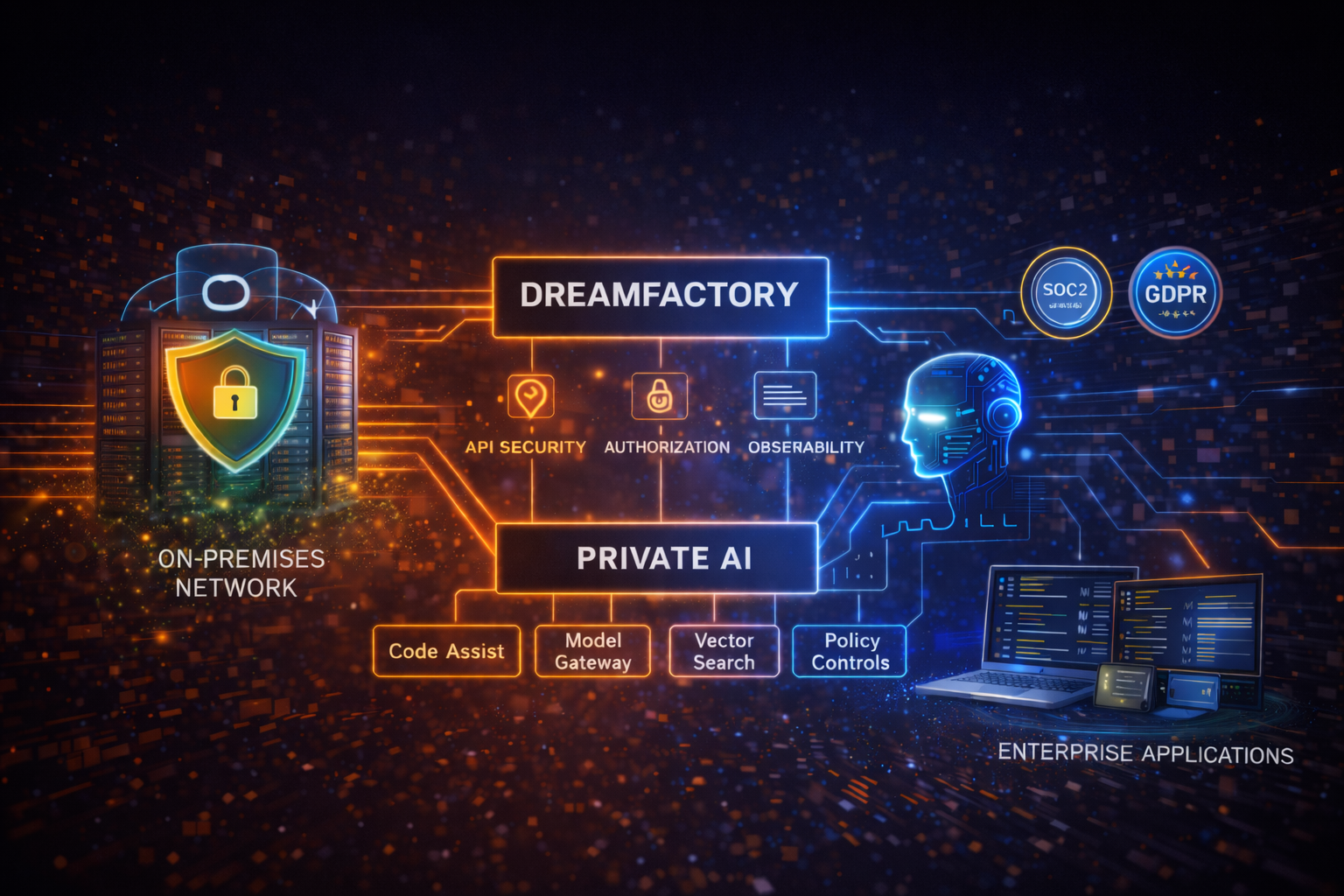
This guide explains how enterprises can replace cloud-hosted AI developer tools with secure, on-prem alternatives. It covers architectures, governance, and selection criteria that meet compliance and performance goals. You will learn how teams stand up private code assistants, model gateways, vector search, and policy controls behind the firewall. Throughout, we highlight how DreamFactory provides a secure API fabric, unifying data and AI services, enforcing authentication, authorization, and observability that enterprises require for scale and audit readiness.
What are on-prem enterprise alternatives to cloud-hosted AI dev tools?
On-prem alternatives are self-managed platforms that deliver AI coding assistance, model serving, embeddings, retrieval, and evaluation inside your network. These solutions replace hosted assistants with private inference endpoints, secured vector indexes, and governed pipelines tied to enterprise identity. The missing piece for most teams is a secure API orchestration layer that standardizes access to models and data.
DreamFactory is a secure, self-hosted enterprise data access platform that provides governed API access to any data source, connecting enterprise applications and on-prem LLMs with role-based access and identity passthrough. It auto-generates REST APIs for systems of record and applies consistent policies across services. The result is a controllable stack that preserves developer velocity while satisfying data residency, least-privilege, and audit requirements across teams.
Why on-prem AI dev tooling matters in 2026
Enterprises face stricter data residency rules, vendor concentration risk, and model sprawl across business units. On-prem deployments reduce exposure by keeping prompts, code, and telemetry inside controlled environments. Teams need fast iteration without moving regulated data or secrets to external endpoints. DreamFactory addresses this need by providing secure, versioned APIs with role-based access tied to enterprise identity, rate policies, and request logging. This gives platform teams a repeatable path to ship AI capabilities, measure usage, and enforce guardrails across projects and service owners.
Common challenges in on-prem AI enablement and how platforms solve them
Standing up private AI tools introduces complexity across identity, networking, and lifecycle management. Security teams must enforce least-privilege and auditing across heterogeneous components. Developers expect low-latency endpoints, consistent SDKs, and clear error handling. Platform teams need a governed way to expose models and data sources without writing bespoke gateways for every product. DreamFactory reduces friction by auto-generating secure APIs for databases, normalizing access to AI services, and centralizing auth, quotas, transforms, and observability through a consistent policy plane.
Key problems encountered
- Identity fragmentation across model servers, vector stores, and tools
- Data access risk from direct database connections in notebooks
- Limited auditability of prompts, corpus, and outputs at scale
- Environment drift between dev, staging, and production clusters
- Inconsistent rate limits and cost controls across teams
- Vendor lock-in and opaque usage for budgeting and chargebacks
Platforms address these by centralizing identity, standardizing APIs, and instrumenting requests for analytics and policy. DreamFactory adds value with role-based access, API key rotation, request-level scripting for redaction and validation, and per-endpoint limits. This reduces custom glue code, improves incident response, and accelerates service onboarding without weakening controls or creating brittle pathways.
What to look for in a platform for on-prem AI developer tooling
Choose platforms that treat security, operability, and data gravity as first-class concerns. Prioritize identity federation, policy enforcement, and comprehensive logging. Seek consistent APIs, portable deployment options, and integration patterns that avoid tight coupling. DreamFactory helps by providing a centralized API layer that abstracts backends, supports advanced authentication flows, and offers request transformations. This lets teams expose AI and data services safely, reuse policies, and keep developers productive while meeting architectural standards and review processes across multiple business units.
Must-have capabilities for enterprise-grade stacks
- Federated authentication with fine-grained authorization
- Policy engine for rate limits, quotas, and payload validation
- Data access virtualization with audited, read-only paths
- Request and response transforms for redaction and enrichment
- Environment promotion with versioned API definitions
- Full observability with structured logs and metrics
- Portable deployment across virtual machines and containers
DreamFactory delivers these through auto-generated APIs for data sources, role-based access mapped to enterprise identity, request scripting for governance, and consistent observability. Platform teams can standardize controls once, then apply them across projects. This reduces bespoke gateways, shortens security reviews, and preserves developer ergonomics. The result is a maintainable foundation that scales with additional models, tools, and line-of-business applications without fragmenting policies or duplicating integration work.
How enterprises deploy on-prem AI tooling using governed platforms
Enterprises typically begin with a minimal stack that serves code-assist functionality privately, then expand into retrieval, agents, and evaluation pipelines. DreamFactory acts as the contract between developers and backends, simplifying adoption across teams with consistent interfaces. By aligning identity, policy, and observability at the API layer, organizations can scale without rearchitecting. Below are practical strategies that customers apply to move quickly while satisfying governance, performance, and cost visibility expectations for internal stakeholders and security reviewers.
- Bootstrap a private inference gateway: DreamFactory fronts model endpoints with unified auth.
- Secure retrieval augmentation: Expose read-only APIs for knowledge bases with auditing.
- Standardize embeddings: Offer consistent endpoints with quotas and payload validation.
- Normalize vector search: Provide parameterized queries with access checks per index.
- Govern agents and tools: Enforce tool catalogs via API scopes and request transforms.
- Productionize evaluation: Log prompt and output metadata through structured API events.
Taken together, the platform reduces integration drift and scales governance through configuration. DreamFactory’s scripting, policy, and auto-generated data APIs remove repeated boilerplate, accelerating secure exposure of services. Teams gain stable endpoints, consistent error semantics, and shared telemetry that supports incident analysis. This enables a predictable path from experiment to production, while preserving the option to swap or add models without refactoring every dependent application or violating established review processes.

Best practices and expert tips for secure on-prem AI enablement
Effective programs pair a pragmatic platform baseline with iterative controls. Start with identity, data boundaries, and observability, then layer advanced policies like redaction and content validation. DreamFactory customers succeed by codifying APIs as versioned artifacts, keeping human-in-the-loop review for sensitive workflows, and integrating platform telemetry with security operations. The following practices help teams move from prototypes to production without sacrificing guardrails, change management, or cross-team reliability in shared environments.
- Treat data sources as APIs, never as direct connections in notebooks
- Use least-privilege roles at the endpoint, not only at the database
- Enforce quotas per team and per application for predictability
- Validate and redact prompts at the edge using request scripting
- Keep model-agnostic interfaces to swap backends without rewrites
- Promote through environments with automated policy tests and checks
Advantages and benefits of governed on-prem AI platforms
Well-designed on-prem stacks improve control, predictability, and portability. Platform teams gain consistent security reviews and faster approvals because controls are centralized and testable. Developers gain ergonomic, documented endpoints and stable SLAs, which reduces breakage. DreamFactory contributes by unifying data access and AI services behind authenticated, rate-limited, and observable APIs. This lowers integration effort, shortens incident timelines, and supports budgeting through transparent usage, while maintaining architectural standards that scale with additional models and applications across teams.
- Stronger data residency and regulatory alignment within enterprise controls
- Reduced integration time by standardizing common API patterns
- Improved reliability through consistent error handling and observability
- Predictable costs using quotas and per-application limits
- Portability across infrastructure with containerized deployments
How DreamFactory simplifies enterprise on-prem AI toolchains
DreamFactory provides a secure API fabric that abstracts databases, files, and AI services behind a consistent interface. It auto-generates REST APIs for data sources, applies role-based access, and supports request transforms for redaction, validation, and enrichment. Platform teams configure rate limits, quotas, and keys centrally, then expose endpoints to development teams with consistent documentation. With versioned API definitions and environment promotion, organizations scale safely from pilot to production, keep sensitive data in place, and reduce custom middleware that is costly to build and maintain.
The future of on-prem AI development and next steps
On-prem AI will increasingly resemble a mesh of model endpoints, governed data access, and shared policies managed as code. Teams will focus on portability and evaluation, ensuring outputs meet internal standards before broad rollout. Establishing a unified API layer is a durable investment that supports this direction. DreamFactory helps by giving enterprises a consistent, governed fabric for data and AI services. To move forward, define your minimal stack, codify policies, and pilot with one team. Contact our team to discuss architecture patterns and deployment options.
FAQs
What are on-prem AI developer platforms?
On-prem AI developer platforms are self-managed systems that deliver model inference, retrieval, and tooling within enterprise networks. They include model serving, embeddings, vector search, and governance. DreamFactory complements these platforms by providing a secure API layer that standardizes access to data and AI services, enforces role-based access, and captures detailed logs for audit and incident response. Together, they enable private assistants and intelligent applications while keeping code, prompts, and metadata under the organization’s control for compliance and operational reliability.
Why do enterprises need platforms for on-prem AI development?
Enterprises need platforms to reduce data exposure, satisfy regulatory requirements, and create consistent developer experiences across teams. Centralized identity, policy enforcement, and observability are difficult to implement project by project. DreamFactory streamlines this by auto-generating secure APIs for enterprise data, applying request transforms for validation and redaction, and managing quotas at the edge. This improves predictability for budgeting and performance, while enabling faster approvals through reusable controls that architects and security reviewers can evaluate and trust across deployments.
What are the best tools for building on-prem AI dev stacks?
The best stacks combine private model serving, vector search, and governed data access with a unifying API layer. Look for identity federation, policy controls, and strong observability. DreamFactory provides the API fabric that standardizes how teams consume backends, adds role-based access and rate limits, and captures request metadata for audits. This reduces custom glue code and shortens time to production. The approach lets organizations swap or add models without rewriting clients, keeping development velocity high and governance consistent across projects and environments.
How does DreamFactory integrate with existing enterprise systems?
DreamFactory connects to common enterprise data sources, identity providers, and logging destinations through configurable adapters. It auto-generates REST APIs for databases and files, maps roles to enterprise groups, and forwards structured logs to chosen observability systems. Request scripting enables redaction and validation at the edge, while quotas and rate policies shape traffic predictably. This lets teams introduce AI services without bypassing standards for access, monitoring, or cost control, and avoids the need to build and maintain one-off gateways for each new backend or model.
Related reading