Blog
Blog
 January 23, 2026
Executive Summary
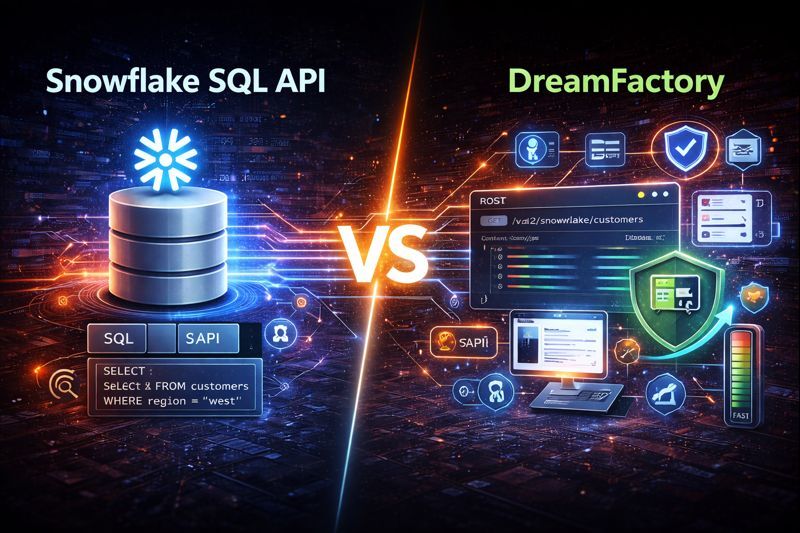
Organizations using Snowflake as their cloud data warehouse face a critical decision when exposing data to applications: use Snowflake's native SQL API or deploy a dedicated API platform like DreamFactory. While Snowflake's SQL API provides basic programmatic access to your data warehouse, DreamFactory delivers a complete API management solution with automatic REST endpoint generation, enterprise security controls, multi-database support, and zero coding requirements. This comparison examines both approaches and demonstrates why DreamFactory provides superior value for teams serious about building production-ready data APIs.

Understanding the Two Approaches
Snowflake SQL API: Basic Programmatic Access
Snowflake's SQL API is a REST interface that allows applications to execute SQL statements against Snowflake warehouses. Released to provide an alternative to JDBC/ODBC connections, it enables HTTP-based query execution with JSON responses.
What Snowflake SQL API Does:
- Accepts SQL statements via HTTP POST requests
- Returns query results as JSON
- Supports asynchronous query execution
- Provides statement status checking and cancellation
What Snowflake SQL API Requires:
- Writing and managing SQL queries in application code
- Custom authentication handling (OAuth or key-pair)
- Building your own response transformation layer
- Implementing pagination, error handling, and retry logic
- Creating documentation manually
- Developing security controls from scratch
DreamFactory: Complete API Platform for Snowflake
DreamFactory is a dedicated API generation and management platform that connects to Snowflake (and 20+ other databases) to automatically create fully-documented REST APIs without writing code. It provides enterprise-grade features out of the box that would take months to build manually.
What DreamFactory Delivers:
- Automatic REST endpoint generation for all tables and views
- Interactive API documentation (OpenAPI/Swagger)
- Built-in authentication and API key management
- Role-based access control with field-level security
- Request/response transformation via scripting
- Caching, rate limiting, and usage analytics
- Multi-database aggregation in a single API layer
Feature Comparison: DreamFactory Wins on Every Enterprise Requirement
|
Capability |
Snowflake SQL API |
DreamFactory |
|---|---|---|
|
API Generation |
Manual SQL writing required | Automatic from schema Winner |
|
REST Endpoints |
Single endpoint for all queries | Dedicated endpoints per resource Winner |
|
Documentation |
None provided | Auto-generated OpenAPI/Swagger Winner |
|
Authentication |
OAuth/Key-pair only | API keys, OAuth, LDAP, SAML, JWT Winner |
|
Authorization |
Snowflake roles only | Granular role-based access control Winner |
|
Field-Level Security |
Not available | Full support Winner |
|
Row-Level Filtering |
Manual WHERE clauses | Declarative server-side filters Winner |
|
Response Transformation |
Build your own | Built-in scripting (PHP, Python, Node.js) Winner |
|
Caching |
Not available | Configurable response caching Winner |
|
Rate Limiting |
Not available | Built-in per-role limits Winner |
|
Multi-Database Support |
Snowflake only | 20+ databases in unified API Winner |
|
Stored Procedure Support |
Via SQL execution | Dedicated REST endpoints Winner |
|
Setup Time |
Weeks to months | Minutes to hours Winner |
Why DreamFactory is the Superior Choice
1. Zero-Code API Generation Eliminates Development Bottlenecks
With Snowflake SQL API, every data access pattern requires custom development:
// Snowflake SQL API: Manual approach for every query
const response = await fetch('https://account.snowflakecomputing.com/api/v2/statements', {
    method: 'POST',
    headers: {
        'Authorization': `Bearer ${token}`,
        'Content-Type': 'application/json',
        'X-Snowflake-Authorization-Token-Type': 'OAUTH'
    },
    body: JSON.stringify({
        statement: 'SELECT customer_id, name, email FROM customers WHERE region = ?',
        bindings: { '1': { type: 'TEXT', value: region } },
        warehouse: 'COMPUTE_WH',
        database: 'PROD_DB',
        schema: 'PUBLIC'
    })
});

// Then handle async polling, pagination, error handling...
With DreamFactory, the same access is immediate after connection:
# DreamFactory: Ready-to-use endpoint, no coding required
curl "https://api.example.com/api/v2/snowflake/_table/customers?filter=region=northeast" \
-H "X-DreamFactory-API-Key: your-api-key"2. Enterprise Security That Snowflake SQL API Cannot Match
Snowflake SQL API relies entirely on Snowflake's native role system, which lacks the granular controls enterprise applications require:
Snowflake SQL API Security Limitations:
- No field-level masking at the API layer
- No server-side row filtering based on API consumer
- No API key management for third-party access
- No rate limiting to prevent abuse
- No usage tracking per consumer
DreamFactory Security Features:
- API Key Management: Generate, rotate, and revoke keys without touching Snowflake
- Role-Based Access Control: Define exactly which endpoints, methods, and fields each role can access
- Field-Level Security: Hide sensitive columns (SSN, salary, internal IDs) from specific roles
- Server-Side Filters: Automatically append WHERE clauses so users only see their own data
- Rate Limiting: Protect your Snowflake warehouse from runaway queries
- Audit Logging: Track every API call for compliance
# DreamFactory role configuration example
role: partner_api_access
  services:
    snowflake_prod:
      tables:
        customers:
          verbs: [GET]  # Read-only
          fields:
            allowed: [customer_id, name, company, region]
            hidden: [email, phone, internal_score]  # PII masked
          filters:
            - field: partner_id
              operator: '='
value: '{user.partner_id}' # Row-level security3. Production-Ready Documentation Out of the Box
Snowflake SQL API provides no documentation tooling. Every consumer needs custom onboarding, and your team manually maintains API specs.
DreamFactory automatically generates interactive OpenAPI (Swagger) documentation for every endpoint:
- Try-it-now functionality in the documentation UI
- Request/response schemas for every endpoint
- Authentication examples pre-configured
- Downloadable OpenAPI specs for client generation
- Automatic updates when schema changes
4. Multi-Database Aggregation Snowflake Cannot Provide
Real-world applications rarely use a single data source. Snowflake SQL API locks you into Snowflake-only architectures, but your data lives across:
- Snowflake (analytics warehouse)
- PostgreSQL or MySQL (operational database)
- MongoDB (document storage)
- Salesforce or HubSpot (CRM data)
- Legacy systems (Oracle, SQL Server)
DreamFactory connects to all of these simultaneously, providing:
- Unified authentication across all data sources
- Consistent REST conventions regardless of backend
- Cross-database scripting to join and transform data
- Single API gateway for all data access
// DreamFactory post-process script: Enrich Snowflake data with CRM info
const snowflakeCustomers = event.response.content.resource;

// Fetch related data from Salesforce
const accountIds = snowflakeCustomers.map(c => c.salesforce_id);
const sfAccounts = await platform.api.get(
    `salesforce/_table/Account?filter=Id IN (${accountIds.join(',')})`
);

// Merge the data
event.response.content.resource = snowflakeCustomers.map(customer => ({
    ...customer,
    account_owner: sfAccounts.find(a => a.Id === customer.salesforce_id)?.Owner_Name,
    last_activity: sfAccounts.find(a => a.Id === customer.salesforce_id)?.Last_Activity_Date
}));5. Response Transformation Without Custom Middleware
Snowflake SQL API returns raw query results. Any transformation—field renaming, data masking, computed fields, format conversion—requires custom code between Snowflake and your consumers.
DreamFactory's scripting engine handles transformations at the API layer:
<?php
// DreamFactory script: Transform Snowflake response for mobile app
$records = $event['response']['content']['resource'];

foreach ($records as &$record) {
    // Rename fields for mobile-friendly format
    $record['id'] = $record['CUSTOMER_ID'];
    $record['displayName'] = $record['FIRST_NAME'] . ' ' . $record['LAST_NAME'];

    // Compute derived fields
    $record['accountAge'] = (new DateTime())->diff(
        new DateTime($record['CREATED_AT'])
    )->days;

    // Format currency for display
    $record['formattedBalance'] = '$' . number_format($record['BALANCE'], 2);

    // Remove internal fields
    unset($record['CUSTOMER_ID'], $record['FIRST_NAME'], $record['LAST_NAME']);
    unset($record['INTERNAL_SCORE'], $record['CREATED_AT'], $record['BALANCE']);
}

$event['response']['content']['resource'] = $records;6. Caching That Protects Your Snowflake Costs
Every Snowflake SQL API call executes a query against your warehouse, consuming credits. Repeated requests for the same data waste money and increase latency.
DreamFactory provides built-in response caching:
- Configurable TTL per endpoint
- Cache invalidation on data changes
- Memory or Redis backend support
- Cache bypass for real-time requirements
# Cache configuration example
Service: snowflake_analytics
  Cache: enabled
  Cache TTL: 300 seconds
  Cache storage: redis

  Endpoints with longer TTL:
    /products: 3600 seconds (reference data)
/regions: 86400 seconds (static lookups)7. Stored Procedure Support as First-Class Endpoints
Snowflake stored procedures contain valuable business logic, but Snowflake SQL API requires wrapping CALL statements in raw SQL execution:
// Snowflake SQL API: Clunky procedure execution
const response = await fetch(sqlApiEndpoint, {
    method: 'POST',
    body: JSON.stringify({
        statement: "CALL calculate_customer_ltv(:customer_id)",
        bindings: { 'customer_id': { type: 'TEXT', value: '12345' } }
    })
});
DreamFactory exposes stored procedures as dedicated REST endpoints:
# DreamFactory: Clean, RESTful procedure call
curl -X POST "https://api.example.com/api/v2/snowflake/_proc/calculate_customer_ltv" \
  -H "X-DreamFactory-API-Key: your-api-key" \
-d '{"customer_id": "12345"}'When Snowflake SQL API Makes Sense
To be fair, Snowflake SQL API has legitimate use cases:
- Internal tooling where security requirements are minimal
- Data science notebooks executing ad-hoc queries
- ETL pipelines where you control both ends
- Proof-of-concept projects before production requirements emerge
However, these scenarios share a common trait: they don't require production-grade API management.
When DreamFactory is the Clear Choice
Choose DreamFactory when you need:
- External API exposure to partners, customers, or third-party applications
- Multiple data sources unified under one API layer
- Enterprise security with granular access control
- Self-service documentation for API consumers
- Cost optimization through intelligent caching
- Rapid delivery without custom development cycles
- Compliance requirements with audit logging and data governance

Total Cost of Ownership: The Hidden Expense of DIY
Building equivalent functionality to DreamFactory using Snowflake SQL API requires:
| Component | DIY Development Estimate |
|---|---|
| REST endpoint framework | 2-4 weeks |
| Authentication/authorization | 2-3 weeks |
| API documentation generation | 1-2 weeks |
| Caching layer | 1-2 weeks |
| Rate limiting | 1 week |
| Logging and monitoring | 1-2 weeks |
| Error handling and retry logic | 1 week |
| Multi-database support | 4-8 weeks |
| Ongoing maintenance | 20-40% of development time annually |
| Estimated Total | 3-6 months of development |
DreamFactory delivers all of this out of the box, with deployment measured in hours, not months.
Migration Path: From SQL API to DreamFactory
Already using Snowflake SQL API? Migration is straightforward:
- Connect DreamFactory to Snowflake using existing credentials
- Auto-generate endpoints for required tables and procedures
- Configure security roles matching current access patterns
- Add caching and transformations as needed
- Update client applications to use new endpoints
- Deprecate custom SQL API code once validated
Most organizations complete migration in days, immediately benefiting from DreamFactory's enhanced capabilities.
Conclusion: DreamFactory Delivers What Snowflake SQL API Cannot
Snowflake SQL API is a low-level interface for programmatic query execution. It's a building block, not a solution.
DreamFactory is a complete API platform that transforms Snowflake (and your entire data ecosystem) into production-ready REST APIs with enterprise security, documentation, caching, and multi-database support—without writing code.
The choice is clear:
- If you want to build and maintain custom API infrastructure, use Snowflake SQL API
- If you want to ship secure, documented, production-ready APIs immediately, use DreamFactory
For organizations serious about data products, API-first architecture, or efficient development practices, DreamFactory isn't just the better choice—it's the only choice that makes business sense.