---
title: Multi-Version API Management for AI Workflows | DreamFactory
description: Best practices for multi-version API management to keep AI workflows stable, secure, and backward-compatible.
image: https://blog.dreamfactory.com/hubfs/api-versioning-ai-workflows-blog-hero.png
---
[](https://www.dreamfactory.com/)
Products & Services
[AI Data Gateway](https://www.dreamfactory.com/ai-data-gateway/overview)
[Overview Why DreamFactory exists](https://www.dreamfactory.com/ai-data-gateway/overview) [Data Gov, Comp, Security Policy enforcement at the API layer](https://www.dreamfactory.com/ai-data-gateway/ai-data-governance) [Standard API Layer One contract for every backend](https://www.dreamfactory.com/ai-data-gateway/standard-api-layer) [API Gateway Functionality Routing, auth, rate limits, observability](https://www.dreamfactory.com/ai-data-gateway/api-gateway-functionality) [Deployment & Integration Self-hosted, cloud, hybrid](https://www.dreamfactory.com/ai-data-gateway/on-premise-deployment-and-integration) [Developer Productivity Auto-generated, never hand-coded](https://www.dreamfactory.com/ai-data-gateway/ai-development-accelerated) [AI App Architectures Patterns for RAG, agents, MCP](https://www.dreamfactory.com/ai-data-gateway/enterprise-ai-architectures)
AI Data Models
[AIOpenAI](https://www.dreamfactory.com/use-cases/openai) [GGoogle Gemini](https://www.dreamfactory.com/use-cases/google-gemini) [CAnthropic Claude](https://www.dreamfactory.com/use-cases/anthropic-claude-landing) [LMeta Llama](https://www.dreamfactory.com/use-cases/meta-llama) [MMistral AI](https://www.dreamfactory.com/use-cases/mistral) [CoCohere](https://www.dreamfactory.com/use-cases/cohere)
Services and support
[Quickstart Service Packages Expert-led Quickstarts to production](https://www.dreamfactory.com/services-and-support/quickstart-services-packages)
API Management
[Generate & Manage REST APIs From any database, in seconds](https://www.dreamfactory.com/api-management/generate-rest-apis) [Features Security, scripting, self-hosted & more](https://www.dreamfactory.com/api-management/features) [API Generation The complete guide to auto-generated APIs](https://blog.dreamfactory.com/a-complete-guide-to-api-generation) [API Management Concepts, tools, and best practises](https://blog.dreamfactory.com/what-is-api-management-a-brief-overview-of-api-management-concepts-and-tools?_gl=1*jl0njh*_gcl_au*MjQzMjgwMTc3LjE3ODIzMjI3MzY)
Use Cases
AI Use Cases
[AI Data Access Secure, governed reads for your LLMs](https://www.dreamfactory.com/use-cases/ai-data-access) [MCP Server Drop-in Model Context Protocol](https://www.dreamfactory.com/use-cases/mcp-server) [Legacy Modernization Wrap mainframes with REST](https://www.dreamfactory.com/use-cases/legacy-modernization) [Data Governance Audit every call, enforce every policy](https://www.dreamfactory.com/use-cases/data-governance)
[Customer Case Studies](https://www.dreamfactory.com/case-studies)
[Energy Modernization](https://www.dreamfactory.com/case-studies/energy-snowflake-modernization) [Government Modernization](https://www.dreamfactory.com/case-studies/government-mainframe-oracle-modernization) [Government Business Intelligence](https://www.dreamfactory.com/case-studies/government-sql-server-bi-analyst-queries) [Manufacturing Modernization](https://www.dreamfactory.com/case-studies/steel-manufacturing-sap-erp-modernization) [Financial Services Investor Portal](https://www.dreamfactory.com/case-studies/financial-services-sql-server-investor-portal) [Non-Profit Partner Data Sharing](https://www.dreamfactory.com/case-studies/non-profit-sql-server-partner-data-sharing) [Professional Services Exec Dashboards](https://www.dreamfactory.com/case-studies/professional-services-erp-dashboards) [Education HR and External Data Sharing](https://www.dreamfactory.com/case-studies/education-student-hr-sql-server-mysql-external-data-sharing)
Industries
Industries
#### [Healthcare HIPAA-grade APIs across EHR, claims, and labs.](https://www.dreamfactory.com/use-cases/healthcare)
#### [Financial Services Portfolios, partners, and portals on one layer.](https://www.dreamfactory.com/use-cases/financial-services)
#### [Government Modernize mainframes without re-platforming.](https://www.dreamfactory.com/use-cases/government)
#### [Manufacturing SAP, MES, and shop-floor data, governed.](https://www.dreamfactory.com/use-cases/manufacturing)
#### [Spotlight How enterprises run on DreamFactory From healthcare to energy to finance — governance baked into every endpoint. Browse case studies →](https://www.dreamfactory.com/case-studies)
Connectors
SQL Database
[SQL SQL Server](https://www.dreamfactory.com/connectors/sql-server) [OR Oracle](https://www.dreamfactory.com/connectors/oracle) [PG PostgreSQL](https://www.dreamfactory.com/connectors/postgresql) [My MySQL](https://www.dreamfactory.com/connectors/mysql)
NoSQL & Docs
[Dy DynamoDB](https://www.dreamfactory.com/connectors/dynamodb) [Do DocumentDB](https://www.dreamfactory.com/connectors/azure-documentdb) [Mo MongoDB](https://www.dreamfactory.com/connectors/mongodb) [Cb CouchDB](https://www.dreamfactory.com/connectors/couch-db)
Cloud Warehouses
[S3 S3](https://www.dreamfactory.com/connectors/amazon-s3) [Ab Azureblob](https://www.dreamfactory.com/connectors/azure-blob) [FS FTP/SFTP](https://www.dreamfactory.com/connectors/ftp-sftp) [LS Local Storage](https://www.dreamfactory.com/connectors/local-storage)
C & SaaS
[Sf Salesforce](https://www.dreamfactory.com/connectors/salesforce) [API REST / SOAP](https://www.dreamfactory.com/connectors/soap-to-rest)
[See all 30+ connectors](https://www.dreamfactory.com/connectors)
[Blog](https://blog.dreamfactory.com/)
[FREE 30 Minute Demo](https://www.dreamfactory.com/demo)
[](https://www.dreamfactory.com/)
 
Back to main menu
Products & Services
Use Cases
Industries
Connectors
[Blog](https://blog.dreamfactory.com/)
[FREE 30 Minute Demo](https://www.dreamfactory.com/demo)
[AI Data Gateway](https://www.dreamfactory.com/ai-data-gateway/overview)
[Overview Why DreamFactory exists](https://www.dreamfactory.com/ai-data-gateway/overview) [Data Gov, Comp, Security Policy enforcement at the API layer](https://www.dreamfactory.com/ai-data-gateway/ai-data-governance) [Standard API Layer One contract for every backend](https://www.dreamfactory.com/ai-data-gateway/standard-api-layer) [API Gateway Functionality Routing, auth, rate limits, observability](https://www.dreamfactory.com/ai-data-gateway/api-gateway-functionality) [Deployment & Integration Self-hosted, cloud, hybrid](https://www.dreamfactory.com/ai-data-gateway/on-premise-deployment-and-integration) [Developer Productivity Auto-generated, never hand-coded](https://www.dreamfactory.com/ai-data-gateway/ai-development-accelerated) [AI App Architectures Patterns for RAG, agents, MCP](https://www.dreamfactory.com/ai-data-gateway/enterprise-ai-architectures)
AI Data Models
[AIOpenAI](https://www.dreamfactory.com/use-cases/openai) [GGoogle Gemini](https://www.dreamfactory.com/use-cases/google-gemini) [CAnthropic Claude](https://www.dreamfactory.com/use-cases/anthropic-claude-landing) [LMeta Llama](https://www.dreamfactory.com/use-cases/meta-llama) [MMistral AI](https://www.dreamfactory.com/use-cases/mistral) [CoCohere](https://www.dreamfactory.com/use-cases/cohere)
Services and support
[Quickstart Service Packages Expert-led Quickstarts to production](https://www.dreamfactory.com/services-and-support/quickstart-services-packages)
AI Data Models
[Generate & Manage REST APIs From any database, in seconds](https://www.dreamfactory.com/api-management/generate-rest-apis) [Features Security, scripting, self-hosted & more](https://www.dreamfactory.com/api-management/features) [API Generation The complete guide to auto-generated APIs](https://blog.dreamfactory.com/a-complete-guide-to-api-generation) [API Management Concepts, tools, and best practises](https://blog.dreamfactory.com/what-is-api-management-a-brief-overview-of-api-management-concepts-and-tools?_gl=1*jl0njh*_gcl_au*MjQzMjgwMTc3LjE3ODIzMjI3MzY)
AI Use Cases
[AI Data Access Secure, governed reads for your LLMs](https://www.dreamfactory.com/use-cases/ai-data-access) [MCP Server Drop-in Model Context Protocol](https://www.dreamfactory.com/use-cases/mcp-server) [Legacy Modernization Wrap mainframes with REST](https://www.dreamfactory.com/use-cases/legacy-modernization) [Data Governance Audit every call, enforce every policy](https://www.dreamfactory.com/use-cases/data-governance)
[Customer Case Studies](https://www.dreamfactory.com/case-studies)
[Energy Modernization](https://www.dreamfactory.com/case-studies/energy-snowflake-modernization) [Government Modernization](https://www.dreamfactory.com/case-studies/government-mainframe-oracle-modernization) [Government Business Intelligence](https://www.dreamfactory.com/case-studies/government-sql-server-bi-analyst-queries) [Manufacturing Modernization](https://www.dreamfactory.com/case-studies/steel-manufacturing-sap-erp-modernization) [Financial Services Investor Portal](https://www.dreamfactory.com/case-studies/financial-services-sql-server-investor-portal) [Non-Profit Partner Data Sharing](https://www.dreamfactory.com/case-studies/non-profit-sql-server-partner-data-sharing) [Professional Services Exec Dashboards](https://www.dreamfactory.com/case-studies/professional-services-erp-dashboards) [Education HR and External Data Sharing](https://www.dreamfactory.com/case-studies/education-student-hr-sql-server-mysql-external-data-sharing)
Industries
#### [Healthcare HIPAA-grade APIs across EHR, claims, and labs.](https://www.dreamfactory.com/use-cases/healthcare)
#### [Financial Services Portfolios, partners, and portals on one layer.](https://www.dreamfactory.com/use-cases/financial-services)
#### [Government Modernize mainframes without re-platforming.](https://www.dreamfactory.com/use-cases/government)
#### [Manufacturing SAP, MES, and shop-floor data, governed.](https://www.dreamfactory.com/use-cases/manufacturing)
SQL Database
[SQL SQL Server](https://www.dreamfactory.com/connectors/sql-server) [OR Oracle](https://www.dreamfactory.com/connectors/oracle) [PG PostgreSQL](https://www.dreamfactory.com/connectors/postgresql) [My MySQL](https://www.dreamfactory.com/connectors/mysql)
NoSQL & Docs
[Dy DynamoDB](https://www.dreamfactory.com/connectors/dynamodb) [Do DocumentDB](https://www.dreamfactory.com/connectors/azure-documentdb) [Mo MongoDB](https://www.dreamfactory.com/connectors/mongodb) [Cb CouchDB](https://www.dreamfactory.com/connectors/couch-db)
Cloud Warehouses
[S3 S3](https://www.dreamfactory.com/connectors/amazon-s3) [Ab Azureblob](https://www.dreamfactory.com/connectors/azure-blob) [FS FTP/SFTP](https://www.dreamfactory.com/connectors/ftp-sftp) [LS Local Storage](https://www.dreamfactory.com/connectors/local-storage)
C & SaaS
[Sf Salesforce](https://www.dreamfactory.com/connectors/salesforce) [API REST / SOAP](https://www.dreamfactory.com/connectors/soap-to-rest)
[See all 30+ connectors](https://www.dreamfactory.com/connectors)
[ Blog](https://blog.dreamfactory.com/)
# Multi-Version API Management for AI Workflows | DreamFactory
by Kevin Hood
 May 5, 2026
Table of contents
RECOMMENDED ARTICLES
- [A Complete Guide to API Generation](https://blog.dreamfactory.com/a-complete-guide-to-api-generation)
- [10 Best API Management Tools](https://blog.dreamfactory.com/what-is-api-management-a-brief-overview-of-api-management-concepts-and-tools)
- [Creating a Microsoft SQL Server API in Less Than 5 minutes with DreamFactory](https://blog.dreamfactory.com/creating-a-microsoft-sql-server-api-in-less-than-5-minutes-with-dreamfactory)
- [Hasura vs. DreamFactory: A Comprehensive Comparison](https://blog.dreamfactory.com/hasura-vs-dreamfactory)
- [Build A Snowflake REST API in Less Than 5 Minutes](https://blog.dreamfactory.com/generate-a-snowflake-rest-api-in-less-than-5-minutes)
Last Updated: May 2026
Asking the right [questions when building an API](https://blog.dreamfactory.com/key-questions-to-ask-when-building-an-api/) for AI systems is critical, especially when updates risk breaking existing integrations. Here's the deal: **API versioning** ensures your AI workflows stay stable while introducing new features. By supporting multiple API versions, you can test updates, maintain compatibility, and avoid disruptions.
### Key Takeaways:
- **Why It Matters**: AI systems rely on APIs for data. Versioning prevents interruptions when APIs evolve.
- **Common Challenges**: Breaking changes, security risks, and managing multiple versions.
- **Versioning Methods**:
- URL Path (`/api/v1/`): Simple and visible.
- Header-Based (`API-Version: 2.0`): Clean but harder to manage.
- Query Parameters (`?version=2`): Flexible but less intuitive.
- **Backward Compatibility**: Keep older versions running during migrations to avoid breaking integrations.
- **Security**: Features like identity passthrough and audit logging protect sensitive data.
- **Tools**: Platforms like [DreamFactory](https://www.dreamfactory.com/) simplify API management with built-in versioning, scripting, and security.
By implementing smart versioning strategies, you can roll out updates without disrupting your AI workflows or compromising security.
## Managing API Versions: The API Lifecycle
## API Versioning Strategies for AI Workflows
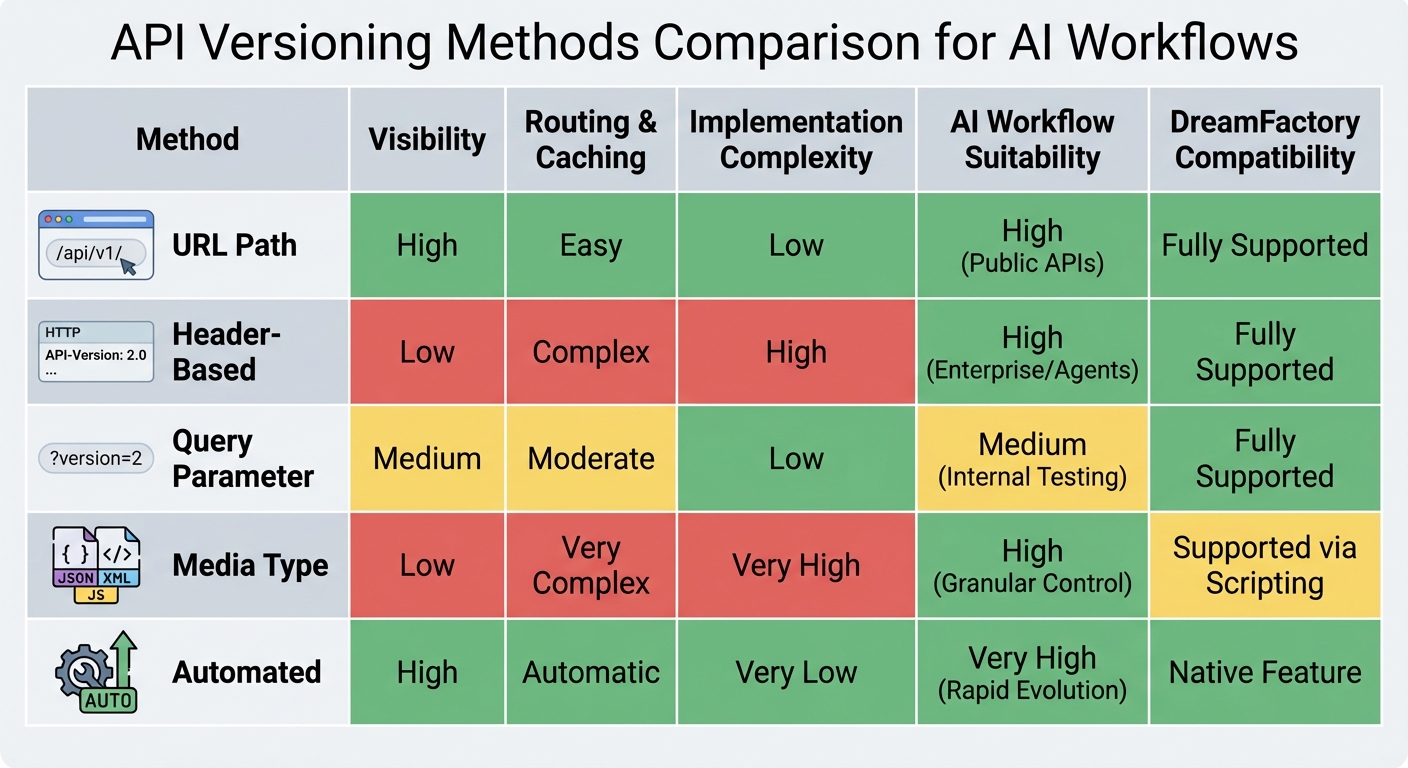
API Versioning Methods Comparison for AI Workflows
When deciding on an API versioning strategy, it's all about finding the right balance between keeping things clear, ensuring long-term usability, and adapting to the ever-changing demands of AI systems. Each approach has its own pros and cons, and the wrong choice can disrupt your workflows. Below, we’ll dive into specific methods and strategies to keep your AI workflows stable and efficient.
### [](https://blog.dreamfactory.com/hs/cta/wi/redirect?encryptedPayload=AVxigLL%2F%2FCkHqv41ZWwSWwevMmQwV3G4Ezh7Ss1L6jchhbM7NaUFSCIcCVw2i9WOH2uRZHQT6SkfHtBKrh7BJ0x61Swtj3ZwW6%2FcCOQ3Qs9eGVxdXGYao2R%2F15nbvJ2NXQXL9gQTFBRI%2F7xod1siYFBTg9iGMrFJJ%2Fm8UsGiEJNgm%2FXLoP2sfg%3D%3D&webInteractiveContentId=167690643360&portalId=44870387)
### API Versioning Methods
**URL path versioning** is a straightforward approach where the version number appears directly in the endpoint, such as `/api/v1/data` or `/api/v2/embeddings`. This method is highly visible and works seamlessly with CDNs by leveraging cache key management. It’s particularly well-suited for public-facing AI models or situations requiring simple routing. Plus, it’s easy to implement and troubleshoot.
**Header-based versioning** avoids cluttering URLs by including version details in HTTP headers, like `API-Version: 2.0`. This method is often favored in enterprise-level AI systems because it keeps URLs clean. However, managing caching becomes trickier, requiring the use of a `Vary: API-Version` header for proper handling.
**Query parameter versioning** involves appending the version as a parameter in the URL, such as `/api/data?version=2`. This method strikes a balance between visibility and flexibility, making it popular for internal testing scenarios where developers may need to switch versions frequently. That said, it can be less intuitive for external users and may cause confusion over whether the parameter is optional or mandatory.
Each of these methods has its place, but implementing them effectively ensures seamless integrations without causing disruptions.
### How to Maintain Backward Compatibility
Backward compatibility is key to keeping your integrations running smoothly. Focus on making changes that add functionality rather than altering or removing existing features. For example, you can introduce new fields, add optional parameters, or create entirely new endpoints - all without breaking existing setups.
Running parallel versions, like maintaining both `/v1` and `/v2` endpoints during a migration, is another effective strategy. Here’s why it matters: 47% of developers report abandoning an API after encountering just one unannounced breaking change. That’s a massive risk to your user base and reputation.
A real-world example comes from [IntegrationFlow](https://integrationflow.net/). In 2024, David Chen, the company’s API Platform Lead, shared how they transitioned from having no versioning strategy (which caused 89 integration failures in the first year) to adopting URL versioning alongside a 12-month deprecation policy. This change eliminated breaking change complaints over the next 18 months, while active integrations soared from 340 to 2,400. API-driven revenue followed suit, jumping from $340K to $1.2M.
**Semantic versioning** (Major.Minor.Patch) is another crucial tool for managing changes clearly. Use major version updates for breaking changes, minor versions for new features, and patches for bug fixes. This system provides clarity, helping AI teams assess the impact of updates before integrating them.
### Comparison Table: API Versioning Methods
Here’s a quick comparison of these versioning methods to help you decide which one aligns best with your AI workflow needs:
| Method | Visibility | Routing & Caching | Implementation Complexity | AI Workflow Suitability | DreamFactory Compatibility |
| --- | --- | --- | --- | --- | --- |
| **URL Path** | High | Easy | Low | High (Public APIs) | Fully Supported |
| **Header-Based** | Low | Complex | High | High (Enterprise/Agents) | Fully Supported |
| **Query Parameter** | Medium | Moderate | Low | Medium (Internal Testing) | Fully Supported |
| **Media Type** | Low | Very Complex | Very High | High (Granular Control) | Supported via Scripting |
| **Automated** | High | Automatic | Very Low | Very High (Rapid Evolution) | Native Feature |
The rise of **AI-assisted versioning** is worth noting. Emerging tools are now leveraging artificial intelligence to predict versioning requirements and automate compatibility testing across API iterations. This automation minimizes human error and speeds up release cycles - an essential advantage when AI models evolve at breakneck speeds, often weekly rather than quarterly.
## How [DreamFactory](https://www.dreamfactory.com/) Supports Multi-Version API Management
DreamFactory simplifies the process of turning databases into REST APIs, enabling AI systems to interact with data securely and efficiently. Instead of exposing complex database schemas, DreamFactory creates secure, versioned API endpoints. For example, older data formats might be accessed through `/api/v1/customers`, while newer, updated schemas are available at `/api/v2/customers`. This approach not only protects sensitive database structures but also speeds up integration efforts - enterprise analytics show a time reduction of 40–60% per version.
### REST API Abstraction and [OpenAPI](https://en.wikipedia.org/wiki/OpenAPI_Specification) Documentation
Every API version generated by DreamFactory is accompanied by **automatically created OpenAPI/[Swagger](https://swagger.io/) documentation**, tailored to the connected data sources and configurations. AI systems and programmatic clients can use discovery endpoints like `GET /api/v2/{service_name}/_spec` to explore available paths, parameters, and schemas before making calls. This automated documentation allows AI agents to self-discover API capabilities, minimizing errors in environments with multiple versions. For example, documentation for `v1` might outline deprecated fields, while `v2` focuses on responses optimized for AI use - all without requiring manual documentation.
> "DreamFactory's ability to display a comprehensive list of API endpoints is contingent upon availability of corresponding OpenAPI documentation. This documentation is automatically generated for the native connectors." - DreamFactory
DreamFactory’s documentation integrates seamlessly with various versioning methods, including URL path, header-based, query parameter, and media type approaches. This flexibility ensures compatibility with diverse AI workflows. Security remains a priority, with every version protected by role-based access control (RBAC), API key management, and identity passthrough, ensuring sensitive data is handled responsibly across all iterations. Developers can also leverage dynamic server-side scripting to manage data efficiently for each version.
### [](https://blog.dreamfactory.com/hs/cta/wi/redirect?encryptedPayload=AVxigLJ06K206ImwlA0y1clugKPNUzghFY7itLZEsAevdHMK95ANHBwHTA7jL30ZCO3pDFJupM9GjHnlANKPJXyd%2BKP56k%2BBAWVIl153NMCi2pL5BoRTtB0gkCy2fEI9l7dE9EBo9%2BkMr09zVJexZQWLvNUR05K%2ByZvv%2BBsT22P8AcxER4donimW46ap6jS%2FjeRKtIeY6Cd91xTZnDhSCeDQwunZ%2BRwsfTKeMQoT6X%2FKTghUAop3NBhZce%2FIKlVaxFR71nJOVxekGS6GaKaYmUHvVURtTwINgJYeBoe5ogWCvQ%3D%3D&webInteractiveContentId=211462711584&portalId=44870387)
### Server-Side Scripting for AI Workflows
DreamFactory’s **server-side scripting engine** supports Python (versions 2 and 3), Node.js, and PHP, enabling developers to perform version-specific data transformations without needing to re-version the entire API. These scripts can be executed at different stages, such as pre-process (validating AI inputs before they interact with the database) or post-process (adjusting responses to meet specific API requirements). For instance, a Python script on `/api/v2/patient-data` might transform flat `v1` records into nested structures better suited for tensor inputs, even adding computed fields like risk scores via lightweight machine learning models.
This scripting capability complements API abstraction, ensuring both legacy and modern data requirements are met. Scripts can access `platform.api` resources, allowing internal calls to other services or databases to enrich data for AI models without requiring external HTTP calls. While the default script execution timeout is set to 5 seconds, it can be extended for more complex AI tasks. For tasks like webhooks or audit logging that don’t need real-time responses, "queued" scripts can run asynchronously, avoiding delays in primary API responses.
### Deployment Options for Secure AI Integration
DreamFactory offers **on-premises, air-gapped, private cloud, edge, and hybrid deployment options**, ensuring enterprise data stays within secure infrastructure while exposing versioned APIs to AI systems. This flexibility is especially important for industries with strict data sovereignty requirements. Supported platforms include Linux, Windows Server, [Docker](https://www.docker.com/), and [Kubernetes](https://kubernetes.io/)/[Helm](https://helm.sh/), giving organizations full control over their data.
> "Deploy on Linux, Windows Server, Docker, Kubernetes/Helm, or Raspberry Pi - no vendor lock-in, no data leaves your infrastructure." - DreamFactory Docs
For environments requiring high availability, Kubernetes deployments allow automated scaling of containerized API versions based on workload demands. Hybrid cloud configurations can direct `v1` requests to on-premise legacy databases and `v2` requests to cloud-optimized services, all while maintaining detailed audit logs to track version usage and inform deprecation plans. With identity passthrough, database logs reflect actual authenticated users instead of generic service accounts, providing a secure and transparent audit trail across all API versions. These deployment options enable seamless version management while safeguarding data access for AI workflows.
## Managing API Deprecations and Updates
### Planning API Updates and Deprecations
Phasing out an API version involves a carefully structured deprecation process to avoid disrupting workflows. The process typically includes three key stages: **soft deprecation**, **hard deprecation**, and **end-of-life (EOL)**.
- **Soft deprecation** allows the API version to remain fully functional but starts issuing warnings to users.
- **Hard deprecation** halts all active development and bug fixes for the version, signaling an urgent need for migration.
- **EOL** marks the complete removal of the version, resulting in HTTP 410 Gone or 404 Not Found errors for any requests.
For internal APIs, this process can move faster. However, public APIs often require longer support timelines to accommodate broader user bases. A 12-month deprecation schedule works effectively in enterprise settings. This timeline typically starts with internal announcements, followed by soft notifications to developers, and includes resources like migration guides, side-by-side code comparisons, and automated tools to ease the transition.
| Deprecation Stage | Description | Impact on Consumer |
| --- | --- | --- |
| **Announcement** | Advance notice about upcoming deprecation | Allows planning and scheduling migration |
| **Soft Deprecation** | API remains functional; warnings are issued | Users see deprecation headers/logs |
| **Hard Deprecation** | No new features or bug fixes | Urgent migration becomes necessary |
| **End-of-Life (EOL)** | API version is decommissioned entirely | Integration fails; 410/404 errors occur |
Once deprecation planning is in place, the focus shifts to ensuring smooth scalability and reliability during API transitions.
### Ensuring Scalability and Reliability
A well-planned deprecation process should be paired with updates that prioritize scalability and reliability. Before rolling out updates, test them thoroughly in a non-production environment. This includes verifying backups and conducting functional, administrative, and performance tests to benchmark response times and resource usage. For example, when upgrading database engines - like moving from [MySQL](https://www.mysql.com/) 5.6 to 5.7+ - temporarily disabling strict mode can help maintain compatibility with older data.
During transitions, maintain security and compatibility by using identity passthrough and field-level security, ensuring that AI agents only access authorized data. Effective API management not only reduces security risks by 99% but can also save an average of $45,719 per project in implementation costs. Additionally, if migrating to new infrastructure, be sure to preserve the original `APP_KEY`. Losing this key could make encrypted data permanently inaccessible.
## Security and Governance for Multi-Version APIs
### Identity Passthrough and Access Controls
Managing multiple API versions can introduce additional security challenges. One way to address this is through **identity passthrough**, which ensures that AI systems access data using the actual end-user's identity rather than a generic service account. This means that when an AI agent queries an API, it uses the permissions of the specific user making the request. By doing so, you can enforce [precise access controls](https://blog.dreamfactory.com/securing-a-multitenant-database-api-with-dreamfactory) across all versions of your API.
DreamFactory seamlessly integrates with existing authentication systems like OAuth 2.0, LDAP, Active Directory, and SSO providers such as [Okta](https://www.okta.com/) or [Azure AD](https://www.microsoft.com/en-us/security/business/identity-access/microsoft-entra-id). This allows features like **row-level security** and **column masking** to function as intended, even when queries are generated by AI. For instance, if a user is restricted to viewing only records from their department, the AI will be similarly restricted when responding on their behalf.
> "The identity of the user asking a question should determine what data the AI can access to answer it." - Nic Davidson, Former Backend Developer
Without identity passthrough, you're often left with two problematic choices: using broad, generic service accounts or creating complicated custom security layers. Limiting access to what a single authenticated user can see reduces the potential damage from a compromised AI session, safeguarding your database from broader exposure.
### Audit Logging and Threat Protection
Once secure access controls are in place, **audit logging** and threat protection become critical, especially for multi-version APIs. Audit trails are indispensable for tracking which API version was accessed, by whom, and what data was retrieved. This is particularly important given that APIs now handle 83% of web traffic, with 84% of organizations reporting API-related incidents. AI workflows amplify the challenge, as a single query can result in multiple API calls across various versions.
DreamFactory provides detailed logging for every request, capturing user identity, API version, endpoint, parameters, status, and timestamps. These logs can be integrated into tools like the ELK stack ([Elasticsearch](https://www.elastic.co/elasticsearch), [Logstash](https://www.elastic.co/logstash), [Kibana](https://www.elastic.co/kibana)) or [Splunk](https://www.splunk.com/), turning raw data into actionable insights.
To further protect your systems, **threat protection** includes multi-layered rate limiting at the instance, service, role, and endpoint levels. For example, in March 2026, an enterprise AI platform managed over 1 million daily queries using [Redis](https://redis.io/)-based distributed rate limiting. This setup handled 5,000 requests per second with latency under 50 milliseconds, while keeping request overruns below 1%. Such measures prevent resource exhaustion from high-volume AI queries and guard against brute-force attacks targeting your data.
> "Don't let LLMs write SQL. Put a secure API gateway between AI and your databases. Enforce zero-trust, parameterization, RBAC, masking, and full-fidelity audit logs." - Kevin McGahey, Solutions Engineer and Product Lead, DreamFactory
### Monitoring and Observability
Securing access and logging is only part of the equation - **proactive monitoring** is essential to ensure service integrity across different API versions. By tracking **version-specific metrics**, you can observe how AI workloads shift between versions over time. Monitoring latency, error rates, and usage patterns for each version helps identify potential issues, such as deprecated versions causing production failures.
Tools like **[Prometheus](https://prometheus.io/)** and **[Grafana](https://grafana.com/)** are commonly used for this purpose. Prometheus collects metrics from endpoints like `/metrics/v1` and `/metrics/v2`, while Grafana visualizes these metrics in real-time dashboards. Alerts can be configured in Grafana to flag anomalies, such as multiple failed login attempts from a single IP address, error spikes in outdated versions, or unusual activity that could indicate data breaches. For high-traffic environments, Redis can replace file-based caching to ensure accurate rate limiting across distributed systems.
Despite the widespread use of APIs, a staggering 99% of organizations report security issues, yet only 20% actively monitor their APIs in real time. With **65% of organizations** now generating revenue directly from APIs, ensuring uptime and security has become a critical business priority. DreamFactory's deployment options support in-network monitoring, keeping sensitive performance data secure while maintaining operational efficiency.
## Conclusion
Managing multiple API versions is a deliberate step toward keeping AI workflows secure, scalable, and reliable as your enterprise grows. Breaking changes, as mentioned earlier, present a significant challenge, making effective versioning essential.
The secret lies in planning for **controlled evolution**. By maintaining at least two versions in production at the same time, you allow seamless migration for both AI systems and legacy applications. This approach enables your teams to roll out new features, improve performance, or address security updates in newer versions without disrupting existing workflows.
> "API versioning represents a strategic commitment to reliability, developer trust, and continuous innovation." - API7.ai
Security and governance remain at the forefront. Features like identity passthrough, role-based access controls, and thorough audit logging ensure that AI systems only access the data they are authorized to use - no matter which API version is in play. This consistent focus on security lays a strong foundation for future advancements.
By building on established strategies, enterprises can take advantage of emerging trends to simplify API management further. Tools like **AI-assisted versioning** and **decoupled architectures** are making it easier to test compatibility and allow frontend and backend components to update independently. Platforms like DreamFactory provide the infrastructure needed to adopt these practices today , including [engineer-led tutorials](https://www.dreamfactory.com/academy) to help you get started, - whether on-premises, in air-gapped environments, or within private clouds - keeping your data protected as your AI workflows expand.
These approaches ensure your API ecosystem is prepared to meet current demands while staying ready for future advancements.
## FAQs
### When should I create a new API version vs. make a backward-compatible change?
When making changes to an API, it's crucial to consider how those updates will impact existing users. For **breaking changes** - like modifying response structures, removing fields, or altering core functionality - it’s best to create a new API version. This ensures that current clients relying on the existing version won’t face unexpected issues.
On the other hand, **non-breaking changes** - such as adding new endpoints, introducing optional parameters, or expanding functionality - can be incorporated into the current version. This approach keeps things stable and avoids forcing clients to update immediately, striking a balance between progress and reliability.
### How can I run v1 and v2 in parallel without disrupting AI agents or integrations?
To operate v1 and v2 simultaneously without interruptions, consider using versioning strategies such as assigning unique namespaces or URL paths (e.g., `/api/v1/...` and `/api/v2/...`). This approach ensures that AI agents and integrations can specifically connect to the correct version. Another option is to set up separate services for each version within DreamFactory. This allows you to manage and update each version independently, ensuring smooth operation without any overlaps or issues.
### What’s the best way to secure and audit AI access across multiple API versions?
To manage and monitor AI access across various API versions, it's crucial to use strong access controls and maintain thorough logging practices. Start by implementing **role-based permissions** that allow only authorized users to access specific resources. This ensures that access is limited to those with proper credentials.
Additionally, enable **detailed audit logging** to record every API interaction. These logs provide a clear trail of activities, helping maintain transparency and adhere to compliance requirements.
Tools like *DreamFactory* make this process easier. They offer features to manage users, assign roles, and configure permissions. Plus, they support detailed audit logs, aligning with enterprise-level security needs.
TAGS: [API Gateways,](https://blog.dreamfactory.com/tag/api-gateways) [API Management,](https://blog.dreamfactory.com/tag/api-management-2) [DreamFactory,](https://blog.dreamfactory.com/tag/dreamfactory) [AI Gateway,](https://blog.dreamfactory.com/tag/ai-gateway) [AI in API Management](https://blog.dreamfactory.com/tag/ai-in-api-management)

Kevin Hood
Kevin Hood is an accomplished solutions engineer specializing in data analytics and AI, enterprise data governance, data integration, and API-led initiatives.
Stay Connected with
The Connector Newsletter!
Subscribe to stay up-to-date with DreamFactory's latest product updates, API best practices, and tech humor in your inbox.
[](https://www.dreamfactory.com/)
[Call Sales +1 (415) 993-5877](tel:+14159935877)
Open – Mon–Fri 9–5 PT
[FREE 30 Minute Demo](https://www.dreamfactory.com/demo)
#### Follow us
- [GitHub](https://github.com/dreamfactorysoftware/dreamfactory)
- [Facebook](https://www.facebook.com/dfsoftwareinc/)
- [X (Twitter)](https://twitter.com/dfsoftwareinc)
- [LinkedIn](https://www.linkedin.com/company/dreamfactory-software)
- [YouTube](https://www.youtube.com/c/dreamfactorysoftware)
### Features
[Features](https://www.dreamfactory.com/features) [Self hosted](https://www.dreamfactory.com/features#self) [API Generation](https://www.dreamfactory.com/features#api) [Security](https://www.dreamfactory.com/features#secure) [Customization](https://www.dreamfactory.com/features#custom) [Pricing](https://www.dreamfactory.com/pricing)
### Installers
[Linux](https://www.dreamfactory.com/features#installer) [Docker](https://www.dreamfactory.com/features#installer) [Kubernetes](https://www.dreamfactory.com/features#installer)
### API Resources
[Documentation](https://docs.dreamfactory.com/) [Case Studies](https://www.dreamfactory.com/stories) [White Papers](https://www.dreamfactory.com/resources/whitepapers) [Academy](https://www.dreamfactory.com/academy) [API Calculator](https://calculator.dreamfactory.com) [Open Source](https://github.com/dreamfactorysoftware)
### Company
[Blog](https://blog.dreamfactory.com/) [Hub](https://www.dreamfactory.com/hub) [About us](https://www.dreamfactory.com/about) [Partners](https://www.dreamfactory.com/partners) [Support](https://www.dreamfactory.com/support) [Connectors](https://www.dreamfactory.com/connectors) [Contact Us](https://www.dreamfactory.com/demo)
© 2025 DreamFactory. All rights reserved.
[Terms of Use](https://www.dreamfactory.com/terms-of-use) [Privacy Policy](https://www.dreamfactory.com/privacy-policy) [LLMs](https://www.dreamfactory.com/llms.txt)
```json
{
"@context" : "https://schema.org",
"@type" : "BlogPosting",
"author" : {
"@type" : "Person",
"name" : "Kevin Hood",
"url" : "https://blog.dreamfactory.com/author/kevin-hoo"
},
"dateModified" : "2026-05-05T17:58:09.356Z",
"datePublished" : "2026-05-05T17:00:00.000Z",
"headline" : "Multi-Version API Management for AI Workflows | DreamFactory",
"image" : [ "https://blog.dreamfactory.com/hubfs/api-versioning-ai-workflows-blog-hero.png" ],
"mainEntityOfPage" : {
"@id" : "https://blog.dreamfactory.com/multi-version-api-management-for-ai-workflows",
"@type" : "WebPage"
},
"publisher" : {
"@type" : "Organization",
"logo" : {
"@type" : "ImageObject",
"url" : "https://blog.dreamfactory.com/hubfs/DreamFactory%20-%20Orange%20-%20Transparent-1.png"
}
}
}
```
```json
{
"@context" : "https://schema.org",
"@id" : "https://blog.dreamfactory.com/multi-version-api-management-for-ai-workflows#article",
"@type" : "Article",
"about" : [ "Multi-version API management", "API versioning", "AI workflows", "Backward compatibility", "API security", "DreamFactory" ],
"articleSection" : "API Management",
"author" : {
"@type" : "Person",
"name" : "Kevin Hood"
},
"dateModified" : "2026-05",
"description" : "Learn how multi-version API management helps AI workflows stay stable, secure, and scalable while supporting updates, backward compatibility, and deprecations.",
"headline" : "Multi-Version API Management for AI Workflows | DreamFactory",
"inLanguage" : "en-US",
"mainEntityOfPage" : {
"@id" : "https://blog.dreamfactory.com/multi-version-api-management-for-ai-workflows",
"@type" : "WebPage"
},
"publisher" : {
"@type" : "Organization",
"name" : "DreamFactory"
}
}
```
```json
{
"@context" : "https://schema.org",
"@id" : "https://blog.dreamfactory.com/multi-version-api-management-for-ai-workflows#breadcrumb",
"@type" : "BreadcrumbList",
"itemListElement" : [ {
"@type" : "ListItem",
"item" : "https://blog.dreamfactory.com/",
"name" : "Blog",
"position" : 1
}, {
"@type" : "ListItem",
"item" : "https://blog.dreamfactory.com/multi-version-api-management-for-ai-workflows",
"name" : "Multi-Version API Management for AI Workflows",
"position" : 2
} ]
}
```
```json
{
"@context" : "https://schema.org",
"@id" : "https://blog.dreamfactory.com/multi-version-api-management-for-ai-workflows#faq",
"@type" : "FAQPage",
"mainEntity" : [ {
"@type" : "Question",
"acceptedAnswer" : {
"@type" : "Answer",
"text" : "Create a new API version when a change could break existing clients, such as modifying response structures, removing fields, or changing core functionality. Backward-compatible updates, such as adding optional parameters, new endpoints, or extra fields, can usually stay within the current version."
},
"name" : "When should I create a new API version vs. make a backward-compatible change?"
}, {
"@type" : "Question",
"acceptedAnswer" : {
"@type" : "Answer",
"text" : "Run versions in parallel by using clear versioning patterns such as unique URL paths, including /api/v1/ and /api/v2/. You can also manage each version as a separate service so integrations can target the correct version during migration."
},
"name" : "How can I run v1 and v2 in parallel without disrupting AI agents or integrations?"
}, {
"@type" : "Question",
"acceptedAnswer" : {
"@type" : "Answer",
"text" : "URL path versioning is often the simplest and most visible option for public APIs. Header-based versioning can work well for enterprise systems with cleaner URLs, while query parameter versioning is useful for internal testing and flexible version switching."
},
"name" : "What is the best API versioning method for AI workflows?"
}, {
"@type" : "Question",
"acceptedAnswer" : {
"@type" : "Answer",
"text" : "Backward compatibility keeps AI agents, integrations, and applications working while APIs evolve. It reduces the risk of workflow interruptions, failed requests, and unexpected behavior when new features or data structures are introduced."
},
"name" : "Why is backward compatibility important for AI workflows?"
}, {
"@type" : "Question",
"acceptedAnswer" : {
"@type" : "Answer",
"text" : "API access can be secured with identity passthrough, role-based access controls, API keys, rate limiting, field-level security, and detailed audit logging. These controls help ensure that AI systems only access authorized data across every supported API version."
},
"name" : "How can API access for AI systems be secured across multiple versions?"
} ]
}
```
```json
{
"@context" : "https://schema.org",
"@type" : "FAQPage",
"mainEntity" : [ {
"@type" : "Question",
"acceptedAnswer" : {
"@type" : "Answer",
"text" : "When making changes to an API, it's crucial to consider how those updates will impact existing users. For breaking changes - like modifying response structures, removing fields, or altering core functionality - it’s best to create a new API version. This ensures that current clients relying on the existing version won’t face unexpected issues.
On the other hand, non-breaking changes - such as adding new endpoints, introducing optional parameters, or expanding functionality - can be incorporated into the current version. This approach keeps things stable and avoids forcing clients to update immediately, striking a balance between progress and reliability.
"
},
"name" : "When should I create a new API version vs. make a backward-compatible change?"
}, {
"@type" : "Question",
"acceptedAnswer" : {
"@type" : "Answer",
"text" : "To operate v1 and v2 simultaneously without interruptions, consider using versioning strategies such as assigning unique namespaces or URL paths (e.g., /api/v1/... and /api/v2/...). This approach ensures that AI agents and integrations can specifically connect to the correct version. Another option is to set up separate services for each version within DreamFactory. This allows you to manage and update each version independently, ensuring smooth operation without any overlaps or issues.
"
},
"name" : "How can I run v1 and v2 in parallel without disrupting AI agents or integrations?"
}, {
"@type" : "Question",
"acceptedAnswer" : {
"@type" : "Answer",
"text" : "To manage and monitor AI access across various API versions, it's crucial to use strong access controls and maintain thorough logging practices. Start by implementing role-based permissions that allow only authorized users to access specific resources. This ensures that access is limited to those with proper credentials.
Additionally, enable detailed audit logging to record every API interaction. These logs provide a clear trail of activities, helping maintain transparency and adhere to compliance requirements.
Tools like DreamFactory make this process easier. They offer features to manage users, assign roles, and configure permissions. Plus, they support detailed audit logs, aligning with enterprise-level security needs.
"
},
"name" : "What’s the best way to secure and audit AI access across multiple API versions?"
} ]
}
```