---
title: What Your CISO Needs to Know About LLM Database Access
description: Summarizes risks of connecting LLMs to enterprise databases and practical controls - API gateways, RBAC, data minimization, encryption, and monitoring for CISOs.
image: https://assets.seobotai.com/cdn-cgi/image/quality=75,w=1536,h=1024/dreamfactory.com/698296390bb6b48a410de09f-1770176582005.jpg
---
[](https://www.dreamfactory.com/)
Products & Services
[AI Data Gateway](https://www.dreamfactory.com/ai-data-gateway/overview)
[Overview Why DreamFactory exists](https://www.dreamfactory.com/ai-data-gateway/overview) [Data Gov, Comp, Security Policy enforcement at the API layer](https://www.dreamfactory.com/ai-data-gateway/ai-data-governance) [Standard API Layer One contract for every backend](https://www.dreamfactory.com/ai-data-gateway/standard-api-layer) [API Gateway Functionality Routing, auth, rate limits, observability](https://www.dreamfactory.com/ai-data-gateway/api-gateway-functionality) [Deployment & Integration Self-hosted, cloud, hybrid](https://www.dreamfactory.com/ai-data-gateway/on-premise-deployment-and-integration) [Developer Productivity Auto-generated, never hand-coded](https://www.dreamfactory.com/ai-data-gateway/ai-development-accelerated) [AI App Architectures Patterns for RAG, agents, MCP](https://www.dreamfactory.com/ai-data-gateway/enterprise-ai-architectures)
AI Data Models
[AIOpenAI](https://www.dreamfactory.com/use-cases/openai) [GGoogle Gemini](https://www.dreamfactory.com/use-cases/google-gemini) [CAnthropic Claude](https://www.dreamfactory.com/use-cases/anthropic-claude-landing) [LMeta Llama](https://www.dreamfactory.com/use-cases/meta-llama) [MMistral AI](https://www.dreamfactory.com/use-cases/mistral) [CoCohere](https://www.dreamfactory.com/use-cases/cohere)
Services and support
[Quickstart Service Packages Expert-led Quickstarts to production](https://www.dreamfactory.com/services-and-support/quickstart-services-packages)
API Management
[Generate & Manage REST APIs From any database, in seconds](https://www.dreamfactory.com/api-management/generate-rest-apis) [Features Security, scripting, self-hosted & more](https://www.dreamfactory.com/api-management/features) [API Generation The complete guide to auto-generated APIs](https://blog.dreamfactory.com/a-complete-guide-to-api-generation) [API Management Concepts, tools, and best practises](https://blog.dreamfactory.com/what-is-api-management-a-brief-overview-of-api-management-concepts-and-tools?_gl=1*jl0njh*_gcl_au*MjQzMjgwMTc3LjE3ODIzMjI3MzY)
Use Cases
AI Use Cases
[AI Data Access Secure, governed reads for your LLMs](https://www.dreamfactory.com/use-cases/ai-data-access) [MCP Server Drop-in Model Context Protocol](https://www.dreamfactory.com/use-cases/mcp-server) [Legacy Modernization Wrap mainframes with REST](https://www.dreamfactory.com/use-cases/legacy-modernization) [Data Governance Audit every call, enforce every policy](https://www.dreamfactory.com/use-cases/data-governance)
[Customer Case Studies](https://www.dreamfactory.com/case-studies)
[Energy Modernization](https://www.dreamfactory.com/case-studies/energy-snowflake-modernization) [Government Modernization](https://www.dreamfactory.com/case-studies/government-mainframe-oracle-modernization) [Government Business Intelligence](https://www.dreamfactory.com/case-studies/government-sql-server-bi-analyst-queries) [Manufacturing Modernization](https://www.dreamfactory.com/case-studies/steel-manufacturing-sap-erp-modernization) [Financial Services Investor Portal](https://www.dreamfactory.com/case-studies/financial-services-sql-server-investor-portal) [Non-Profit Partner Data Sharing](https://www.dreamfactory.com/case-studies/non-profit-sql-server-partner-data-sharing) [Professional Services Exec Dashboards](https://www.dreamfactory.com/case-studies/professional-services-erp-dashboards) [Education HR and External Data Sharing](https://www.dreamfactory.com/case-studies/education-student-hr-sql-server-mysql-external-data-sharing)
Industries
Industries
#### [Healthcare HIPAA-grade APIs across EHR, claims, and labs.](https://www.dreamfactory.com/use-cases/healthcare)
#### [Financial Services Portfolios, partners, and portals on one layer.](https://www.dreamfactory.com/use-cases/financial-services)
#### [Government Modernize mainframes without re-platforming.](https://www.dreamfactory.com/use-cases/government)
#### [Manufacturing SAP, MES, and shop-floor data, governed.](https://www.dreamfactory.com/use-cases/manufacturing)
#### [Spotlight How enterprises run on DreamFactory From healthcare to energy to finance — governance baked into every endpoint. Browse case studies →](https://www.dreamfactory.com/case-studies)
Connectors
SQL Database
[SQL SQL Server](https://www.dreamfactory.com/connectors/sql-server) [OR Oracle](https://www.dreamfactory.com/connectors/oracle) [PG PostgreSQL](https://www.dreamfactory.com/connectors/postgresql) [My MySQL](https://www.dreamfactory.com/connectors/mysql)
NoSQL & Docs
[Dy DynamoDB](https://www.dreamfactory.com/connectors/dynamodb) [Do DocumentDB](https://www.dreamfactory.com/connectors/azure-documentdb) [Mo MongoDB](https://www.dreamfactory.com/connectors/mongodb) [Cb CouchDB](https://www.dreamfactory.com/connectors/couch-db)
Cloud Warehouses
[S3 S3](https://www.dreamfactory.com/connectors/amazon-s3) [Ab Azureblob](https://www.dreamfactory.com/connectors/azure-blob) [FS FTP/SFTP](https://www.dreamfactory.com/connectors/ftp-sftp) [LS Local Storage](https://www.dreamfactory.com/connectors/local-storage)
C & SaaS
[Sf Salesforce](https://www.dreamfactory.com/connectors/salesforce) [API REST / SOAP](https://www.dreamfactory.com/connectors/soap-to-rest)
[See all 30+ connectors](https://www.dreamfactory.com/connectors)
[Blog](https://blog.dreamfactory.com/)
[FREE 30 Minute Demo](https://www.dreamfactory.com/demo)
[](https://www.dreamfactory.com/)
 
Back to main menu
Products & Services
Use Cases
Industries
Connectors
[Blog](https://blog.dreamfactory.com/)
[FREE 30 Minute Demo](https://www.dreamfactory.com/demo)
[AI Data Gateway](https://www.dreamfactory.com/ai-data-gateway/overview)
[Overview Why DreamFactory exists](https://www.dreamfactory.com/ai-data-gateway/overview) [Data Gov, Comp, Security Policy enforcement at the API layer](https://www.dreamfactory.com/ai-data-gateway/ai-data-governance) [Standard API Layer One contract for every backend](https://www.dreamfactory.com/ai-data-gateway/standard-api-layer) [API Gateway Functionality Routing, auth, rate limits, observability](https://www.dreamfactory.com/ai-data-gateway/api-gateway-functionality) [Deployment & Integration Self-hosted, cloud, hybrid](https://www.dreamfactory.com/ai-data-gateway/on-premise-deployment-and-integration) [Developer Productivity Auto-generated, never hand-coded](https://www.dreamfactory.com/ai-data-gateway/ai-development-accelerated) [AI App Architectures Patterns for RAG, agents, MCP](https://www.dreamfactory.com/ai-data-gateway/enterprise-ai-architectures)
AI Data Models
[AIOpenAI](https://www.dreamfactory.com/use-cases/openai) [GGoogle Gemini](https://www.dreamfactory.com/use-cases/google-gemini) [CAnthropic Claude](https://www.dreamfactory.com/use-cases/anthropic-claude-landing) [LMeta Llama](https://www.dreamfactory.com/use-cases/meta-llama) [MMistral AI](https://www.dreamfactory.com/use-cases/mistral) [CoCohere](https://www.dreamfactory.com/use-cases/cohere)
Services and support
[Quickstart Service Packages Expert-led Quickstarts to production](https://www.dreamfactory.com/services-and-support/quickstart-services-packages)
AI Data Models
[Generate & Manage REST APIs From any database, in seconds](https://www.dreamfactory.com/api-management/generate-rest-apis) [Features Security, scripting, self-hosted & more](https://www.dreamfactory.com/api-management/features) [API Generation The complete guide to auto-generated APIs](https://blog.dreamfactory.com/a-complete-guide-to-api-generation) [API Management Concepts, tools, and best practises](https://blog.dreamfactory.com/what-is-api-management-a-brief-overview-of-api-management-concepts-and-tools?_gl=1*jl0njh*_gcl_au*MjQzMjgwMTc3LjE3ODIzMjI3MzY)
AI Use Cases
[AI Data Access Secure, governed reads for your LLMs](https://www.dreamfactory.com/use-cases/ai-data-access) [MCP Server Drop-in Model Context Protocol](https://www.dreamfactory.com/use-cases/mcp-server) [Legacy Modernization Wrap mainframes with REST](https://www.dreamfactory.com/use-cases/legacy-modernization) [Data Governance Audit every call, enforce every policy](https://www.dreamfactory.com/use-cases/data-governance)
[Customer Case Studies](https://www.dreamfactory.com/case-studies)
[Energy Modernization](https://www.dreamfactory.com/case-studies/energy-snowflake-modernization) [Government Modernization](https://www.dreamfactory.com/case-studies/government-mainframe-oracle-modernization) [Government Business Intelligence](https://www.dreamfactory.com/case-studies/government-sql-server-bi-analyst-queries) [Manufacturing Modernization](https://www.dreamfactory.com/case-studies/steel-manufacturing-sap-erp-modernization) [Financial Services Investor Portal](https://www.dreamfactory.com/case-studies/financial-services-sql-server-investor-portal) [Non-Profit Partner Data Sharing](https://www.dreamfactory.com/case-studies/non-profit-sql-server-partner-data-sharing) [Professional Services Exec Dashboards](https://www.dreamfactory.com/case-studies/professional-services-erp-dashboards) [Education HR and External Data Sharing](https://www.dreamfactory.com/case-studies/education-student-hr-sql-server-mysql-external-data-sharing)
Industries
#### [Healthcare HIPAA-grade APIs across EHR, claims, and labs.](https://www.dreamfactory.com/use-cases/healthcare)
#### [Financial Services Portfolios, partners, and portals on one layer.](https://www.dreamfactory.com/use-cases/financial-services)
#### [Government Modernize mainframes without re-platforming.](https://www.dreamfactory.com/use-cases/government)
#### [Manufacturing SAP, MES, and shop-floor data, governed.](https://www.dreamfactory.com/use-cases/manufacturing)
SQL Database
[SQL SQL Server](https://www.dreamfactory.com/connectors/sql-server) [OR Oracle](https://www.dreamfactory.com/connectors/oracle) [PG PostgreSQL](https://www.dreamfactory.com/connectors/postgresql) [My MySQL](https://www.dreamfactory.com/connectors/mysql)
NoSQL & Docs
[Dy DynamoDB](https://www.dreamfactory.com/connectors/dynamodb) [Do DocumentDB](https://www.dreamfactory.com/connectors/azure-documentdb) [Mo MongoDB](https://www.dreamfactory.com/connectors/mongodb) [Cb CouchDB](https://www.dreamfactory.com/connectors/couch-db)
Cloud Warehouses
[S3 S3](https://www.dreamfactory.com/connectors/amazon-s3) [Ab Azureblob](https://www.dreamfactory.com/connectors/azure-blob) [FS FTP/SFTP](https://www.dreamfactory.com/connectors/ftp-sftp) [LS Local Storage](https://www.dreamfactory.com/connectors/local-storage)
C & SaaS
[Sf Salesforce](https://www.dreamfactory.com/connectors/salesforce) [API REST / SOAP](https://www.dreamfactory.com/connectors/soap-to-rest)
[See all 30+ connectors](https://www.dreamfactory.com/connectors)
[ Blog](https://blog.dreamfactory.com/)
# What Your CISO Needs to Know About LLM Database Access
by Kevin Hood
 February 3, 2026
Table of contents
RECOMMENDED ARTICLES
- [A Complete Guide to API Generation](https://blog.dreamfactory.com/a-complete-guide-to-api-generation)
- [10 Best API Management Tools](https://blog.dreamfactory.com/what-is-api-management-a-brief-overview-of-api-management-concepts-and-tools)
- [Creating a Microsoft SQL Server API in Less Than 5 minutes with DreamFactory](https://blog.dreamfactory.com/creating-a-microsoft-sql-server-api-in-less-than-5-minutes-with-dreamfactory)
- [Hasura vs. DreamFactory: A Comprehensive Comparison](https://blog.dreamfactory.com/hasura-vs-dreamfactory)
- [Build A Snowflake REST API in Less Than 5 Minutes](https://blog.dreamfactory.com/generate-a-snowflake-rest-api-in-less-than-5-minutes)
**Directly connecting large language models (LLMs) to enterprise databases can expose your organization to serious security risks**, including data leaks, prompt injection attacks, and compliance violations. While LLMs can simplify tasks like querying databases or automating workflows, they also introduce vulnerabilities traditional security models can’t handle.
Here’s what you need to know:
- **Top Risks**: LLMs can be exploited through prompt-to-SQL injection, excessive permissions, and indirect attacks using stored malicious data.
- **Compliance Issues**: Connecting LLMs to databases risks non-compliance with regulations like [GDPR](https://en.wikipedia.org/wiki/General_Data_Protection_Regulation) and [HIPAA](https://en.wikipedia.org/wiki/Health_Insurance_Portability_and_Accountability_Act) due to potential data exposure.
- **Best Practices**: Use secure API gateways, enforce Role-Based Access Control (RBAC), and implement data minimization techniques to protect sensitive information.
- **Tools to Consider**: Platforms like [DreamFactory](https://dreamfactory.com/) create secure REST API layers to mediate LLM database access, reducing vulnerabilities while maintaining functionality.
**Bottom Line**: Treat LLMs as untrusted clients. Secure database access with strict governance, API controls, and robust monitoring to mitigate risks without sacrificing productivity.
## Don't get hacked! (LLM security)
## Risks of Direct LLM Database Access
When large language models (LLMs) are directly connected to enterprise databases, they inherit full database permissions without the ability to distinguish safe usage. This creates a significant vulnerability. **Prompt injection currently ranks as the top security threat on the [OWASP](https://owasp.org/) Top 10 for LLM Applications**. Chenta Lee, Chief Architect of Threat Intelligence at [IBM Security](https://www.ibm.com/solutions/security), explains the danger:
> **"With LLMs, attackers no longer need to rely on Go, JavaScript, Python, etc., to create malicious code, they just need to understand how to effectively command and prompt an LLM using English"**.
Here’s a closer look at the three primary vulnerabilities tied to direct LLM database access.
### Prompt Injection and Data Exfiltration
**Prompt-to-SQL (P2SQL) injection** attacks exploit middleware that converts natural language prompts into database queries. Attackers manipulate these prompts to create SQL queries that bypass application logic, enabling them to extract, delete, or modify sensitive data. A 2025 study of five real-world applications using LLMs revealed that **every single one was vulnerable to P2SQL injections**. Alarmingly, even with a specialized detection tool, only **48% of attacks** by the red team were identified.
The problem doesn’t stop with direct user input. **Indirect prompt injection** occurs when malicious instructions are hidden in stored data. If the LLM accesses this compromised data to answer a legitimate query, it can unknowingly execute harmful commands. These commands might send sensitive information to external servers. For instance, in 2024, researchers identified **CVE-2024-21513** in the `langchain-experimental` package. This vulnerability allowed attackers to use natural language prompts to execute arbitrary shell commands, such as `whoami`, on the host server through the `get_result_from_sqldb` function.
### Excessive Permissions and Data Exposure
LLMs often prioritize functionality over security, which can lead to significant risks. Nathan Hamiel, AI Lead at [Black Hat](https://blackhat.com/), sums it up:
> **"Don't treat LLM coding agents as highly capable superintelligent systems. Treat them as lazy, intoxicated robots"**.
This lack of precision in permission management amplifies the risks posed by injection threats. Granting overly broad permissions - such as allowing UPDATE or DELETE when only SELECT is necessary - makes attacks far more damaging. In tests with [Llama](https://ai.meta.com/blog/meta-llama-3/) 3.1, attackers achieved a **99% success rate in extracting secrets** when no safeguards were in place. Even with system prompt protections, secret leakage rates reached **34% for smaller models** and **21% for larger models**.
The core issue is that LLMs treat instructions and data as the same type of input. This makes it difficult for them to differentiate between legitimate security rules and malicious user commands. In a benchmark of 15 LLM families, the highest-performing model only achieved **61.7% accuracy** in preventing sensitive data leaks, compared to **94% accuracy for humans**. Many models performed at or below random chance when tasked with detecting and preventing sensitive data leaks during SQL generation.
### Regulatory Compliance Violations
Direct LLM database access also introduces significant compliance risks. When cloud-hosted LLMs handle queries containing personal health information, financial data, or personally identifiable information, organizations risk violating regulations like GDPR, HIPAA, and [CCPA](https://en.wikipedia.org/wiki/California_Consumer_Privacy_Act). Studies show that **the success rate of extracting confidential data increases by up to 73%** when LLMs are integrated with external tools compared to standalone use. This means connecting an LLM to a customer database can turn a compliant system into one that risks unauthorized disclosures, undermining both regulatory compliance and customer trust. These risks highlight the urgent need for structured access controls.
## How to Govern LLM Database Access
Securing database interactions for large language models (LLMs) requires strict controls at the data layer. Jorge Sancha, Co-founder of Tinybird, explains the importance of this approach:
> **"LLMs can not be trusted for security purposes, and when it comes to database access, you must always enforce security at the data layer, where access is deterministic and can be governed by cryptographically signed tokens"**.
Below are strategies to ensure LLMs interact securely with enterprise data, laying the groundwork for robust API control practices.
### Role-Based Access Control and Least Privilege
LLM operations should follow the principle of least privilege, limiting permissions based on the intersection of the model, user, and task. **Row-Level Access Control (RLAC)** is a practical way to enforce this. Instead of granting broad table access, RLAC filters results based on user identity. For example, appending `WHERE user_id = 123` to every query ensures that even if an LLM attempts to access "all customer records", only authorized rows are returned.
Tinybird implemented this approach in August 2025 using signed JWT tokens, which define filters added to every SQL query generated by their LLM.
Static API keys are insufficient for LLMs since models often create unpredictable queries. Instead, organizations should assign **dedicated service accounts** to different AI agents. For instance, a "Marketing Bot" and a "DevOps Bot" should have separate identities to maintain clear and isolated audit trails.
| Access Level | Role Example | Data Access Permissions |
| --- | --- | --- |
| **High** | Organization Director | Full access to all tables, including sensitive contracts/pricing |
| **Medium** | Team Lead | Limited to team-level resources and general company data |
| **Low** | General Member | Access to non-sensitive, organization-wide information |
### Identity Passthrough and API Security
To prevent privilege escalation, user identity should be preserved through APIs. Replace static API keys with an **OAuth2 client credentials flow**, which issues time-bound access tokens with specific scopes. These tokens, valid for 15 to 60 minutes, reduce the risk of stolen credentials being exploited. Embedding details like user tenant IDs and subscription levels into JSON Web Tokens (JWT) allows API gateways to validate access without additional state management.
For environments requiring extra security, use **Mutual TLS (mTLS)** to authenticate both the LLM application and the API server, protecting against interception attacks. Oracle’s SQLcl MCP Server, introduced in version 25.2, tracks identity by logging both the client and LLM names in session metadata, offering transparency into database activity.
Centralized controls at the **API gateway level** are essential. This includes authentication, rate limiting, and filtering requests and responses to block malicious or malformed queries. Managed tools like AWS Secrets Manager or [HashiCorp Vault](https://www.hashicorp.com/en/products/vault) can also automate the rotation of database passwords and API keys, reducing exposure windows.
### Data Minimization and Encryption
Preventing data leaks is critical. Ensure that LLMs never process raw sensitive data. Use **pseudonymization and redaction** at the AI Gateway to identify Personally Identifiable Information (PII) with Named Entity Recognition (NER) or regex. Replace sensitive data with placeholders like `[PERSON_1]` before processing. The original data can be temporarily stored at the gateway and restored in the final response through a process called **re-hydration**, ensuring the LLM never directly interacts with sensitive information.
Minimizing data exposure further enhances security. Instead of granting LLMs access to production databases, use **read-only replicas** or sanitized datasets. For stored data, encrypt model weights, vector databases, and logs using **Customer-Managed Keys (CMKs)** via a Key Management Service (KMS). Regularly rotate encryption keys - typically every 90 days - to limit the impact of potential breaches and provide an emergency "kill switch".
For data in transit, enforce **TLS 1.3 or higher** and implement mTLS for service-to-service communication. Avoid logging raw prompts or responses; instead, use deterministic, cryptographically secure hashes to maintain audit trails without exposing sensitive details. Oracle’s implementation logs interactions in a dedicated `DBTOOLS$MCP_LOG` table and appends comments like `/* LLM in use ... */` to queries for easier auditing.
These practices not only reduce security risks but also support effective API-driven database management.
## Using [DreamFactory](https://dreamfactory.com/) for Secure LLM Database Access
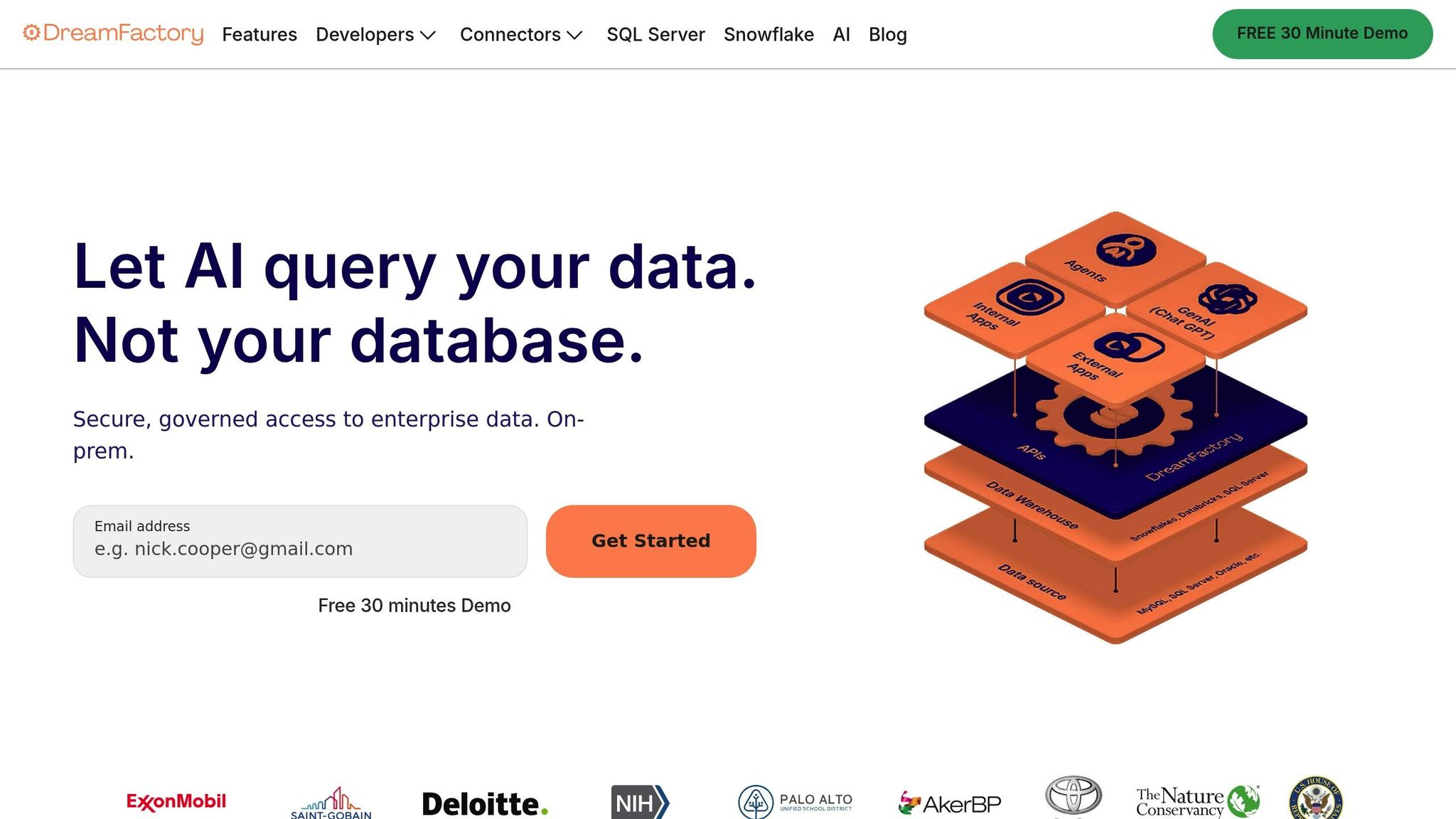
DreamFactory acts as a protective layer between large language models (LLMs) and your databases by creating a REST API abstraction. Instead of directly connecting an AI model to your database via SQL, DreamFactory sets up controlled API endpoints. These endpoints carefully validate inputs, enforce rules, and return sanitized data, significantly reducing risks like prompt injection - an attack where an LLM could be manipulated into running unintended queries.
> "Security starts with architecture. Treat your AI like an untrusted actor - and give it safe, supervised access through a controlled API, not a login prompt."
> – Kevin McGahey, Solutions Engineer
### REST API Abstraction for Database Control
DreamFactory supports over 20 database types, including SQL Server, Oracle, [PostgreSQL](https://www.postgresql.org/), [MySQL](https://www.mysql.com/), and [MongoDB](https://www.mongodb.com/), by automatically generating REST APIs. These APIs rely on the Model Context Protocol (MCP), which provides a standardized interface for AI systems to query live data. With parameterized queries at its core, the platform prevents injection attacks.
It goes a step further by enabling field-level redaction through server-side scripting in JavaScript, PHP, or Python. This feature lets you mask sensitive data, such as Social Security numbers or health records, before it ever reaches the AI model. Additional safeguards, like limiting payload sizes and truncating results, prevent the extraction of excessive data. When paired with Retrieval-Augmented Generation (RAG), this secure setup can improve LLM response accuracy by up to 90%.
DreamFactory also integrates identity and deployment controls, ensuring security across all enterprise levels.
### Integration with Existing Authentication Systems
DreamFactory works seamlessly with enterprise authentication frameworks like [OAuth 2.0](https://en.wikipedia.org/wiki/OAuth), OpenID Connect, [LDAP](https://en.wikipedia.org/wiki/Lightweight_Directory_Access_Protocol), [Active Directory](https://learn.microsoft.com/en-us/windows-server/identity/ad-ds/get-started/virtual-dc/active-directory-domain-services-overview), and SAML-based SSO. This integration allows identity passthrough, meaning LLM requests inherit the authenticated user's credentials rather than relying on static API keys. With this setup, an LLM can only access endpoints permitted under the authenticated user's profile.
The platform also issues time-restricted tokens with defined scopes and maintains an interaction log. These measures reduce the risk of credential misuse and align with compliance standards such as HIPAA and GDPR.
### Self-Hosted Deployment Options
DreamFactory enhances security further by offering flexible deployment options.
You can deploy DreamFactory on [Docker](https://www.docker.com/), [Kubernetes](https://kubernetes.io/), or directly on Linux/Windows servers, allowing for operation in air-gapped networks with no external dependencies. This ensures that sensitive data and database credentials remain securely stored within your infrastructure. Additionally, server-side scripting can anonymize personal information and enforce data minimization policies.
For industries with strict regulations, air-gapped deployments eliminate any external exposure of sensitive data. Kubernetes deployments, supported by Helm charts, enable autoscaling and multi-region data residency controls, while compatibility with standard hardware ensures you retain full control over your infrastructure, whether on-premises, in private VPCs, or hybrid environments.
> "Your database credentials never leave your environment. DreamFactory runs in your infrastructure and exposes only controlled API endpoints."
> – Terence Bennett, CEO, DreamFactory
| Deployment Option | Best Use Case | Key Security Benefit |
| --- | --- | --- |
| **On-Premises (Linux/Windows)** | Legacy systems & high-security zones | Physical control over hardware and data |
| **Private VPC (Cloud)** | Enterprise AI agents | Network isolation with cloud-based LLMs |
| **Kubernetes / Docker** | Scalable AI microservices | Portability and rapid scaling/recovery |
| **Air-Gapped** | Highly regulated industries (Gov/Defense) | Zero external exposure of sensitive data |
## Implementation Framework for Enterprise LLM Database Access
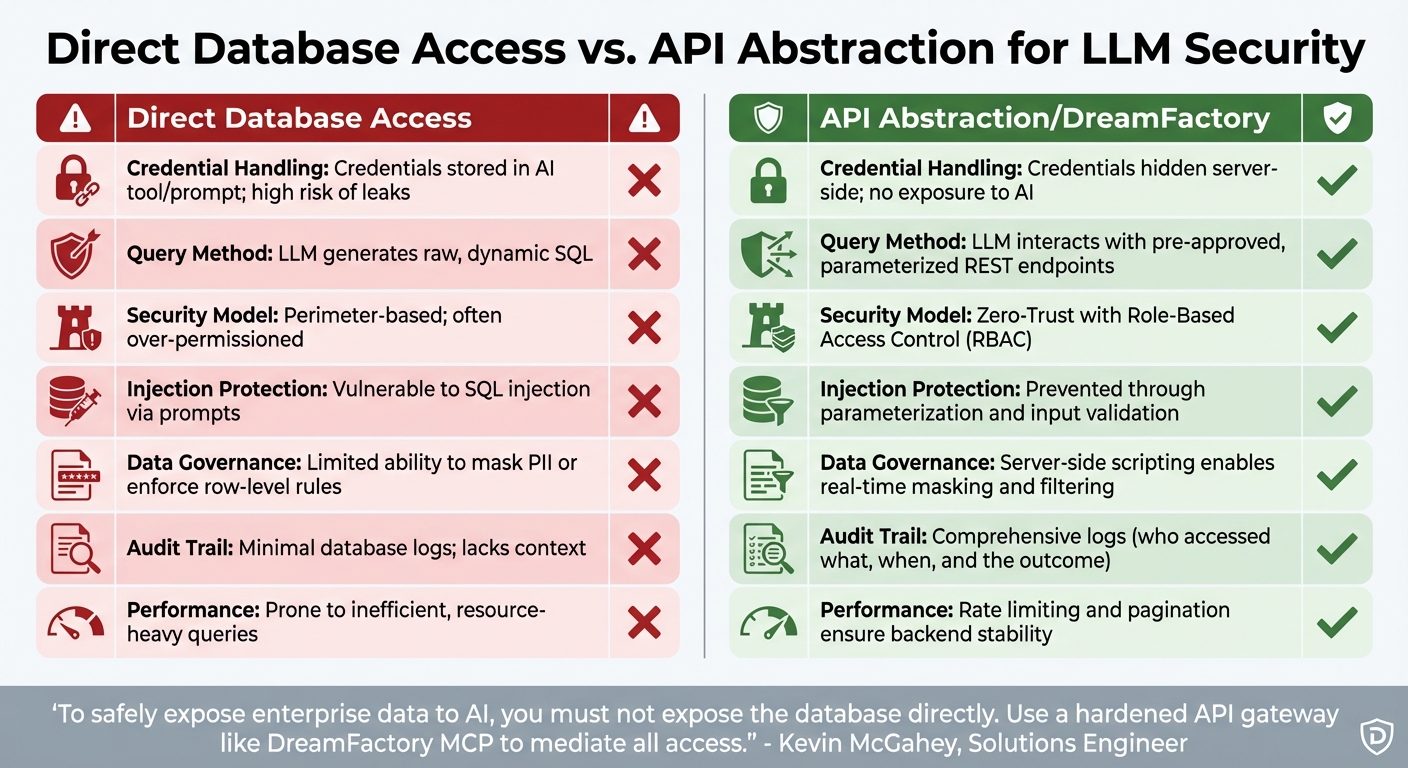
Direct Database Access vs API Abstraction Security Comparison for LLMs
Ensuring secure database access for Large Language Models (LLMs) requires a methodical approach. Start by defining the agent's use case, then create [optimized and secure APIs](https://blog.dreamfactory.com/5-ways-to-optimize-your-api) that adhere to strict data policies like Role-Based Access Control (RBAC) and field-level masking. Once these are in place, deploy them behind a gateway for added protection. Modern generative AI gateways play a dual role: they not only manage **Tokens Per Minute (TPM)** to control usage and costs but also act as **programmable trust layers**. These gateways enforce compliance and provide visibility into AI agent activity, making them essential for secure and efficient operations. With these steps, businesses can integrate precise rules through server-side scripting.
### Server-Side Scripting for Business Rules
DreamFactory uses server-side scripting in languages like **JavaScript, PHP, or Python** to apply business rules before data reaches the LLM. By creating **database views** with built-in filters and masking logic, sensitive raw data is shielded from the AI, ensuring compliance and security.
To simplify monitoring and improve consistency, enforce **strict JSON schemas** for API responses. This approach makes responses predictable and easier to cache. Additionally, tools like **AWS Secrets Manager** or **HashiCorp Vault** can automate secret rotation, reducing the risk of credential exposure.
### Monitoring and Security Testing
Ongoing monitoring is a cornerstone of the DreamFactory framework. Set up real-time tracking to detect **model drift, unusual API activity, or resource spikes**, which could signal potential security threats. Research shows that cloud misconfigurations significantly increase the risk of breaches, so proactive measures are critical.
Incorporate **automated security validation** and digital signing during the model release phase to prevent insecure models from being deployed. Regularly conduct **adversarial testing** - also known as "jailbreak" testing - to ensure the gateway effectively blocks unauthorized actions or data exfiltration attempts. Given that many generative AI systems lack sufficient logging, robust auditing is essential. This should include detailed records of system prompts, model versions, and plugin activities for effective forensic analysis.
### Comparison: Direct Database Access vs. API Abstraction
The table below highlights the differences between direct database access and API abstraction, particularly when using a solution like DreamFactory.
| Feature | Direct Database Access | API Abstraction (DreamFactory) |
| --- | --- | --- |
| **Credential Handling** | Credentials stored in AI tool/prompt; high risk of leaks | Credentials hidden server-side; no exposure to AI |
| **Query Method** | LLM generates raw, dynamic SQL | LLM interacts with pre-approved, parameterized REST endpoints |
| **Security Model** | Perimeter-based; often over-permissioned | Zero-Trust with Role-Based Access Control (RBAC) |
| **Injection Protection** | Vulnerable to SQL injection via prompts | Prevented through parameterization and input validation |
| **Data Governance** | Limited ability to mask PII or enforce row-level rules | Server-side scripting enables real-time masking and filtering |
| **Audit Trail** | Minimal database logs; lacks context | Comprehensive logs (who accessed what, when, and the outcome) |
| **Performance** | Prone to inefficient, resource-heavy queries | Rate limiting and pagination ensure backend stability |
> "To safely expose enterprise data to AI, you must not expose the database directly. Use a hardened API gateway like DreamFactory MCP to mediate all access."
> – Kevin McGahey, Solutions Engineer
## Conclusion
Directly linking large language models (LLMs) to enterprise databases introduces serious risks, including credential leakage, SQL injection vulnerabilities, and potential data exposure. Allowing AI to generate raw SQL or access database credentials creates a significant security challenge for CISOs. For instance, the CVE-2023-29374 vulnerability in certain LLM "chains" earned a critical CVSS score of 9.8, underlining the magnitude of these threats. Addressing these dangers requires a layered, security-first approach.
A reliable solution involves using a [secure API gateway](https://blog.dreamfactory.com/securing-a-postgresql-api), such as DreamFactory. This tool ensures credentials stay server-side, employs injection-resistant queries, and enforces Role-Based Access Control (RBAC) at the table, column, and row levels. These safeguards are essential for mitigating risks tied to LLM interactions.
Because LLMs can generate unpredictable requests, traditional perimeter defenses alone are insufficient. Instead, organizations need runtime protections like strict JSON schemas, real-time field masking, and detailed audit logs that record every AI interaction. Research indicates that Retrieval-Augmented Generation (RAG) can boost LLM answer accuracy by up to 90%, but only when paired with secure, well-governed data access.
DreamFactory’s Model Context Protocol (MCP) strengthens security by auto-generating REST APIs for over 20 data sources, integrating seamlessly with existing authentication systems, and supporting secure self-hosted environments. This ensures data stays within your control, and raw credentials are never exposed to AI. This approach aligns with earlier governance strategies by keeping sensitive information secure while enabling reliable AI performance.
## FAQs
### How can you protect against prompt injection attacks when connecting LLMs to databases?
When working with large language models (LLMs) connected to databases, security should be a top priority. One of the key steps is creating prompts that reduce risks. This means **avoiding direct user input** in commands that deal with sensitive data and sticking to **pre-defined templates** with strict formatting rules.
Beyond that, techniques like **input sanitization**, **access controls**, and **response validation** play a big role in keeping things secure. These measures help catch and block potential exploits before they cause harm.
For added protection, advanced methods such as **reinforcement learning with constraints** or **layered defenses** (like guardrails and prompt filtering) can make interactions even safer. Regular system monitoring for unusual activity and keeping an eye on new threats are also essential for ensuring your LLM integrations stay secure and comply with enterprise data standards.
### What compliance risks should CISOs consider when connecting LLMs to enterprise databases?
Integrating large language models (LLMs) with enterprise databases can bring a host of compliance challenges. These include the potential exposure of sensitive or regulated data, the risk of unauthorized access, and the difficulty of maintaining compliance with privacy laws such as GDPR, CCPA, or HIPAA. If these risks are not managed carefully, the consequences could include legal penalties, data breaches, or damage to your organization's reputation.
To address these risks, it's essential to implement **strict access controls** and **monitor data usage** diligently. Ensuring robust encryption protocols are in place is another critical step. Additionally, conducting regular audits and using secure, API-driven access frameworks can help maintain compliance while still taking full advantage of LLM capabilities.
### How does API abstraction enhance the security of LLM database access?
API abstraction acts as a protective barrier for database access, offering a controlled interface that limits direct interaction with sensitive data. Through this approach, organizations can implement **authentication**, **authorization**, and **monitoring** directly at the API level, reducing the chances of unauthorized access and potential security weaknesses.
By consolidating security policies at a central point, API abstraction ensures that only verified and compliant requests from LLMs are allowed. It also enables advanced security frameworks like **zero-trust architectures**, **OAuth2**, and **contextual request filtering**. These measures help defend against risks such as lateral access escalation and malicious prompt injections. This strategy not only protects sensitive information but also ensures compliance and preserves data integrity, even when handling unpredictable AI-generated queries.
## Related Blog Posts
- [Zero‑Trust for LLMs: Applying Security Principles Through DreamFactory’s Gateway](https://blog.dreamfactory.com/blog/zero-trust-for-llms-applying-security-principles-through-dreamfactorys-gateway/)
- [Bridging SQL and Vector DBs: Unified Data AI Gateways for Hybrid AI Stacks](https://blog.dreamfactory.com/blog/bridging-sql-and-vector-dbs-unified-data-ai-gateways-for-hybrid-ai-stacks/)
- [Blueprint for Enterprise GenAI: Governance, Gateways, and Guardrails](https://blog.dreamfactory.com/blog/blueprint-for-enterprise-genai-governance-gateways-and-guardrails/)
- [Zero-Trust for LLMs: Applying Security Principles to AI Systems](https://blog.dreamfactory.com/blog/zero-trust-for-llms-applying-security-principles-to-ai-systems/)

Kevin Hood
Kevin Hood is an accomplished solutions engineer specializing in data analytics and AI, enterprise data governance, data integration, and API-led initiatives.
Stay Connected with
The Connector Newsletter!
Subscribe to stay up-to-date with DreamFactory's latest product updates, API best practices, and tech humor in your inbox.
[](https://www.dreamfactory.com/)
[Call Sales +1 (415) 993-5877](tel:+14159935877)
Open – Mon–Fri 9–5 PT
[FREE 30 Minute Demo](https://www.dreamfactory.com/demo)
#### Follow us
- [GitHub](https://github.com/dreamfactorysoftware/dreamfactory)
- [Facebook](https://www.facebook.com/dfsoftwareinc/)
- [X (Twitter)](https://twitter.com/dfsoftwareinc)
- [LinkedIn](https://www.linkedin.com/company/dreamfactory-software)
- [YouTube](https://www.youtube.com/c/dreamfactorysoftware)
### Features
[Features](https://www.dreamfactory.com/features) [Self hosted](https://www.dreamfactory.com/features#self) [API Generation](https://www.dreamfactory.com/features#api) [Security](https://www.dreamfactory.com/features#secure) [Customization](https://www.dreamfactory.com/features#custom) [Pricing](https://www.dreamfactory.com/pricing)
### Installers
[Linux](https://www.dreamfactory.com/features#installer) [Docker](https://www.dreamfactory.com/features#installer) [Kubernetes](https://www.dreamfactory.com/features#installer)
### API Resources
[Documentation](https://docs.dreamfactory.com/) [Case Studies](https://www.dreamfactory.com/stories) [White Papers](https://www.dreamfactory.com/resources/whitepapers) [Academy](https://www.dreamfactory.com/academy) [API Calculator](https://calculator.dreamfactory.com) [Open Source](https://github.com/dreamfactorysoftware)
### Company
[Blog](https://blog.dreamfactory.com/) [Hub](https://www.dreamfactory.com/hub) [About us](https://www.dreamfactory.com/about) [Partners](https://www.dreamfactory.com/partners) [Support](https://www.dreamfactory.com/support) [Connectors](https://www.dreamfactory.com/connectors) [Contact Us](https://www.dreamfactory.com/demo)
© 2025 DreamFactory. All rights reserved.
[Terms of Use](https://www.dreamfactory.com/terms-of-use) [Privacy Policy](https://www.dreamfactory.com/privacy-policy) [LLMs](https://www.dreamfactory.com/llms.txt)
```json
{
"@context" : "https://schema.org",
"@type" : "BlogPosting",
"author" : {
"@type" : "Person",
"name" : "Kevin Hood",
"url" : "https://blog.dreamfactory.com/author/kevin-hoo"
},
"dateModified" : "2026-02-09T18:00:00.111Z",
"datePublished" : "2026-02-04T03:41:16.000Z",
"headline" : "What Your CISO Needs to Know About LLM Database Access",
"image" : [ "https://assets.seobotai.com/cdn-cgi/image/quality=75,w=1536,h=1024/dreamfactory.com/698296390bb6b48a410de09f-1770176582005.jpg" ],
"mainEntityOfPage" : {
"@id" : "https://blog.dreamfactory.com/ciso-needs-to-know-llm-database-access",
"@type" : "WebPage"
},
"publisher" : {
"@type" : "Organization",
"logo" : {
"@type" : "ImageObject",
"url" : "https://blog.dreamfactory.com/hubfs/DreamFactory%20-%20Orange%20-%20Transparent-1.png"
}
}
}
```
```json
{
"@context" : "https://schema.org",
"@type" : "BlogPosting",
"about" : [ {
"@type" : "Thing",
"name" : "Role-Based Access Control (RBAC)"
}, {
"@type" : "Thing",
"name" : "Row-Level Access Control (RLAC)"
}, {
"@type" : "Thing",
"name" : "Identity Passthrough"
}, {
"@type" : "Thing",
"name" : "API Gateway / Abstraction"
}, {
"@type" : "Thing",
"name" : "Prompt-to-SQL Injection"
}, {
"@type" : "Thing",
"name" : "Audit Logging & Compliance"
} ],
"alternativeHeadline" : "Treat LLMs as Untrusted Clients: Governance, RBAC, and API Abstraction for Secure Data Access",
"articleSection" : [ "Executive Summary", "Risks of Direct LLM Database Access", "Prompt Injection & Data Exfiltration", "Excessive Permissions & Exposure", "Regulatory Compliance Risks", "Governance Controls: RBAC, RLAC, Identity Passthrough", "Data Minimization & Encryption", "API Abstraction with DreamFactory", "Deployment Options (On-Prem, VPC, Air-Gapped, K8s)", "Implementation & Monitoring Framework", "Direct DB vs API Gateway Comparison", "Conclusion & CISO Action Items" ],
"audience" : {
"@type" : "Audience",
"audienceType" : "CISOs, security architects, data platform teams, compliance leaders"
},
"description" : "A CISO-focused guide to securing large language model (LLM) access to enterprise databases. Covers top risks like prompt-to-SQL injection, excessive permissions, and indirect attacks; compliance pitfalls (GDPR, HIPAA); best-practice controls including governed REST APIs, RBAC/row-level policies, identity passthrough, data minimization, rate limiting, and audit logging; and how DreamFactory provides a secure, self-hosted API abstraction for AI access.",
"headline" : "What CISOs Need to Know About LLM Database Access",
"inLanguage" : "en",
"isPartOf" : {
"@type" : "Blog",
"name" : "DreamFactory Blog",
"url" : "https://blog.dreamfactory.com/"
},
"keywords" : "CISO, LLM security, database security, prompt injection, P2SQL, OWASP Top 10 for LLM, RBAC, row-level security, identity passthrough, API gateway, data minimization, audit logging, DreamFactory, MCP",
"mainEntityOfPage" : {
"@id" : "https://blog.dreamfactory.com/ciso-needs-to-know-llm-database-access"
},
"publisher" : {
"@type" : "Organization",
"name" : "DreamFactory",
"url" : "https://www.dreamfactory.com"
},
"url" : "https://blog.dreamfactory.com/ciso-needs-to-know-llm-database-access"
}
```
```json
{
"@context" : "https://schema.org",
"@type" : "FAQPage",
"mainEntity" : [ {
"@type" : "Question",
"acceptedAnswer" : {
"@type" : "Answer",
"text" : "Primary risks include prompt-to-SQL injection (including indirect injections via poisoned data), excessive permissions that enable mass exfiltration or modification, and compliance exposure (e.g., GDPR/HIPAA) from uncontrolled access paths. LLMs lack native authorization, so least-privilege enforcement, input validation, and governed access are required."
},
"name" : "What are the top risks when connecting LLMs directly to enterprise databases?"
}, {
"@type" : "Question",
"acceptedAnswer" : {
"@type" : "Answer",
"text" : "Enforce least privilege with RBAC and row-level controls; use identity passthrough and short-lived OAuth2/JWT tokens; centralize policy at a secure API gateway with parameterized endpoints, schema validation, rate limiting, and full audit trails; apply data minimization, masking/redaction, and encryption in transit/at rest; and continuously monitor and test with adversarial ‘jailbreak’ scenarios."
},
"name" : "How should CISOs govern LLM access to data?"
}, {
"@type" : "Question",
"acceptedAnswer" : {
"@type" : "Answer",
"text" : "API abstraction prevents credential exposure and raw query execution. Pre-approved, parameterized REST endpoints sanitize inputs, apply RBAC/RLAC and field masking, enforce rate limits/pagination, and produce audit-ready logs—significantly reducing injection and over-permission risks while standardizing responses for downstream AI."
},
"name" : "Why use API abstraction instead of direct SQL from an LLM?"
}, {
"@type" : "Question",
"acceptedAnswer" : {
"@type" : "Answer",
"text" : "DreamFactory auto-generates governed REST APIs for 20+ databases, supports identity passthrough with OAuth/OIDC/SAML/LDAP, enforces RBAC and row-level filters, provides server-side redaction/masking via scripts, and logs every call for compliance. Its built-in MCP server safely exposes tools/data to LLMs without revealing credentials."
},
"name" : "How does DreamFactory help secure LLM database access?"
}, {
"@type" : "Question",
"acceptedAnswer" : {
"@type" : "Answer",
"text" : "Self-hosted options include on-prem servers, private VPCs, Kubernetes/Docker for scaling, and fully air-gapped environments. These keep credentials and data plane traffic inside your control while integrating with enterprise IAM and SIEM for audit and monitoring."
},
"name" : "What deployment models support strict compliance requirements?"
}, {
"@type" : "Question",
"acceptedAnswer" : {
"@type" : "Answer",
"text" : "Use parameterized endpoints (no raw SQL), strict JSON schemas, input/output filtering, per-role rate limits and result caps, read-only replicas for AI, short-lived scoped tokens, server-side masking/redaction, mTLS where required, and end-to-end auditing to detect and contain abuse."
},
"name" : "What controls mitigate prompt-injection and data exfiltration?"
} ]
}
```
```json
{
"@context" : "https://schema.org",
"@type" : "FAQPage",
"mainEntity" : [ {
"@type" : "Question",
"acceptedAnswer" : {
"@type" : "Answer",
"text" : "When working with large language models (LLMs) connected to databases, security should be a top priority. One of the key steps is creating prompts that reduce risks. This means avoiding direct user input in commands that deal with sensitive data and sticking to pre-defined templates with strict formatting rules.
Beyond that, techniques like input sanitization, access controls, and response validation play a big role in keeping things secure. These measures help catch and block potential exploits before they cause harm.
For added protection, advanced methods such as reinforcement learning with constraints or layered defenses (like guardrails and prompt filtering) can make interactions even safer. Regular system monitoring for unusual activity and keeping an eye on new threats are also essential for ensuring your LLM integrations stay secure and comply with enterprise data standards.
"
},
"name" : "How can you protect against prompt injection attacks when connecting LLMs to databases?"
}, {
"@type" : "Question",
"acceptedAnswer" : {
"@type" : "Answer",
"text" : "Integrating large language models (LLMs) with enterprise databases can bring a host of compliance challenges. These include the potential exposure of sensitive or regulated data, the risk of unauthorized access, and the difficulty of maintaining compliance with privacy laws such as GDPR, CCPA, or HIPAA. If these risks are not managed carefully, the consequences could include legal penalties, data breaches, or damage to your organization's reputation.
To address these risks, it's essential to implement strict access controls and monitor data usage diligently. Ensuring robust encryption protocols are in place is another critical step. Additionally, conducting regular audits and using secure, API-driven access frameworks can help maintain compliance while still taking full advantage of LLM capabilities.
"
},
"name" : "What compliance risks should CISOs consider when connecting LLMs to enterprise databases?"
}, {
"@type" : "Question",
"acceptedAnswer" : {
"@type" : "Answer",
"text" : "API abstraction acts as a protective barrier for database access, offering a controlled interface that limits direct interaction with sensitive data. Through this approach, organizations can implement authentication, authorization, and monitoring directly at the API level, reducing the chances of unauthorized access and potential security weaknesses.
By consolidating security policies at a central point, API abstraction ensures that only verified and compliant requests from LLMs are allowed. It also enables advanced security frameworks like zero-trust architectures, OAuth2, and contextual request filtering. These measures help defend against risks such as lateral access escalation and malicious prompt injections. This strategy not only protects sensitive information but also ensures compliance and preserves data integrity, even when handling unpredictable AI-generated queries.
"
},
"name" : "How does API abstraction enhance the security of LLM database access?"
} ]
}
```